Spoiled for choice – writer’s support network

My writing has been stalled because I had finished one project and was in desperate need of feedback on the other two.

The project, an article on my airman uncle (A Very Unlikely Hero) had been sent to a specialist blogger. My non-fiction (Writing to a Ghost: Letter to the River Kwai) was being read, as a favour, by a wonderfully meticulous friend and my re-re-re revised fiction book (Border Line) was in a queue to a busy writing friend.Two days ago my writing frustration peaked and I also felt a need of independent professional advice for some tricky chapters. So I sent them off to Sally Jenkins, who had done such a swift and helpful job on the synopsis, agent letter and first chapter of Border Line.

Later that same day the blogger, Pierre Lagacé, of Lest we Forget, http://athabaskang07.wordpress.com came up trumps and starting posting a new blog using parts of my article on my Mosquito Navigator uncle at http://johncustancebaker.wordpress.com/2013/09/10/and-if-by-chance/ I am thrilled with this.

Yesterday my friend, Lesley, came round with a wonderfully annotated manuscript of my non-fiction book and some very good advice.

Today, to my amazement, Sally Jenkins came through with the critique of my tricky chapters in Border Line. Her speed of turnaround only equalled by the seriously helpful advice on my chapters. http://www.sallyjenkins.wordpress.com/

Writing is something of a game of snakes and ladders. Today I am on a ladder. Back at my desk, I feel like a bee in clover – totally happy and busy though spoiled for choice about which manuscript to tackle first. It is this wonderful network of support from people we know and, in this new age, those we have never met that make writing possible.

This state of affairs has been very good for the house. DIY flourished, I have insulated a tricky section of bay wall with thermal lining, put up a pane of secondary glazing and ordered more lining, glazing panels etc.

(And my L reg. Nissan passed its MOT!)
The darlings he killed

A fascinating and salutary article about how life can sometime rob a writer. Mark Lawson, journalist, broadcaster, writer has had both fiction and non-fiction books snatched from him, half-written, by a variety of circumstances. In a his article he talks about each of these lost enterprises with modesty, humour and insight.

http://www.theguardian.com/books/2013/sep/06/mark-lawson-books-never-were

Hungrier, thinner, speedo and then cholera – POWs 14

Barry and the remaining men of 27 Line Section reached a big well-run camp, Tha Khanun, more than 200 km up the river Kwai Noi. To their disappointment they had to march on up-river and then inland:

When we reached the site of (the misnamed) 211kilo camp it was as usual raining and there were no preparations at all, in particular there were no huts or latrines or cookhouses. Our Jap O.C. pointed out a heap of green tents… There were not nearly enough to accommodate the whole group but fortunately these tents were supplied with separate fly sheets, and these extra sheets could be pitched on improvised bamboo poles to provide extra cover although without ends.

On our first morning at 211 we were roused out very early, in the rain and in darkness for a full scale Tenko [parade headcount]. Through the medium of a Japanese interpreter who spoke very little English, our Jap commander told us that the progress of the railway building had fallen far behind schedule and that this was caused by the idleness and incompetence of the British workers and their officers… This speech was recognized as a “speedo”, which meant longer working hours and more harrying, shouting and beating by the guards.

There was no barge traffic up to 211 camp and our rice ration came up through the jungle paths on a hand cart or carried on our backs by ourselves. A 50kg bag (one hundredweight) is not an impossible burden for a fit man, but by now most of us were far from fit and were anyhow already fully occupied building the new section of railway, so that the rice ration was small and became steadily smaller.

…the rice ration, now down to a very few ounces, would be calculated strictly according to the number of men who went out to work. This put us in the unhappy position of being forced to detail for work men who were too weak to stand. It was quite usual to see a man actually suffering from a malaria rigor being supported between two others on the march out to the railway site. Such men were, of course, no use for actual work.

One day a few dysentery cases started violent vomiting as well as producing sudden dehydration and death within a day or two. Men who had served in India recognised the symptoms of cholera… The cholera spread rapidly and it soon became impossible to bury the dead so, on the advice of those who had experience of such epidemics in India, we started to burn the bodies… The fire was kept burning continuously by a small duty party. We never ran short of fuel.

Novel People – Faulks on Fiction

Faulks on Fiction (Sebastian Faulks) is the kind of book you are so unwilling to stop reading that you read every last word – and discover that he would have preferred the title Novel People. 

This is a book about the people who inhabit fiction and it has walked straight into my personal favourites’ list for two main and several minor reasons. First, he uses, with delicious freedom, exactly the right word for what he wants to say. This is non-fiction, so Faulks is not constrained by his potential reading public or his characters’ vocabularies (or even an ageing brain) in his choice of words. He does not use obscure words, simply the right ones. The writing is also entertaining and fully accessible to the layman.

Secondly, as a reader and writer, to have all these characters from classic fiction (some of which I have read and others not) opened up for me to investigate both as people and as examples of their roles (e.g. hero, villain) in the stories they inhabit, is pure joy. This provides an extra dimension for a re-reading or a first reading of such books and an invaluable lesson in anatomy for a struggling writer.

The sections and chapters can be read separately and if you loathe Amis or love Austen (or vice versa) you can dip in and out. I find it very satisfying that he distances himself so convincingly from the ‘fiction is autobiography’ school. He has chosen a good eclectic mix of characters over the whole life of the English novel and he scans wider horizons each time he selects one.

Do I have any quibbles? My feminist side might have asked for a few more female writers. This book is a trawl through significant writers of the last two centuries. It will I hope become a school text. Many female writers are mentioned, but far fewer women than men make the cut and that saddens me. So Woolf, Zadie Smith, George Eliot and Mary Renault are mentioned, but Byatt, Murdoch and Drabble, for instance, don’t get a look in. These are not writers for whom I carry a flag and Faulks is very clear about the reasons for his selections. Also many great male writers are missing too. Still I am sad.

I will re-read this book over and over again. I will keep it among my dictionaries and style-guides for reference as a writer. I think it speaks usefully to writers of every level. As a reader, I will pick my way through the books it unwraps and that I have not yet read. As you can see I am struggling to put down.

Walking, Walking, Long Time Walking – POWs 13

After constructing the Wampo Viaduct, Barry and the remaining men of 27 Line Section started a very long march up the river Kwai during the rainy season (early summer) of 1943. Barry had been born in Malaya and before he became a prisoner had been studying the language. This led, as he remembers, to a random encounter:

During the march after Wang Po, on the way up river towards 211 kilo, the weather became gradually worse and we were slogging through rain and mud with no comfort at the end of the day’s journey. I often passed the time by talking to myself in Malay and repeating some of the pantuns that I could remember. On this particular occasion I was marching beside a stranger whom I recognised as probably a Dutchman as his dress was different from ours, but he had no rank badges or any other recognition signs. I started to say aloud a particularly apposite pantun, which goes:

“Jalan, Jalan, sa-panjang jalan,
Singa menyunga di pagar orang,
(Walking, walking, long time walking
Looking over neighbours’ fences)

At this moment, half way through the pantun, the man beside me joined in and recited the last two lines,

“Pura pura men-chari ayam,
Ekor mata di-anak orang.”
(Is he perhaps searching for a lost chicken?
But the corner of his eye is looking at his neighbour’s daughters)

At the same time he put a finger to the outer corner of his eye, which was exactly what my munshi had told me that a Malay would do.

Most real Malays know hundreds of these pantuns and by saying a key word from them can indicate a meaning to another Malay, which might not be apparent to someone else. That “ekor mata”, the corner of the eye, is a hint that some one is on the prowl and that girls, and wives too, should be on the look out. This episode cheered me up very much during a wet and miserable period of our long march northwards, and we spent the rest of the day talking Malay to one another; mine very stumbling and uncertain, his accurate and fluent. I lost touch with him and found no other Malay speakers in our group.

writing critique – real help

A couple of weeks ago I gave my non-fiction project (on Far East POWs) to a neighbour to read and got out my neglected novel Border Line. I’d had a four-month break from it and, as sometimes happens, this gave me the courage to make some radical alterations.

Now I needed someone with fresh, and ideally professional, eyes to read the changes. My options were limited. My writing friends, my other friends and even some relatives had read earlier drafts. I had already shelled out for Literary consultants (extremely useful but equally expensive). However, through blogging I had come across writer Sally Jenkins, who runs a critiquing service.

http://sallyjenkins.wordpress.com/first-impressions-critique-service/

So I sent her my agent letter and altered synopsis. Following this I sent my first chapter (i.e. all the material I would be submitting to agents). In a remarkably short time, for a very reasonable fee (and I like that I could pay through BACS if I wanted), I received clear, concise, pertinent feedback. Sally also spotted a very important gap in my letter – I’d not mentioned a potential market or similar publication.

This has led me to do some hefty thinking as this is a question I have tried, and failed, to answer before. I know well that my writing crosses boundaries. In Border Line I have written a love story with topical issues (suicide and assisted dying). It is between literary and commercial in style, and readers for my previous two books have been both sexes and mixed ages. Mulling this over and looking at another writers’ website that Sally mentioned, I trawled through descriptions by agents of the types of books they liked. This helped me to focus, as did the fact that I will be talking to a reading group in the autumn about my earlier book Unseen Unsung.

So, I think that the mixture of love, adventure and topical issues would make Border Line ideal for reading groups. Thank you Sally, I shall go into battle again perhaps a little better armed than before.

You might think that after 25 rejections from agents I should be throwing in the towel. However these rejections included 4 requests for the full manuscript, one resulting in some very positive work with an agent. This, in psychological terms, is called random reinforcement, and encourages persistence, and anyway I am too bloody-minded to give up.

Fiction is making stuff up

I have now finished Hornby’s Juliet Naked – I continued to chuckle to the end. I love the way he persuades his characters to reveal their worst, yet the writing is so tenderly ironic that you go on loving humanity all the same.

This morning straight into Faulks on Fiction. I am only a few pages into the Introduction, yet I am already making triumphant squeaks of agreement and admiration. Faulks suffered from people persistently unwilling to believe that he had ‘made it up’ when he wrote Birdsong. Though in a somewhat different league, I was shaken to hear that a reading group I had been to talk to, from an area about 20 miles from my home, had disapproved of my first novel at a later meeting. They ‘knew’ that I had based the story on two local disabled people – a couple I had never heard of or met.

The other very recognisable experience for an author is of having their writing judged entirely on how closely it fits with the reader’s personal experience. I am flattered when readers recognise themselves in my writing. I am also astonished at what they find in my text. So strong is the tendency to translate through a personal viewfinder, that you can hear your own story relayed back to you in an unrecognisable form: the main role given to one of your minor characters; jealousy supplied as a motive, where only boredom had been  evident; scenes relocated; names changed. (All this and I have only published two novels on a very small scale).

The is another reaction from readers that bothered me at first. If you mention an aspect of of a character, anything from a skill (eg playing a violin) to a handicap (eg being deaf), people are miffed if you stray from the stereotype or their personal experience. So if John, your violinist, is pernickety about dress, the reader will point out that they know three violinists who are totally carefree about clothing. If your deaf character, Sophie, is an extrovert who likes to party, you will have conversations that run: ‘I actually have a deaf friend, and she much prefers one-to-one encounters because then she can lipread.’ ‘Sure, but my Sophie character cares more about the warmth of social contact than words.’ ‘But surely that’s not true for most deaf people.’ ‘Maybe not, but I’m not writing about most deaf people, I’m writing about Sophie.’ Half the fun of writing is to fight your way out of these corners.

I am really looking forward to the meat of the Faulks book on fiction, and I am hoping that some of Hornby’s lightness and sureness of touch will rub off onto my own writing.

Mother of the regiment – POWs 12

String of letters from Phyllis

String of letters from Phyllis

In 1943 while Barry and the men of 27 Line Section are sweating and starving on the Thailand Burma railway, Barry’s wife Phyllis is juggling her responsibilities. She is living at home with her parents, she has two-year old Robin and her mother (demanding and increasingly an invalid) to look after. She wants to move out of her parents home, but can’t unless she finds a job, and she needs one in which she can continue to look after Robin. She has heard nothing from Barry for over a year:

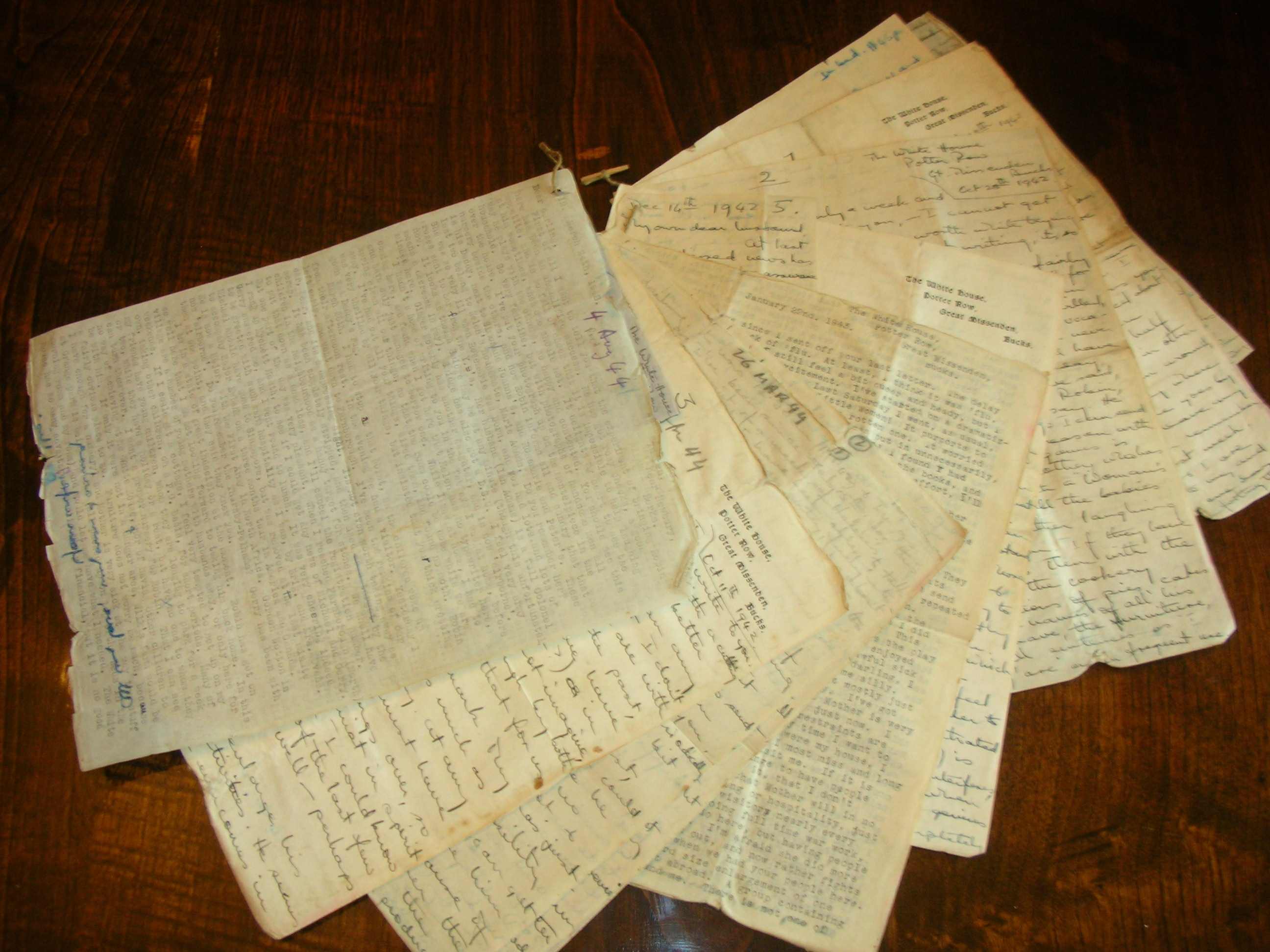
Dear darling, if I didn’t have to type this, which makes one stop to think what one is saying, and was not therefore very conscious of the censor, I could write you a real letter tonight. It is 11p.m. and I have been re-reading all the letters you have sent me since you left England. It has somehow brought you much nearer to me for a while…

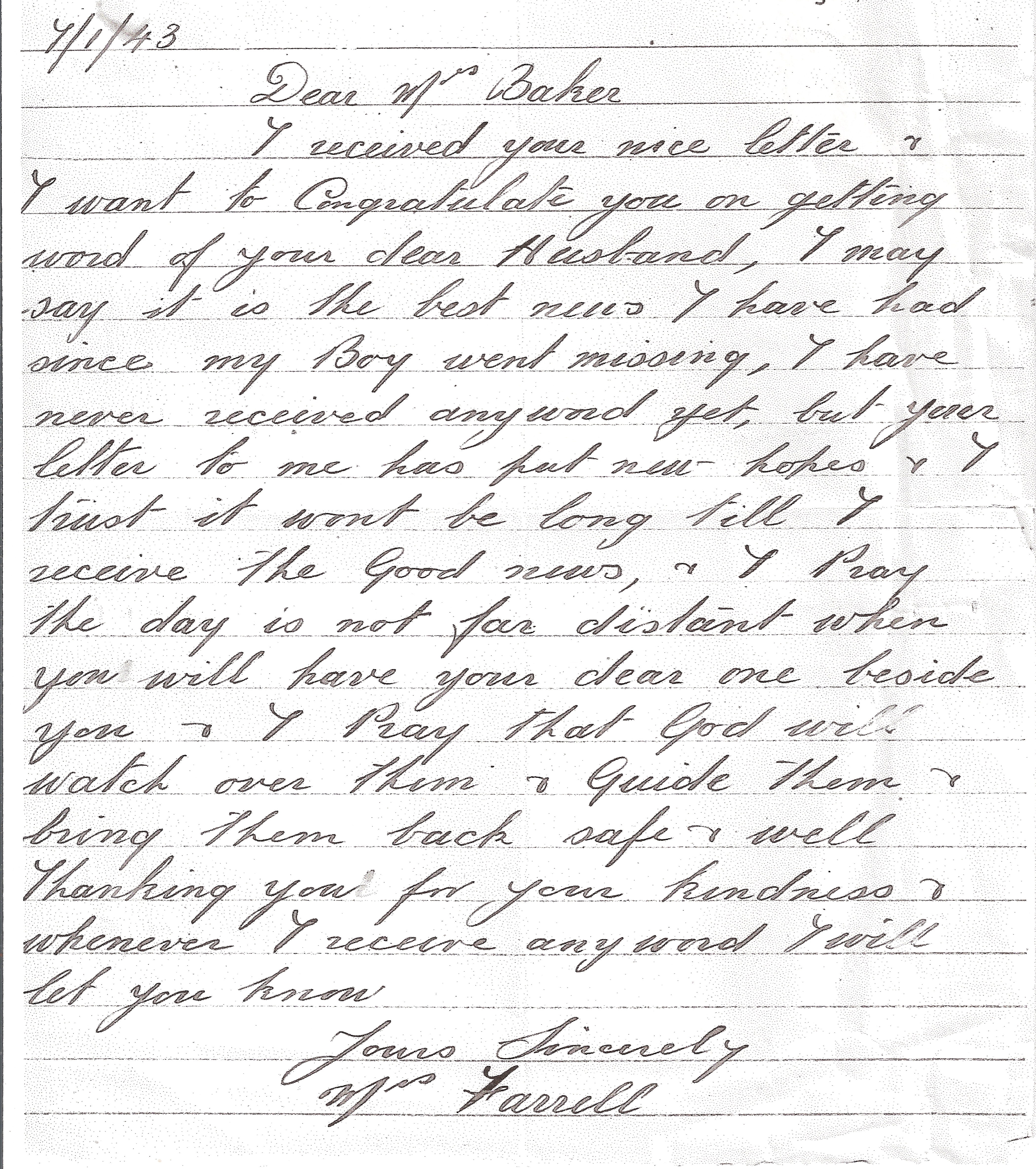
Then there is her correspondence with the wives, mothers, fiancées and grandparents of Barry’s men. Phyllis heard that Barry was a prisoner in October 1942, 8 months after he disappeared. She wrote to the relatives over Christmas, replies like this came back:

A mother writes to Phyllis

A mother writes to Phyllis

By June 1943 some more relatives hear, more than a year after silence fell, that their men are prisoners.

Dear Mrs Baker, I am now able to tell you that my husband Dvr. E. Parker 2587178 has been reported a Prisoner of War in “Tai Camps”. I received notification of this from Army Records Office on 6.5.43.

 I am very thrilled, but sorry to say that none of the other Glossop Girls have heard any news as yet, but there are great hopes.

I will take this opportunity of thanking you with all my heart Mrs Baker for your unceasing comfort through those long weary hours of suspense.

My very kindest regards & wishes for your husband’s speedy return. Yours Sincerely. Marjorie Parker.

Phyllis writes to them and then to Barry:

Darling, I’m probably going to get a wigging from Mother, but I just must sit down and finish this letter to you. I have had letters from four more next-of-kin of the men in your section to say their men are POWs… I can’t type up in my room, as they can hear me, and it’s not worth having a row with Mother… (They get so worried at the time I get into bed as it is. With lots of sympathy for me, they can’t fully appreciate how much I dislike going to bed). But all day and every day I am thinking of you, either all the many many happy memories we have, or hopes for the future…

The news of bad treatment of Far Eastern POWs is beginning to trickle through. All the relatives are worrying, Phyllis writes:

Always now I think of the past, and only realise with my mind, not with my emotions, that you must inevitably have changed a lot. Only my darling please don’t let anything you have or are suffering take away that light touch that was so essentially part of you. It was that which comes back to me almost more than anything else when thinking of that mad summer, and our two years engagement… This letter is going all wrong. Partly I know that Mother and Daddy are waiting for me to come upstairs, and though my heart and mind are just full of you…

There is no way for relatives to know, but some of their letters do eventually arrive, a year or so after they are written. Barry keeps them on a piece of string held with a bamboo toggle. All except one are still readable today. The one below is from Barry’s mother, Barbara.

String of letters from Barbara & Alan

String of letters from Barbara & Alan

Leo Tolstoy & Nick Hornby

I was going to title this Tolstoy versus Hornby, but that’s not what I mean.

Having recently finished Anna Karenina I picked out of my bedside stack a Christmas present (at least two years old) of Nick Hornby’s Juliet Naked. I had started it once before, but as the subject matter appeared to be the insane fan worship of a has-been rock star – not exactly central to my interests – it got queue-jumped.

I hesitate to admit it, but my enjoyment of my in-bed morning reading has now risen sharply. Hornby’s language is a chuckling delight. For instance, the fan and the colleague he has inadvertently started sleeping/living with arrive at work together: “Gina kissed him goodbye, on the lips, and squeezed his bottom playfully while colleagues watched, stupefied with excitement.”

Of course, Hornby is a lighter read than a Russian classic. Tolstoy’s people and the period are distant, and his use of language may well have lost some of its verve in translation. Also, while I was reading Anna Karenina, I did enjoy it, but there is relief in finding a character springing off the page in a sentence or two, and of internal monologues that make me smile in recognition (and don’t last for five pages).

With Anna Karenina there is a vast and satisfying depth to the characters, but so little humour and how much I miss it (and how difficult I find that in my own writing). It is difficult to love a character if you don’t get to smile while reading about them.

Desert island lily

These unassuming oriental lilies are scenting the air for about ten feet in all directions. They create an atmosphere you could willingly drown in. I found tasks in that corner of the garden all afternoon, it acts on me like catmint on cats. It’s my choice for a desert island lily.

DSCN4202