The Mind’s Eye – Oliver Sacks

I have just finished this book and it addresses so many of the areas that interest me that I struggle to know where to begin. It also highlights the foolishness of my attempt to give my blog six categories. Two major elements in my life and work (as a sculptor and research psychologist) have no assigned category.

Before I become boringly introspective, I should say that The Mind’s Eye is a fascinating book for both layman and those interested in brain function. There are case studies of real people, full of human detail, telling what happens when parts of the brain cease to work as they should. It also contains a thrilling chapter about the discovery of a brain capacity – stereoscopic vision – in a person who had never had it before. The wonder and delight this brings makes you appreciate the world we live in even more. In addition, Dr Sacks uses his personal diaries to talk us through the complex and alarming experience of his own loss of vision in one eye. One of the revelations to me, is the variation in how much people have, or are able to use, visual imagination. Some people have none to speak of, others have continuous, 3D Technicolor images (as I do), simply by reading a description.

The final chapter, titled The Mind’s Eye, looks at the current state of research into vision and imagery. There are multiple examples from individuals who were born or became blind, as well as input from experts on the brain function behind visual imagery. The whole field of imagination, and its visual substrates, is discussed in an accessible way. A great read.

Now for the introspection:

For many years I was a sculptor and for many years a research psychologist and now I write. Yet the roles are not as separate as they appear in my life. From childhood I have performed thought experiments in the hope of deciphering the actions inside my head, and even now, twenty years since I last made a three-dimensional object, my inner imagination is undoubtedly 3D – very handy for writing. And of course I have a penchant for building brick paths and suchlike.

While I have no synesthesia (cross firing of the senses, e.g. Monday is seen as blue, or the number three smells of vanilla), I have long been convinced that beneath the conscious separation of the senses the brain is more promiscuous. I have been aware (just) of the brain touting problems around at another level. So an engineering problem, which starts life as, perhaps, a set of calculations, with some visual aspects (trying to get, say, a pole to stay upright without a hole or visible means of support) is taken on a tour of unlikely brains areas – hearing, sensory, motor, olfactory, emotional etc – in case these can contribute to the solution – which they sometimes do.

Certainly I belong among the people for whom vivid visual imagery is normal, so from childhood, I can sometimes be confused about whether an image in my head is from a book or a film. I am also baffled and irritated by people who assume that to write about something, you must have lived it. In my experience there are no limits to what you can create inside your own head.

How ‘visual’ is inner imagery? Any activity in the brain is made up of cells firing together. In this sense all imagery is the outcome of sets of switches being on or off – cells a,d,f are on, cells g to z are off etc. Yet if you imagine a complex 3D item in your mind’s eye and turn it round, timing and fMRI scans, show that this actions takes place over natural time as would in the physical world. This suggests there is a spatial element in the brain’s instantiation of inner images…

I’d better stop there.
A writer’s responsibilities?

This is a post that has been sitting in the draft folder for a (long) while. Ever since a rejection for Border Line in April. I guess I should face it now. How much responsibility does the writer have towards the reader when dealing with tricky subject matter?

Border Line is essentially and upbeat novel, yet it has suicide at its core and touches on assisted dying. It is fiction, it is written as a ‘good read’, is upbeat and life affirming and is essentially a love story – but the eleven characters’ main intention is to quit life.

I’m not daft. Suicide is only ever the least worst option for the person who chooses to go. For the people who are left behind it is misery in varying degrees. That does not mean it is never the right choice. The crucial word in this is choice. If I publish this novel, perhaps more particularly, if I self-publish, and if it is read by anyone vulnerable, could I be said to be encouraging them to take that route out?

Some friends, pointing out the range and gruesome subject matter available in print, think my scruples are absurd. I could certainly thin the story out to a ‘will-they-won’t-they’ thriller by taking out all the personality and debate, and it would become a harmless guessing game – I think this is what one agent had in mind. But I am curious about real people, how they deal with internal guilt or the random acts of life. My previous books have tended to deal with real issues and that seems to be what interests the kind of readers who enjoy them.

Drafts of the MS have been requested several times, and revised after each rejection. When do I stop submitting to agents and use those spare ISBNs?

Not an amusing post, but I started this with the aim of using the space as a notepad for writing-related thoughts and dilemmas.

Books, Books, Books

In the last few weeks my reading has ranged a little widely, but unintentionally each book influences my reading of the next

Contested Will by James Shapiro – an excellent and absorbing analysis of the many, often hilarious, theories about who wrote Shakespeare. The astonishing thing is that so many people still believe one or other of these. The Shakespeare doubters fall roughly into two schools, those who believe that a shoemaker’s son from Stratford could never have achieved such sophisticated heights and those who believe that all writing is autobiographical. Shapiro deals painstakingly with the wide spectrum of theories and then returns the reader to solid ground with the contemporary evidence.

The Daughter of Time by Josephine Tey – the investigation into the true nature of King Richard the III, written as an immensely entertaining novel. I have read this several times before, it is still in print after 70 years. She makes her characters live and makes you love them. (Oh envy!).

The Right Attitude to Rain by Alexander McCall Smith – A slightly dour book, it is difficult to love the main character, Isabel. On the other hand, I have a strong sense of self-recognition; Isabel over-thinks and imagines full-blown scenarios out of the tiniest stimuli. It is uncomfortable to have your own failings brought before you. EG is enjoying it for its Edinburgh setting.

Beastly Things by Donna Leon – As always, Leon creates a good read and deals with important subject matter, in this case the introduction of meat unfit for human consumption into the food chain. Greed, nepotism, and the criminal underbelly of Italy are displayed, and set against the warm surroundings of Brunetti’s home life and cuisine. These stories are a little formulaic and the use of metaphor occasionally gets out of hand (http://www.guardian.co.uk/books/2013/may/23/rules-writing-block-metaphor), but still, especially for lovers of Venice, a good read.

I have started reading Fitz by Jenifer Roberts (in manuscript) – a lively and entertaining history of James Edward FitzGerald, a wayward, charming, talented man who was so influential in the colonisation of New Zealand. The story is much enhanced by the original diary material of so many of the men and women involved.

Mozart plus and minus

Opera on DVD last night with friends, Marriage of Figaro (Mozart), one of the best recordings of all time from the Royal Opera House with Pappano and a great cast. Singing blissful, much enhanced by sublime acting and seriously good direction. Only problem is I always forget how long this opera is. I love Mozart at any one minute white listening, but… the music always seems to live within some kind of constraint that, for me, makes it less fulfilling than, say, Verdi, or Mahler. I am well aware that Mozart is sacrosanct and that stylistically he is of his period (and a great innovator within it), still, the fact remains, that I can admire, even feel faint at the beauty of it, but don’t have the same feel of new horizons found, or enlargement of mind and senses as I do with, say, Verdi.

Not the most coherent analysis – and I am not a musician – just trying to put inchoate feelings into words. I guess that’s what writers try to do.

Drive excitement

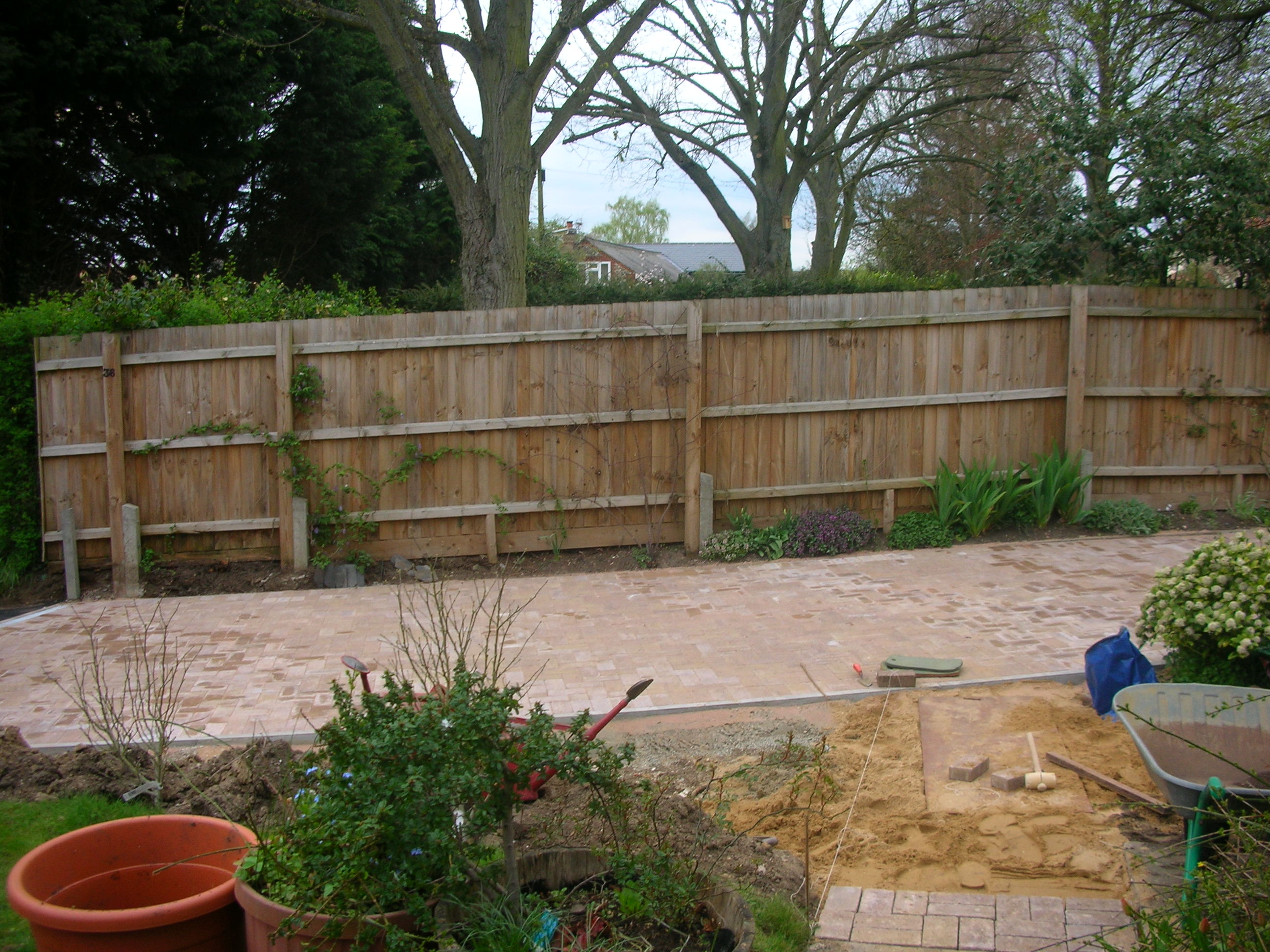
You wouldn’t think that the excitement of a new drive was worth waking up at 5.30 am for. Yet, for the last three mornings I have been waking at this hour and been out in the garden working on my bit of path or levelling bricks in the old bit of the drive before the men come to fill in the sand again. I think it is the sense of coming near completion of a project. This is (nearly) the end stage of a very long sequence, of dreams, ideas, design, assessing finance, finding builders, working as they worked (they were very helpful). I don’t think it is that different from writing a book – though rather quicker and a little more under one’s own control in the final stages. When I was working 9 to 5, I used to wake early and write before setting off for work.

They have finished – we have a new drive – but the surrounding chaos is daunting. We will have to barrow large quantities of earth and probably buy some as well. I still have much path work to do, and this includes the path to the front door. We forgot to ask them to move back the wooden half-barrel they had shifted and whose bottom will certainly fall out if we touch it. Still the fun bit is to come, making the surrounding garden beautiful again.

DSCN3645


We’re a little concerned about the birds. The noise and movement right near their feeding areas must have been very disruptive. The mad blackbird is unfazed, but I think is short of some (bird) marbles and doesn’t know it is supposed to be wild.

Mahler and garden ghosts

White souls have been inhabiting the garden last two mornings. These rather beautiful ghosts are the frost covers that I wrap around vulnerable plants that are just coming into new leaf. And yes, I know I should only grow hardy plants, but sometimes the tender growth on tree peonies gets zapped and one of the great joys of spring is waiting for the oh-so-slow buds to open into fragile cabbage-sized blooms. I am equally soppy about the new growth on my maples. In fact I go a little gaga each spring as I watch the leaves unfolding (and again in autumn as they blaze before dying).

DSCN3573

Last night was a treat beyond description. We had recorded a performance of Mahler 1, conducted by Simon Rattle with the Berlin Phil, in Singapore. I am a Mahler addict anyway, but this was so beautiful, intense and powerful, that I cannot imagine a more fulfilling experience. I so much prefer to have my heart beating too fast because of a musical crescendo than because a foolish character in fiction or TV drama is blatantly putting themselves in danger and we are invited to watch their downfall.

Shattering, but immensely satisfying day playing with bricks. The brick paving on the drive was washed so all the sand has gone. Over the twenty years they have been there many bricks have sunk and there are bad, wobbly patches. I found I could extract the bad bricks, introduce sharp sand and make them level again. I have also been robbing the bricks from the area that is being redone (THEY START TOMORROW – only a week later than scheduled) and my brick paths can progress at last. The garden is a war zone now, with piles of earth, turfs, pots full of uprooted shrubs and bulbs, bags of rubble and sand.

The birds are unfazed and nesting industriously. The early martins have stayed and settled and are burbling away outside the bedroom window.

DSCN3600

On Thursday I did some serious work on Border Line and managed to post another submission yesterday. I don’t plan to talk about politics in this blog, but the events in Boston and elsewhere have made an uncomfortable backdrop to our domestic and very lucky and privileged lives.

On the other hand

I’m damned if I’ll give up yet. After three days of gardening distraction, I am back at my desk working on more submissions. Border Line has had several bites from agents and I should at least persist until the whole MS is asked for again in its revised form.

Feel invigorated since making this decision. In the meantime I have rebuilt the really rough bit of path, put turfs into bare areas, dug all the available granite setts into the edge of the dragon bed, moved a lot of earth on the new bank by the drive-to-be, started cleaning up the area by the knot-garden and had an all out battle with a dark corner of the garden full of cow parsley and Lords and Ladies (arum italicum). So rejection has had a very good outcome for the garden.

Martins were probably passers-by. We haven’t seen any more. Maybe they are the ones who arrive at my brother’s house in the South West about now.

Managed to go Lindy hopping this evening, interesting moves, but way too much talking. Feel pleasantly exhausted now. No piano practice for three days. So tomorrow piano and writing.

Double trouble

If you are submitting two different manuscripts, of course you get two sets of rejections. Todays’ was for the POW non-fiction book. A very kind email from an agent whose submissions were closed anyway and who still read the first 50 pages. A little troubling though that there was praise for the idea of varying my ‘novel’ by using letters. This is a history book that I am editing, full of original correspondence from 1941-1945.

The remaining Far Eastern POWs are in their 90s and it is now, as these men reach the end of their lives, that their children and grandchildren want to understand what they lived through. These documents need to be made available, so I think self-publishing has to be the route. The materials – letters from many sources, memoirs, linking passages and illustrations would have been better presented and pruned with professional advice, but I can’t spend the next ten years tinkering and waiting for rejections.

I have self-published once before, but the world has changed (e-books etc). So I have downloaded a free up-to-date guide. Just have to pick up the bag and get marching.

writer’s balancing act

A rejection yesterday; today a request to discuss my first novel, A Small Rain (out of print), with a book group. In yesterday’s paper a brief article by a literary agent complaining about capricious, deadline missing, needy, rude authors. I want to put my hand in the air and shout, “Please Miss, please Miss, take me instead. I work happily to deadline’s, I don’t do rude, or writer’s block and…” but she’s not listening.

However many books I finish, I always seem to be reading three more. Current trio are Kate Atkinson’s One Good Turn, James Shapiro’s Contested Will (good scholarly look at the history of Shakespeare doubters) and Sue Monk Kidd’s The Secret Life of Bees.

Warm, sunny, windy spring day. Gardened to exhaustion.