Fiction is making stuff up

I have now finished Hornby’s Juliet Naked – I continued to chuckle to the end. I love the way he persuades his characters to reveal their worst, yet the writing is so tenderly ironic that you go on loving humanity all the same.

This morning straight into Faulks on Fiction. I am only a few pages into the Introduction, yet I am already making triumphant squeaks of agreement and admiration. Faulks suffered from people persistently unwilling to believe that he had ‘made it up’ when he wrote Birdsong. Though in a somewhat different league, I was shaken to hear that a reading group I had been to talk to, from an area about 20 miles from my home, had disapproved of my first novel at a later meeting. They ‘knew’ that I had based the story on two local disabled people – a couple I had never heard of or met.

The other very recognisable experience for an author is of having their writing judged entirely on how closely it fits with the reader’s personal experience. I am flattered when readers recognise themselves in my writing. I am also astonished at what they find in my text. So strong is the tendency to translate through a personal viewfinder, that you can hear your own story relayed back to you in an unrecognisable form: the main role given to one of your minor characters; jealousy supplied as a motive, where only boredom had been  evident; scenes relocated; names changed. (All this and I have only published two novels on a very small scale).

The is another reaction from readers that bothered me at first. If you mention an aspect of of a character, anything from a skill (eg playing a violin) to a handicap (eg being deaf), people are miffed if you stray from the stereotype or their personal experience. So if John, your violinist, is pernickety about dress, the reader will point out that they know three violinists who are totally carefree about clothing. If your deaf character, Sophie, is an extrovert who likes to party, you will have conversations that run: ‘I actually have a deaf friend, and she much prefers one-to-one encounters because then she can lipread.’ ‘Sure, but my Sophie character cares more about the warmth of social contact than words.’ ‘But surely that’s not true for most deaf people.’ ‘Maybe not, but I’m not writing about most deaf people, I’m writing about Sophie.’ Half the fun of writing is to fight your way out of these corners.

I am really looking forward to the meat of the Faulks book on fiction, and I am hoping that some of Hornby’s lightness and sureness of touch will rub off onto my own writing.

Mother of the regiment – POWs 12

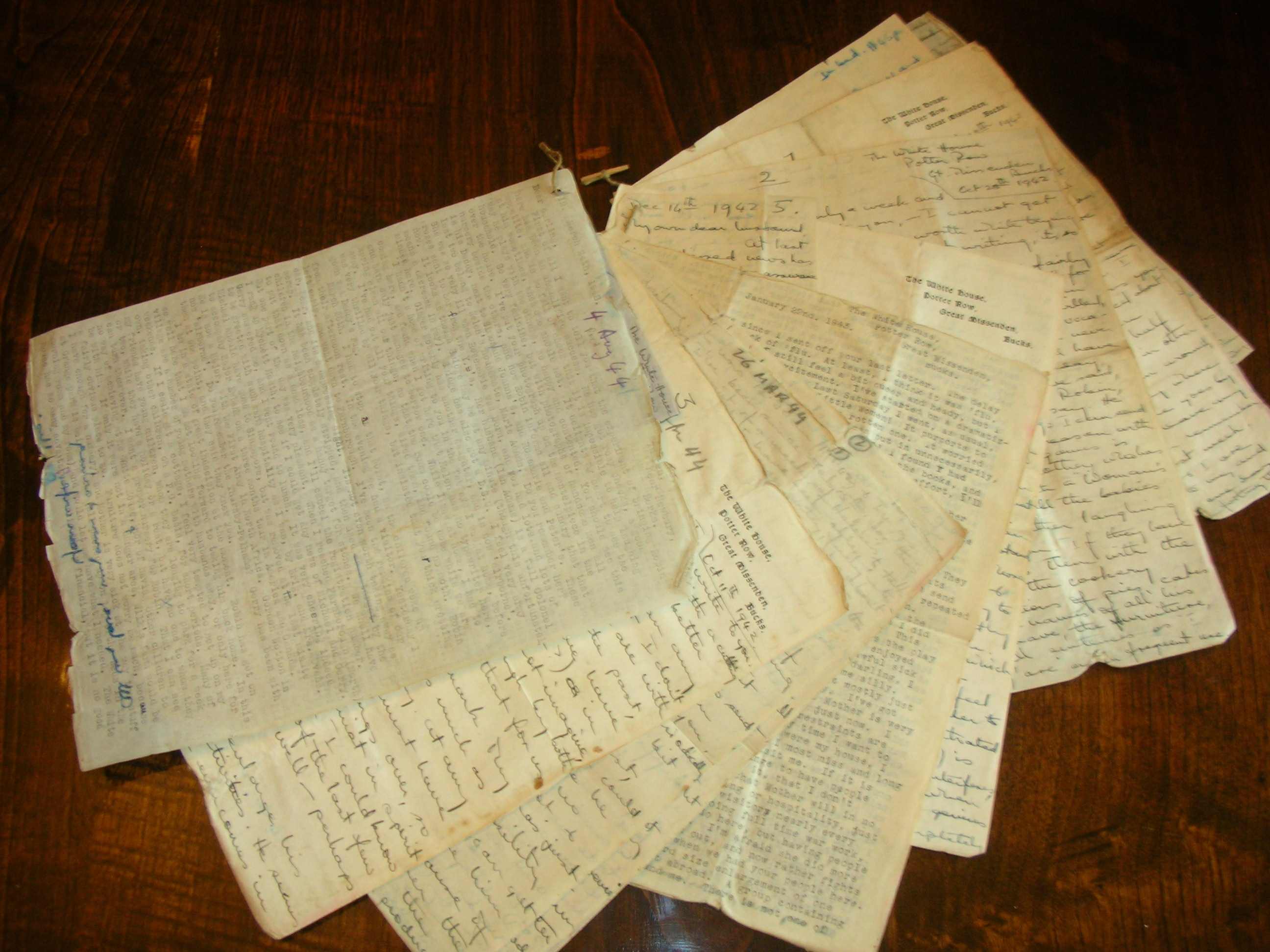
String of letters from Phyllis

String of letters from Phyllis

In 1943 while Barry and the men of 27 Line Section are sweating and starving on the Thailand Burma railway, Barry’s wife Phyllis is juggling her responsibilities. She is living at home with her parents, she has two-year old Robin and her mother (demanding and increasingly an invalid) to look after. She wants to move out of her parents home, but can’t unless she finds a job, and she needs one in which she can continue to look after Robin. She has heard nothing from Barry for over a year:

Dear darling, if I didn’t have to type this, which makes one stop to think what one is saying, and was not therefore very conscious of the censor, I could write you a real letter tonight. It is 11p.m. and I have been re-reading all the letters you have sent me since you left England. It has somehow brought you much nearer to me for a while…

Then there is her correspondence with the wives, mothers, fiancées and grandparents of Barry’s men. Phyllis heard that Barry was a prisoner in October 1942, 8 months after he disappeared. She wrote to the relatives over Christmas, replies like this came back:

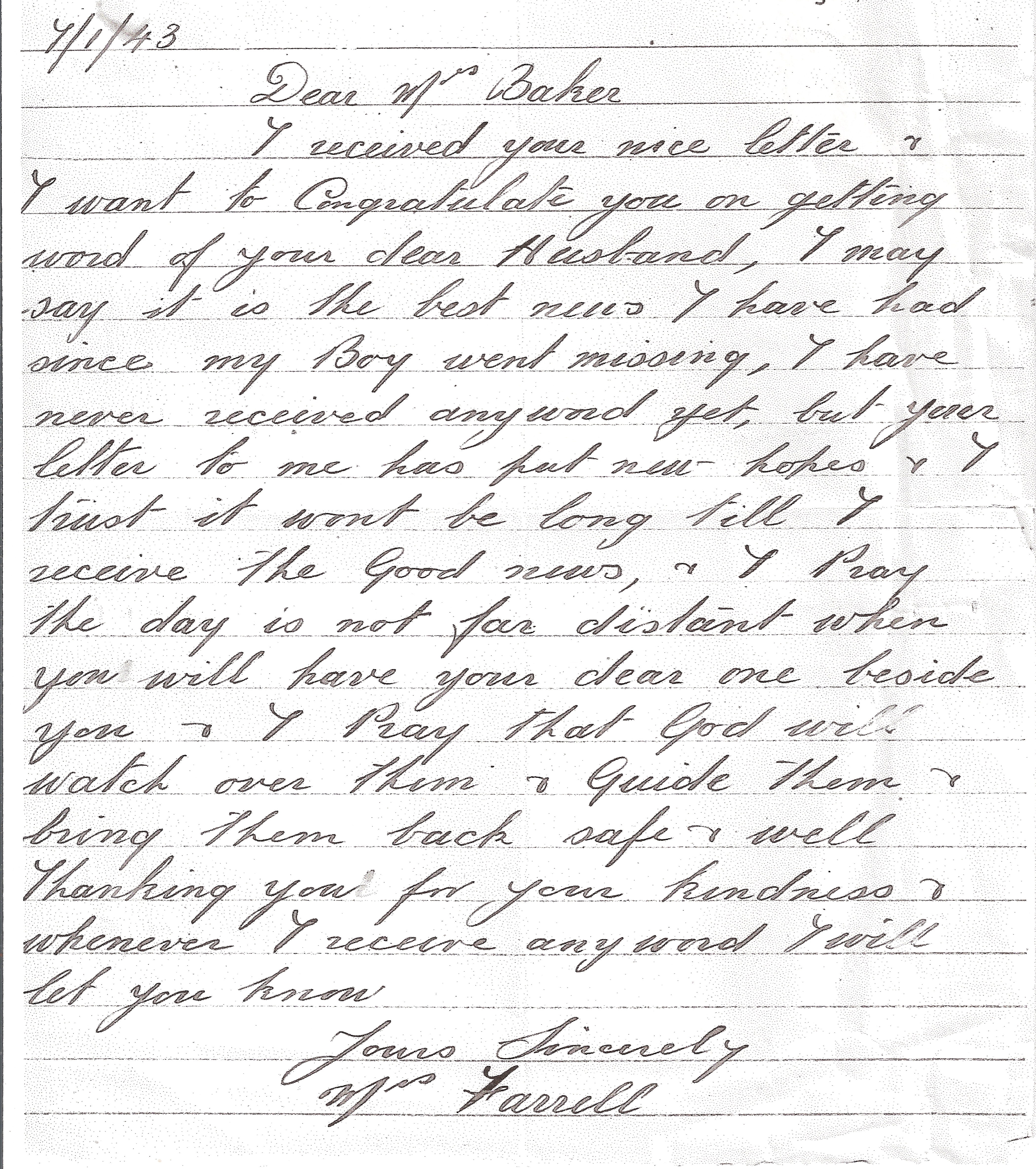
A mother writes to Phyllis

A mother writes to Phyllis

By June 1943 some more relatives hear, more than a year after silence fell, that their men are prisoners.

Dear Mrs Baker, I am now able to tell you that my husband Dvr. E. Parker 2587178 has been reported a Prisoner of War in “Tai Camps”. I received notification of this from Army Records Office on 6.5.43.

 I am very thrilled, but sorry to say that none of the other Glossop Girls have heard any news as yet, but there are great hopes.

I will take this opportunity of thanking you with all my heart Mrs Baker for your unceasing comfort through those long weary hours of suspense.

My very kindest regards & wishes for your husband’s speedy return. Yours Sincerely. Marjorie Parker.

Phyllis writes to them and then to Barry:

Darling, I’m probably going to get a wigging from Mother, but I just must sit down and finish this letter to you. I have had letters from four more next-of-kin of the men in your section to say their men are POWs… I can’t type up in my room, as they can hear me, and it’s not worth having a row with Mother… (They get so worried at the time I get into bed as it is. With lots of sympathy for me, they can’t fully appreciate how much I dislike going to bed). But all day and every day I am thinking of you, either all the many many happy memories we have, or hopes for the future…

The news of bad treatment of Far Eastern POWs is beginning to trickle through. All the relatives are worrying, Phyllis writes:

Always now I think of the past, and only realise with my mind, not with my emotions, that you must inevitably have changed a lot. Only my darling please don’t let anything you have or are suffering take away that light touch that was so essentially part of you. It was that which comes back to me almost more than anything else when thinking of that mad summer, and our two years engagement… This letter is going all wrong. Partly I know that Mother and Daddy are waiting for me to come upstairs, and though my heart and mind are just full of you…

There is no way for relatives to know, but some of their letters do eventually arrive, a year or so after they are written. Barry keeps them on a piece of string held with a bamboo toggle. All except one are still readable today. The one below is from Barry’s mother, Barbara.

String of letters from Barbara & Alan

String of letters from Barbara & Alan

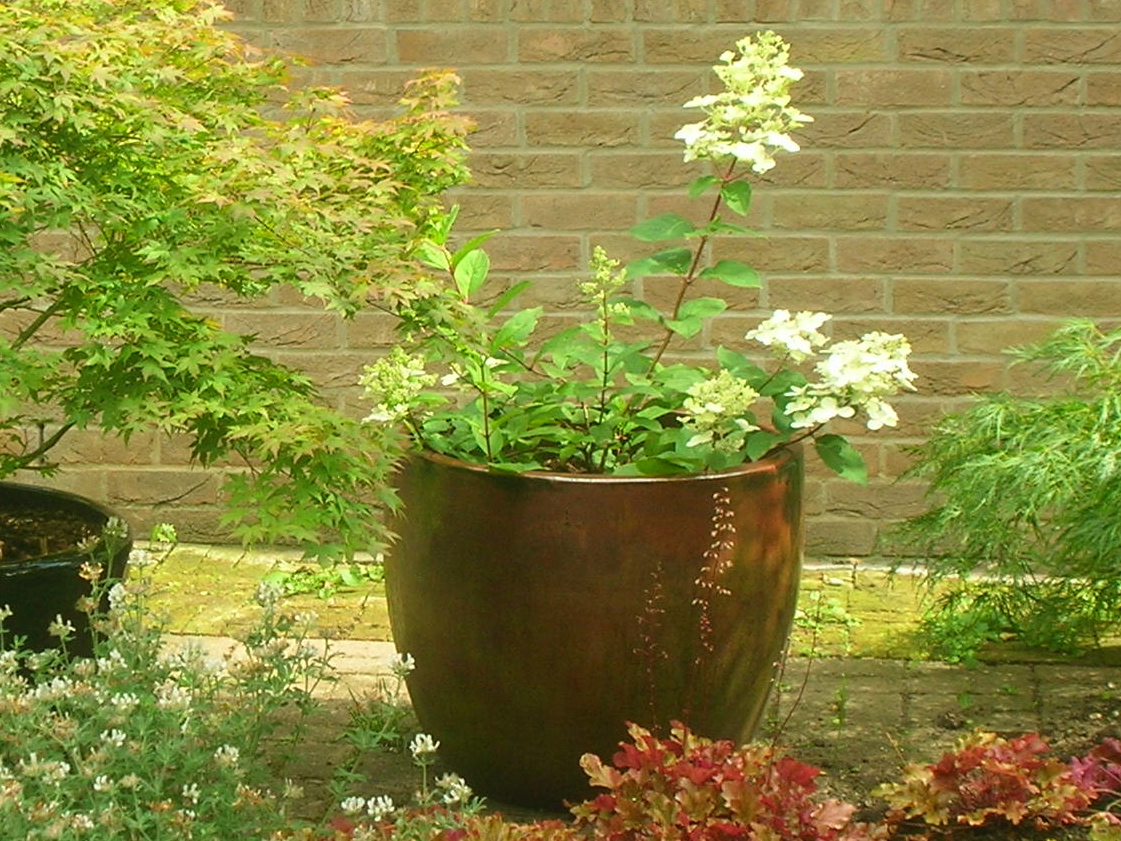
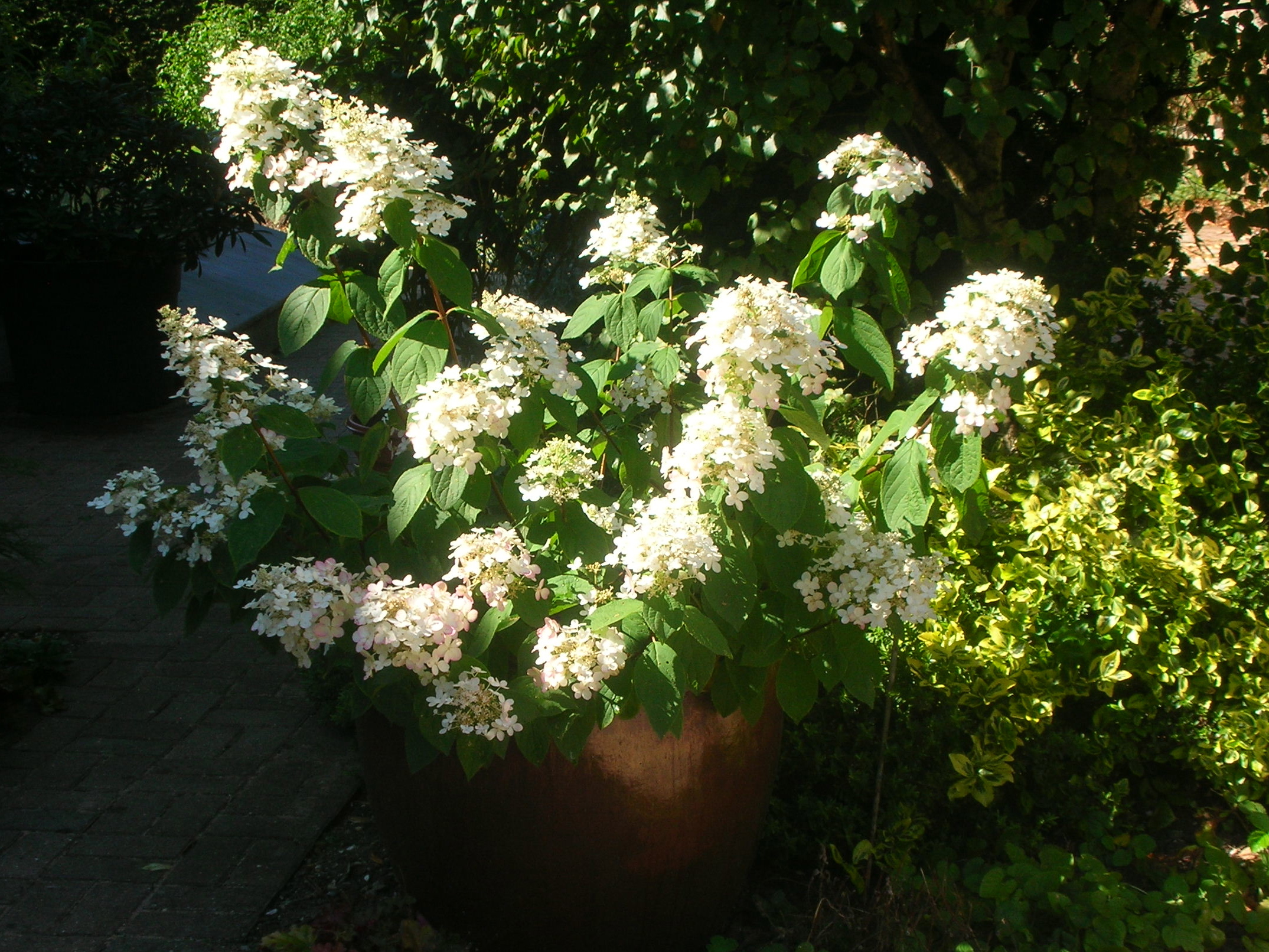
Hydrangea paniculata in one year and garden works

We bought this a year ago and were impressed by its growth in its first season.

DSCN3271

This year, it really decided to get up and go.

DSCN4205DSCN4208_2

We have now re-sealed the big wooden shed around its base – a job that has been waiting for nearly ten years! We have relaid the wobbly bricks in front of said shed and repainted both bay windows on the front of the house.

It can rain tomorrow if it wants.

Leo Tolstoy & Nick Hornby

I was going to title this Tolstoy versus Hornby, but that’s not what I mean.

Having recently finished Anna Karenina I picked out of my bedside stack a Christmas present (at least two years old) of Nick Hornby’s Juliet Naked. I had started it once before, but as the subject matter appeared to be the insane fan worship of a has-been rock star – not exactly central to my interests – it got queue-jumped.

I hesitate to admit it, but my enjoyment of my in-bed morning reading has now risen sharply. Hornby’s language is a chuckling delight. For instance, the fan and the colleague he has inadvertently started sleeping/living with arrive at work together: “Gina kissed him goodbye, on the lips, and squeezed his bottom playfully while colleagues watched, stupefied with excitement.”

Of course, Hornby is a lighter read than a Russian classic. Tolstoy’s people and the period are distant, and his use of language may well have lost some of its verve in translation. Also, while I was reading Anna Karenina, I did enjoy it, but there is relief in finding a character springing off the page in a sentence or two, and of internal monologues that make me smile in recognition (and don’t last for five pages).

With Anna Karenina there is a vast and satisfying depth to the characters, but so little humour and how much I miss it (and how difficult I find that in my own writing). It is difficult to love a character if you don’t get to smile while reading about them.

Desert island lily

These unassuming oriental lilies are scenting the air for about ten feet in all directions. They create an atmosphere you could willingly drown in. I found tasks in that corner of the garden all afternoon, it acts on me like catmint on cats. It’s my choice for a desert island lily.

DSCN4202

Anna Karenina, a mixed reception

We discussed Anna Karenina last evening. Tolstoy apparently described his book as sentimental, ‘serving no purpose’ and ‘bad’. Writerly modesty? Nerves? Depressive reaction?

At a simple level I would agree that there is sentimentality in Anna Karenina, but I can see no reason why a book should have to ‘serve a purpose’ and something that has stood the test of time and criticism so well is surely not ‘bad’.

That said, several of our group were not impressed, at least two had given up at an early stage, some were barely half way. Others felt (as I did) that Anna was not the main character, though the consequences of her actions created fallout for most of the other characters. The characters, as depicted by Tolstoy, would have survived and behaved as they did if Anna had not even existed. This, for me, was the most potent effect of the book. Each of the main characters whirled on his or her own axis, internally consistent, baffled, enraged, delighted by the other characters, but not changed. This does not mean that they did not develop, only that their development was internally driven.

All the major characters went in for thought, and boy did they think a lot. Large tracts of the book are taken up with internal monologues. But this is how we are – at least this is how I am. Life is an endless guessing game, through which we each have to navigate solo, but some of us are luckier in our companions than others. Anna is unlucky; Kitty and Levin lucky. Others, such as Vronsky, Alexei, Sergei, Stiva, and Dolly have mixed luck in their companions, but vary a great deal in the uses they make of it. There is some inconsistency in the characters and their behaviour, but I buy that too. I think that is real, though a modern writer would struggle to get away with this.

We were an elderly bunch discussing the book and there was short shrift given to ‘the passions of youth’ and little sympathy for Anna, who was seen as choosing sex (though no one spelled it out) over her love for her son. For me there was something timeless and classical, about Anna’s situation. In a marriage in which passion played no part, she was as much a victim of passion when is hit her as Phèdre (c’est Venus as sa proie toute entiere attaché), consumed by Venus before she had understood the danger. From then on, there were no right choices for her and tragedy was inevitable.

Levin, like Anna, came in for some stick. His prickly behaviour, mood changes and endless existential angst made some want to strangle him, for others he was a loveable innocent – and the main character. On reflection, I can’t think of many characters I felt fond of (Agafya springs to mind), though I had no trouble feeling sympathetic.

As we were an all-female discussion group, it’s no surprise that Vronsky was dismissed as, not so much the villain more, the standard badly-behaved man. Stepan – Stiva, in the same grouping, was barely mentioned. Personally, I thought Stiva’s mixture of self-absorption and charm was interesting, and the dinner party where he mixed tricky personalities and managed to smooth social discomfort, was one of (or the?) book’s highlights. But would such a selfish man have had the empathy to behave like this? If he had empathy, would he really have treated Dolly as he did? I guess empathy and selfishness are not mutually exclusive, a successful con-man would possess both. Alexei, got less attention than expected. An essentially unlovable character, Tolstoy works hard to give him his due without, at any stage hiding his cruel and vulnerable self-justifying behaviour.

On the whole Tolstoy avoided authorial generalisations – but sometimes as here… ‘This playing with words, this concealment of the secret, held great charm for Anna, as for all women.'[my italics] he succumbs to a personal belief. Tolstoy also tackled such a vast number of existential worries, that you could take home any number of ‘messages’ from the book and adapt them your own belief system, perhaps that is one reason for it’s enduring popularity. Towards the end, talking of Levin, he says. ‘He lived (without being aware of it) by those spiritual truths that he had drunk in with his mother’s milk…’ (culture). Yet Levin goes on to worry that if he did not know that he should live for God, not for his needs: ‘I would rob, lie, kill.’ Yet again he also recognises the essential fallacy of this statement as he realises that other religions, other outlooks don’t make people more or less likely to rob, lie or kill.

This has now become a ramble on the experience of reading Anna Karenina, so I shall stop. I am glad to have read something that both daughters have so consistently praised. I may post again after discussing the book with them.

Opera zeitgeist – industrial market garden, gas station or the kitchen?

Not sure what the zeitgeist is here.

Last week we saw L’Elisir d’Amore set in the distribution area of a market garden (Holland Park Opera). This looked good and was a very jolly production, but musically a little pedestrian? less elastic than it should be?

In Bayreuth they have set Das Rheingold in a gas station. This, plus other violations of the audiences expectations, seems to have lit the blue touch-paper and caused fury. I am not a Wagner enthusiast, so not sure what the big beef is here as musically it was apparently great.

Last night we saw Glyndebourne’s Baroque opera, Hippolyte and Aricie (Rameau) set, at least for some of the time, inside a commercial fridge. As the director Jonathan Kent said in an interview: ‘Just think of the Opening Ceremony of the 2012 Olympics – that was a Baroque event.’ I just wish I had read this interview before watching the opera.

For me, new to the Baroque genre, this was a baffling mixture – every part of which gave me something – from the exquisite sounds of the ancient instruments, to a farcical sailor dance routine from the vaudeville stage. At the heart of it was a moving, classical forbidden-love story.

I admired the way the stage designer had observed The Fridge and put all the details of it on stage. Cupid breaking cockerel-like out of an egg, on the upper shelves, in orange-yolk colours against the crystalline white of the ice-flakes (hand-maids of Diana) in fur coats, was a delight. Hell was depicted in amongst the working entrails at the back of a (gigantic) fridge – great detail.

I could just about follow the main story as the characters were dressed in modernish clothes. There was a really moving scene in which both upstairs and downstairs rooms of a 1950-60s house were seen. Each room had a singer stuck in their own dilemma within.  BUT, the mayhem of styles among the gods and chorus that surrounded them, the killing of stags and distributing of blood onstage and the costumes of the denizens of the underworld distracted me from the singing and the story.

Dancing – and there was masses of it (essential in French Baroque opera) – was beautifully executed but randomly choreographed. I don’t mean it was unskilful, it wasn’t, but the sense of going in whatever direction the whim took you was extreme.

Having, too late, read the interview between the director Jonathan Kent and Cori Ellison, I think they achieved exactly what they intended and that this was a clever modern update of the composers wish ‘to astonish and delight’ and to appeal to all the senses. I also think that a trad opera goer probably needs to read this elucidation in order to sit back and enjoy.

Highlight for me the long and sweet aria (from the upper chamber of a giant morgue fridge) by, I think, a shepherdess. This must be the Nightingale aria, but I don’t know the opera well enough to be sure.

Sorry, long post, but a weird and wonderful experience for me, though of limited interest to non-opera goer.

Below is an intro video from Glyndebourne, including part of the opera and below that a couple of good reviews.

http://glyndebourne.com/production/hippolyte-et-aricie

http://www.seenandheard-international.com/2013/07/01/glyndebourne-captures-spirit-of-the-baroque-in-rameaus-first-opera/

http://www.operatoday.com/content/2013/07/glyndebourne_ra.php

Remembering Far East POWs

The Researching FEPOW History website have published my article on the discovery of documents about the Far Eastern POW experience for both the prisoners and those left in their latest Newsletter. It contains several articles of interest to Relatives and Researchers in the field.

Click to access RFHG_newsletter_10.pdf

I still hope to make contact with some of the relatives of the men in the story.

Wang Po (Wampo), a handmade viaduct – POWs 11

Barry and the men of 27 Line Section, much reduced in numbers but still a coherent body, continued to work their way up the Kwai Noi building the Thailand-Burma Railway. In April 1943 they reached Wang Po (Wampo) Camp.  Barry remembers:

This was to be quite a different “one off” job, unlike the usual jungle clearance and embankment. Wang Po is at the 113 km mark, and when we reached it in early 1943, was quite a new camp, the rains had not started and the camp was quite dry and fairly clean. We were by now dying off quite frequently but not more than one or two each day and we were still on two bowls of rice per day, not one.
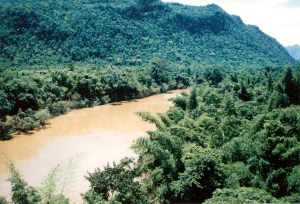
Wang Po area 1980s

Wang Po area 1980s

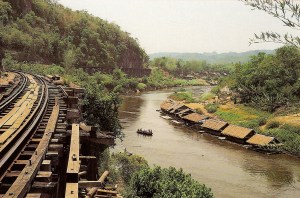
… near the village of Wang Po the river makes a sudden eastward loop into a rocky gorge that cuts into the line of the railway and here it was necessary to build a viaduct about half a mile long to carry the rails over the gorge beside the river.

Wampo Davies book

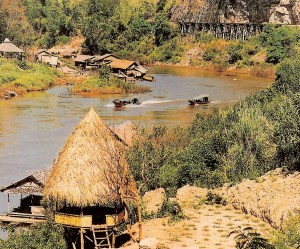
Our camp was set up on the west bank, opposite the working site as the gorge made it impossible to build a camp on the east bank. The camp was located on the edge of a forest of teak trees, which were to be the source of timber for the construction. We were a big group, a thousand or more I think… . One half of the group worked on the trees preparing the beams, the rest, of which I was one, worked in the gorge.
Wampo pc3

Our first job was to clear rocks and boulders from the planned route of the viaduct, which we did by drilling and blasting. The holes were made with a rock drill. One brave man holds the drill while two others smite the head of it with sledgehammers. We Linemen were used to sledgehammer work and did not often damage the hands of the drill holder but some of the other parties suffered several damaged or broken wrists. There was no power machinery of any sort in the whole construction, just hand tools.

By the time of the midday tea break our holes had generally gone in deep enough, and while we rested and drank our tea (no midday rice now), the Japanese engineers packed the holes with plastic gelignite and set detonators and lengths of safety fuse in them. There might have been as many as fifty blasts set off at once and it was important, both for us and for the Japs, to make sure they all went off. In the afternoon we shifted all the broken rocks and carried them down towards the riverbank.

When all the boulders had been cleared we set about making the concrete foundation piers, all built by hand with hand mixed concrete. …  which had to be carried to the site on the usual rice sack stretchers. Wet concrete makes a very heavy load. The Japanese engineers had already set up wooden shuttering for the piers… .

I should have mentioned that we had to cross the river from the camp to the site, morning and evening, but as it was in the dry season the water was quite shallow and you could walk on the bottom most of the way and only had to swim in the middle.

While we were clearing the rocks and building the piers, the other half of the group were felling teak trees. Very tiring work, as fresh teak is extremely hard. The trunks when felled were cut to length and then squared up by Japanese engineers using an adze. I have seen one of their engineers square up a log fifteen foot long and around two foot thick in one morning’s work.

When the concrete piers were nearly finished, 27 Line Section and others rejoined the timber party and started the very heavy task of carrying the squared timbers down to the riverbank. The intention had been to float them across the river but some of the POWs who had worked in the Burma teak forests insisted that green teak is so dense it will not float. The Japanese were unconvinced but the first trial proved the point. From then on we swam the beams across the river fastened to bundles of bamboo to keep them afloat.
Wampo pc1

A few elephants with their Burmese mahouts helped in this work of shifting the beams down to the river but they were the only powered machinery on the job. They seemed extraordinarily precise, even fussy, in their handling of these heavy loads seemingly without any orders from the mahouts. There were not enough of them, of course, and we had to do much of the carrying ourselves. I reckon these beams must have weighed around 3/4 of a ton (or tonne) each, more or less, depending on their length. At first we tried to get them up on to our shoulders like undertaker’s men with a coffin. But the edges were too rough and sharp, so instead we used the ever-present bamboo poles. Eight or ten stout poles pushed under the beam and then lifted with one or two men at each end and the beam could then be carried down to the river looking like a giant caterpillar.

There were no cranes, simply intricate bamboo scaffolding fastened onto the rocky cliffs above the site and multi sheave pulley blocks fastened to it. A long rope over the pulleys with 50 POWs tailing on to it served to raise each of these beams into its proper position, where they were then all fastened together with dog spikes.

When the trestles were in place, held up by more bamboo props, then the even heavier horizontal beams which connected them together had to be heaved up into place by the same method and then spiked together. With the crudest estimate there must be between 500 and 1000 beams in the viaduct. While we were doing this other groups of POWs had laid sleepers and rails on the prepared embankment and were ready to go on over our viaduct as soon as each section was completed.

[The next section of the Railway had already been completed, so] we POWs who had built it were actually carried forward for a short section of our next march in railway trucks over the viaduct. I remember it as a very scary proceeding. The train went at a walking pace and at each rail joint, with its sudden change of direction, we felt that the wheels might easily jump the track and tumble us all down into the River. We got over without incident but I heard that the engineers kept a working party permanently on the viaduct with crowbars to lever bogey wheels back on to the rails if they came off.
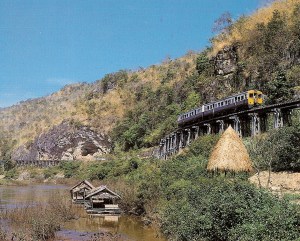
Wampo pc4

I have to admit that when this job at Wang Po was finished we POWs felt a certain mixed up pride in the work. We could see the completed viaduct and it worked and we had built it ourselves without mechanical aids of any sort beyond hand tools and a few elephants. I was left with a great admiration for the skill and planning ability of the Japanese engineers and an ever-growing bitter hatred for our guards.

[The b/w photo is from Peter Davies, The Man Behind the Bridge. The others are postcards from the 1980s/90s]