
Mother of the regiment – POWs 12

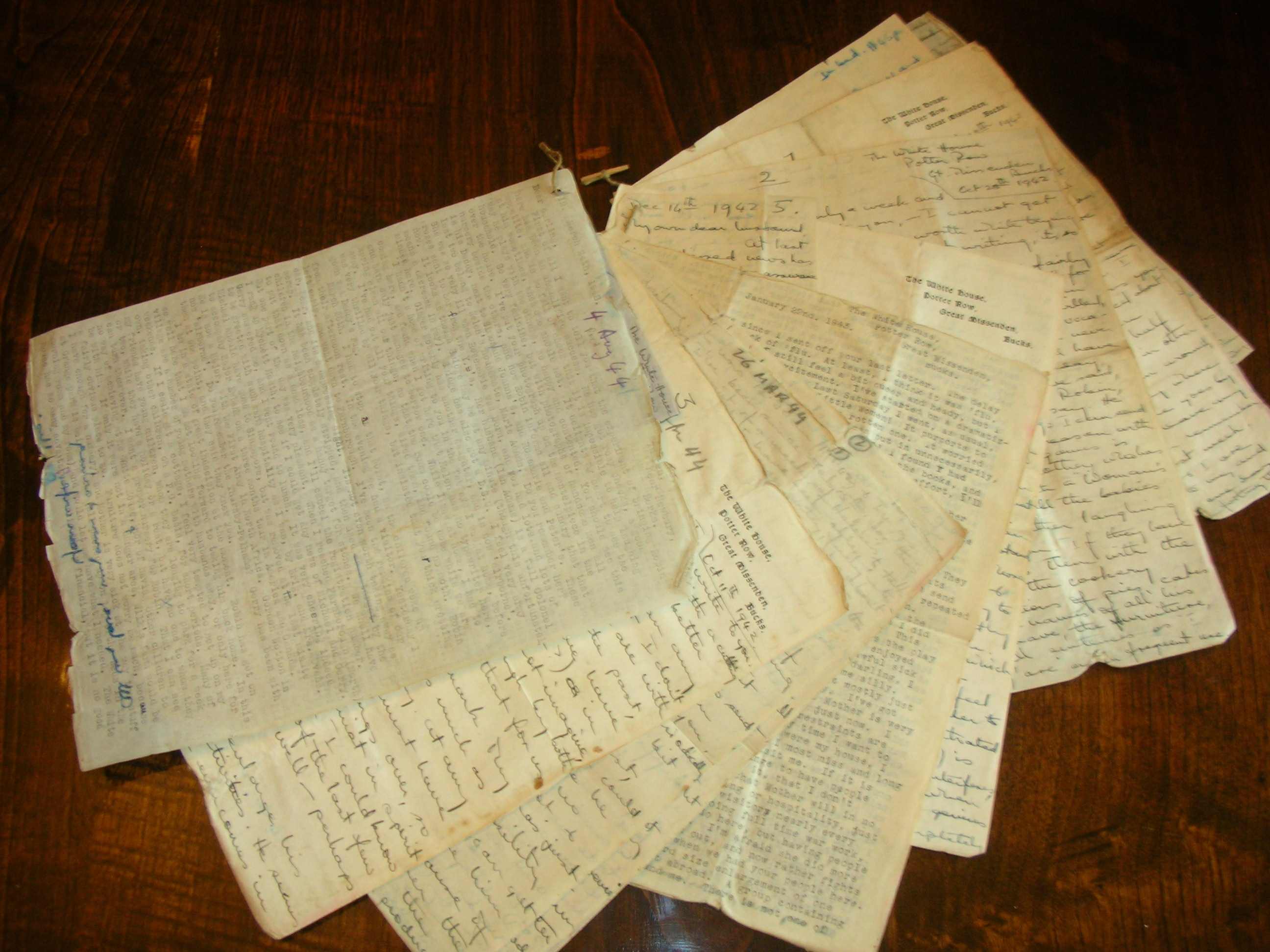
String of letters from Phyllis

String of letters from Phyllis

In 1943 while Barry and the men of 27 Line Section are sweating and starving on the Thailand Burma railway, Barry’s wife Phyllis is juggling her responsibilities. She is living at home with her parents, she has two-year old Robin and her mother (demanding and increasingly an invalid) to look after. She wants to move out of her parents home, but can’t unless she finds a job, and she needs one in which she can continue to look after Robin. She has heard nothing from Barry for over a year:

Dear darling, if I didn’t have to type this, which makes one stop to think what one is saying, and was not therefore very conscious of the censor, I could write you a real letter tonight. It is 11p.m. and I have been re-reading all the letters you have sent me since you left England. It has somehow brought you much nearer to me for a while…

Then there is her correspondence with the wives, mothers, fiancées and grandparents of Barry’s men. Phyllis heard that Barry was a prisoner in October 1942, 8 months after he disappeared. She wrote to the relatives over Christmas, replies like this came back:
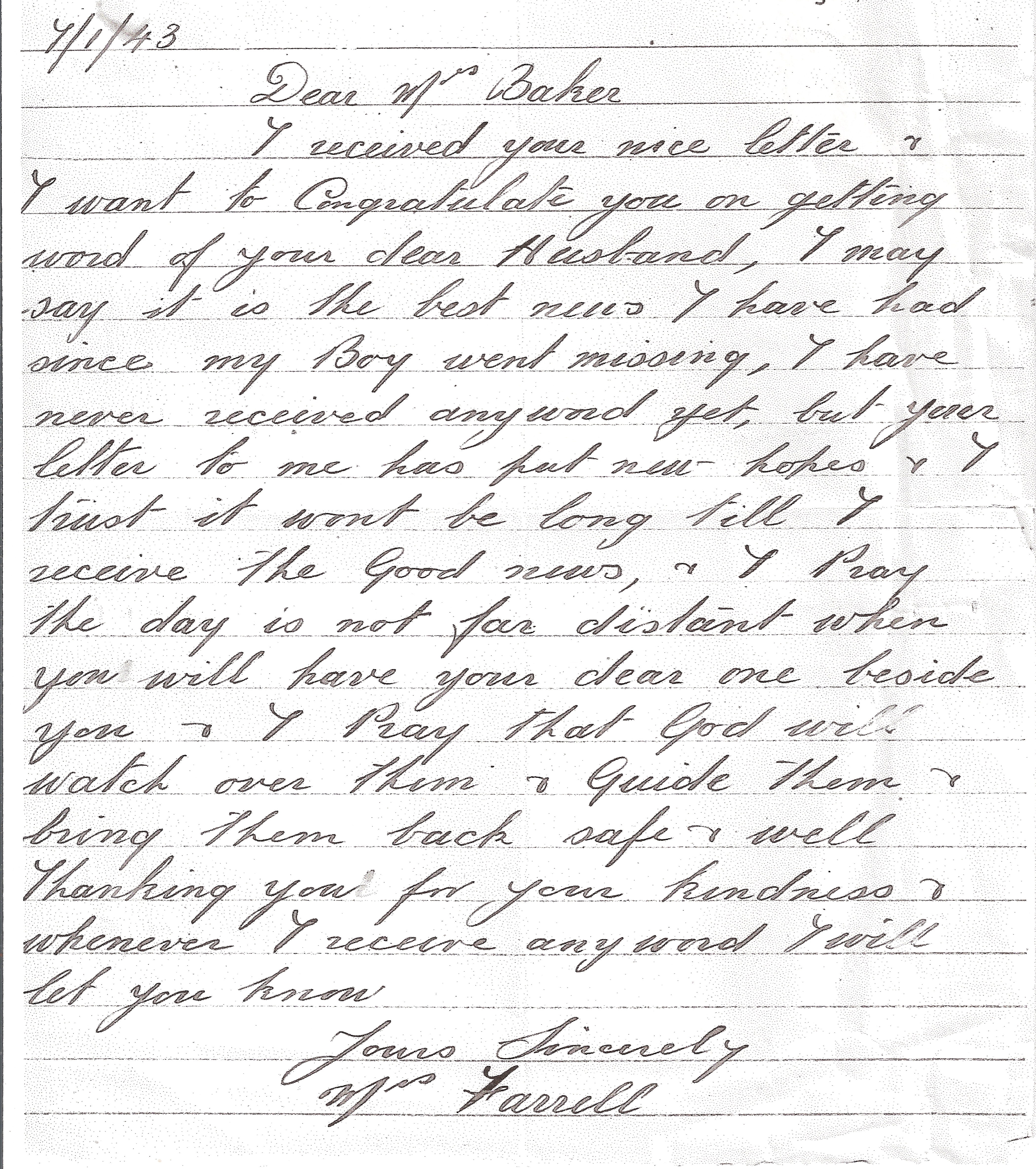
A mother writes to Phyllis

A mother writes to Phyllis

By June 1943 some more relatives hear, more than a year after silence fell, that their men are prisoners.

Dear Mrs Baker, I am now able to tell you that my husband Dvr. E. Parker 2587178 has been reported a Prisoner of War in “Tai Camps”. I received notification of this from Army Records Office on 6.5.43.

 I am very thrilled, but sorry to say that none of the other Glossop Girls have heard any news as yet, but there are great hopes.

I will take this opportunity of thanking you with all my heart Mrs Baker for your unceasing comfort through those long weary hours of suspense.

My very kindest regards & wishes for your husband’s speedy return. Yours Sincerely. Marjorie Parker.

Phyllis writes to them and then to Barry:

Darling, I’m probably going to get a wigging from Mother, but I just must sit down and finish this letter to you. I have had letters from four more next-of-kin of the men in your section to say their men are POWs… I can’t type up in my room, as they can hear me, and it’s not worth having a row with Mother… (They get so worried at the time I get into bed as it is. With lots of sympathy for me, they can’t fully appreciate how much I dislike going to bed). But all day and every day I am thinking of you, either all the many many happy memories we have, or hopes for the future…

The news of bad treatment of Far Eastern POWs is beginning to trickle through. All the relatives are worrying, Phyllis writes:

Always now I think of the past, and only realise with my mind, not with my emotions, that you must inevitably have changed a lot. Only my darling please don’t let anything you have or are suffering take away that light touch that was so essentially part of you. It was that which comes back to me almost more than anything else when thinking of that mad summer, and our two years engagement… This letter is going all wrong. Partly I know that Mother and Daddy are waiting for me to come upstairs, and though my heart and mind are just full of you…

There is no way for relatives to know, but some of their letters do eventually arrive, a year or so after they are written. Barry keeps them on a piece of string held with a bamboo toggle. All except one are still readable today. The one below is from Barry’s mother, Barbara.

String of letters from Barbara & Alan

String of letters from Barbara & Alan

Remembering Far East POWs

The Researching FEPOW History website have published my article on the discovery of documents about the Far Eastern POW experience for both the prisoners and those left in their latest Newsletter. It contains several articles of interest to Relatives and Researchers in the field.

Click to access RFHG_newsletter_10.pdf

I still hope to make contact with some of the relatives of the men in the story.

What makes writers mad

There is a great article in the Guardian by a new Canadian novelist about what makes writer’s mad. I agree with every word. AND it’s a smashing read.

http://www.guardian.co.uk/books/2013/jul/25/anakana-schofield-how-to-write?CMP=twt_gu

writing, painting and Tolstoy

I am more than half way through Anna Karenina now, and I had an ongoing draft blog about several things that struck me. However, this morning I read Tolstoy’s description of an artist letting visitors into his studio to look at his latest painting. Tolstoy writes about the moment that the artist, unveiling the painting, sees it anew from another’s point of view. “…he saw it with their indifferent, estranged, new eyes and found nothing good in it.” He saw banality and a “heap of defects”.

The idea of their attention excites the artist, the smallest praise, the slightest suggestion of defects affects him deeply and alters his own judgement of his work. The fact that he had assessed his visitors fairly accurately on sight and knew that they were unlikely to offer him constructive comments does not alter their effect on him.

Although Tolstoy is talking about painting, every word can be translated to written work. Since I started writing I have been baffled at how one day you can read a piece you have written and be surprised how well it reads and a few days later the same passages will strike you as banal or defective in some way. Pick up the book a year later and you could have either of these reactions. It is as if some malign optician is forever changing your glasses until you have no idea when you are seeing straight.

In October I will be meeting a reading group to discuss a novel about an opera singer I published in 2008 (Unseen Unsung). I will have to re-read it. Will I be appalled, amazed, embarrassed? I really wish I knew.

They are prisoners; they are safe – POWs 10

For Phyllis, and the other relatives in England of the men who vanished in Singapore on 15 February 1942, their greatest fear was that their men had died or been wounded in the fighting. The best news they could hope to hear was that they were prisoners. They might be bored or hungry, but they would be safe from death until the end of the war. In addition they could be sent comforts, they would be able to communicate (when the authorities had sorted a route out) and all would eventually be well. So Barry’s father wrote to him:

“I know that you will understand how important it is in spite of the many difficulties of being a prisoner to try and keep fit in mind and body. I hope you will try and find some special interest. You have a real gift for languages try if possible to keep up your French and Malay to learn to write in Arabic characters, and if possible also to learn to speak Japanese. Also learning good verse will be a help and writing and composing yourself. Also if possible work with your hands. I’m afraid that as yet we cannot send you any parcels but perhaps you can get some books in Singapore.”

Relatives have no information about those who have already died. Relatives of these men would go on writing into the blue, waiting and hoping, sometimes as long as three years. The War Office struggled to get reliable data, from any source. Sometimes relatives heard before they did. One wife wrote to Phyllis on 5 January 1943:

“I have had no official news of my husband, but a friend of his, serving in the Middle East, sent me an airgraph, telling me my husband was a prisoner, he wrote as though I had already heard the news, so each day I hope the good news will arrive, and as soon as it does I will let you know.”

The situation never improved. On the 5th of November 1945 nearly three months after the end of the war in the Far East, one of the mothers wrote to Phyllis:

“I am sorry to trouble you, but I wonder if you could try & find out any information about my son, we have not heard a word about him, & as they are nearly all home, makes us wonder if anything has happened to him.”

The pig-sty that was Ban Pong – POWs 9

In late autumn of 1942 we were told of a new delight to come. We were to be moved north into Siam [Thailand] where we would be engaged in light healthy labour with good food and pleasant sunny weather, housed in well-built camps in open country. We couldn’t wait for this promised treat.

We marched to the station carrying our backpacks and were there entrained in metal-sided cattle trucks, about 40 to each truck. […] We took it in turns to sit in the better places and arranged our packs in rows so that we could sit on them with our legs pointing towards the middle of the truck. […]

There were no latrine arrangements at all, not even a bucket. One could pee through the open sliding door and the train stopped twice a day at some point well away from a village so that we could get out and ease ourselves squatting over a ditch or under a hedge. As many of us were already suffering from dysentery, these two stops were not nearly enough and we got over the problem by rigging a rope across the doorway at a convenient height so that one could hang on with both hands, bottom outwards and shit on to the track.

We arrived at Ban Pong, all 800 of us soon after the start of the rainy season. Ban Pong was a substantial small town of about 5000 and the camp was a very disgusting place. As a transit camp there was no senior British officer in command who could see that the place was kept in order. […] After a few days we marched out of the pigsty of Ban Pong.

Ban Pong in Thailand was the starting point for the railway designed by the Japanese to link Bangkok with Moulmein in Burma. The planned stretch between Ban Pong and Thanbyusayet (roughly 400 km) ran through barely charted territory following the river Kwai Noi. Designing the railway posed an enormous engineering undertaking; building it, in wartime, with no mechanical aids, required enormous manpower and resulted in over 100,000 deaths, the majority of which were forced gangs of Chinese, Indians and Malays, but also included around 13,000 Allied POWs.

Silence in England – POWs 7

After the Fall of Singapore in February 1942, Phyllis and the other wives and mothers of 27 Line Section wait anxiously to hear what has happened to their men. The silence is absolute. No one in authority can tell them anything, The men of 27 Line Section could be dead, evacuated or prisoners of war. Phyllis has addresses for many of the wives and mothers. She sends out a circular and several write to thank her for: “…your kind letter which has given me new heart at a time when I have nearly made myself ill with anxiety.”

Phyllis starts writing to Barry: “Dear Love, I haven’t written a letter for a fortnight hoping each day may bring me good news  from you…”

Nine months later she is still writing and waiting. So are almost all the other relatives, though there is now a presumption, unless they died in the battle for Singapore, they are now prisoners of the Japanese. The War Office finally thrash out an agreement with Japan to exchange information and send post using the Swiss Red Cross and a complex route across Russia. Relatives can now write – though it is into the blue and they still have no idea where the men are. For the Japanese, overwhelmed by the numbers of prisoners they have captured, the gathering and release of names is very low priority.

Finally, on the 12 December 1942, Phyllis hears that Barry is a prisoner. She writes :

My own dear husband, At last that blessed news has come to me – the assurance that you are a prisoner of war. I am awaiting the letter from the war office now with further details. The relief has left me a little lightheaded, I think. Dear darling, I fear my letters have been dreadful lately – but it was like holding a telephone conversation with a deaf & dumb person. Things have become real again now, & worth while.

Phyllis is lucky and she knows it, because she keeps in touch with the other wives and mothers. Some have to wait several more months for that news. Others hear nothing at all for another two and a half years.

Death and Churchill – POWs 6

In the Changi POW camps epidemic diseases took hold. In the space of eight days three men of 27 Line Section died, two of dysentery, one of Cerebral Malaria. They were three of Barry’s highly regarded Sergeants.

By summer all the senior officers had been sent away to Japan – supposedly to foil any attempts at an uprising – and the Kempi Tei (special police) cracked down on any whiff of escape plans. The little news the POWs received on secret radios was dire. As Barry remembers:

The general spirit of the POWs was in fact very sad and pessimistic with no serious thoughts of revolt or even of escaping. In a European War once out of the prison camp one may well pass for a native of the country, but in Asia any European is immediately recognisable.

[On the radio] We heard much of the false propaganda, which even then seemed untrue, but once quite unexpectedly, I heard the very recognisable voice of the Prime Minister, Winston Churchill. It made a lasting impression as he was quoting a poem by Arthur Hugh Clough. The war was going very badly for the Brits. We were out of Europe with not much prospect of getting back again. Rommel was winning all his battles in the desert against Wavell, the Russians were falling back on Moscow overpowered by the Nazi armour, our Fortress Singapore had fallen, our two biggest battleships had been sunk and the US Pacific Fleet almost destroyed at Pearl Harbor. Churchill quoted:

Say not the struggle naught availeth
The labour and the wounds are vain.
The enemy faints not nor faileth
And as the things have been they remain.

If hopes were dupes fears may be liars
It may be, in yon smoke concealed
Your comrades chase e’en now the flyers
And but for you possess the Field.

For while the tired waves vainly breaking
Seem here no painful inch to gain
Far back through creek and inlet making
Comes silent, flooding in, the Main.

And not by Eastern windows only
When daylight comes, comes in the light
In front the sun climbs slow, how slowly,
But westward look! The land is bright.

This was obvious reference to the fact that the USA was now at war and on our side.

Changi prisoners – making boreholes – POWs 5

After capture, British and Australian soldiers marched across the island of Singapore and joined many thousands of other prisoners in the complex of camps around Changi barracks. Over the next few months they learned to eat rice for breakfast and lunch and supper. Disease, particularly malaria and dysentery, became a serious problem. 27 Line Section turned their expertise in boring post holes to the more urgent need of making latrines. They found some large auger bits and constructed a tall set of sheer legs fitted with a block and tackle.

Barry remembers:

The first hole went well, about fifteen feet deep, say 4 metres. One of our carpenter-and-joiners built a seat with a cover, very civilized. Then we then collected the other big auger bit from the Post Office stores and set up a second team of bore hole makers. We made several holes within our Unit’s area and a few for other regiments, until one day when we were at work the sergeant in charge of the other party came to me to announce a disaster.

The drill head had fallen off and stuck in the shaft. The team had tried everything then decided someone would have to be lowered head first into the hole. Since I was the officer I would, according to the sergeant, naturally volunteer for the job, especially as I was probably the thinnest and lightest man in the section. So I volunteered.

My ankles were tied onto the rope and I was heaved up and then lowered into the hole with my arms stretched out like a diver. I just fitted, but only just. When I reached the bit I found that there was luckily only a little earth in it and I was able to loosen it and get a good grip on it. At my word the team pulled me gently up again and swung me aside onto the spoil heap, untied me and then untied the bit. We found that the fastening bolt was too thin and had sheered under the strain, so we fitted a stouter bolt and restarted the work. I warned them that if it happened again someone else would have to go down. It is not an adventure that I recall with any pleasure.

A writer’s responsibilities?

This is a post that has been sitting in the draft folder for a (long) while. Ever since a rejection for Border Line in April. I guess I should face it now. How much responsibility does the writer have towards the reader when dealing with tricky subject matter?

Border Line is essentially and upbeat novel, yet it has suicide at its core and touches on assisted dying. It is fiction, it is written as a ‘good read’, is upbeat and life affirming and is essentially a love story – but the eleven characters’ main intention is to quit life.

I’m not daft. Suicide is only ever the least worst option for the person who chooses to go. For the people who are left behind it is misery in varying degrees. That does not mean it is never the right choice. The crucial word in this is choice. If I publish this novel, perhaps more particularly, if I self-publish, and if it is read by anyone vulnerable, could I be said to be encouraging them to take that route out?

Some friends, pointing out the range and gruesome subject matter available in print, think my scruples are absurd. I could certainly thin the story out to a ‘will-they-won’t-they’ thriller by taking out all the personality and debate, and it would become a harmless guessing game – I think this is what one agent had in mind. But I am curious about real people, how they deal with internal guilt or the random acts of life. My previous books have tended to deal with real issues and that seems to be what interests the kind of readers who enjoy them.

Drafts of the MS have been requested several times, and revised after each rejection. When do I stop submitting to agents and use those spare ISBNs?

Not an amusing post, but I started this with the aim of using the space as a notepad for writing-related thoughts and dilemmas.