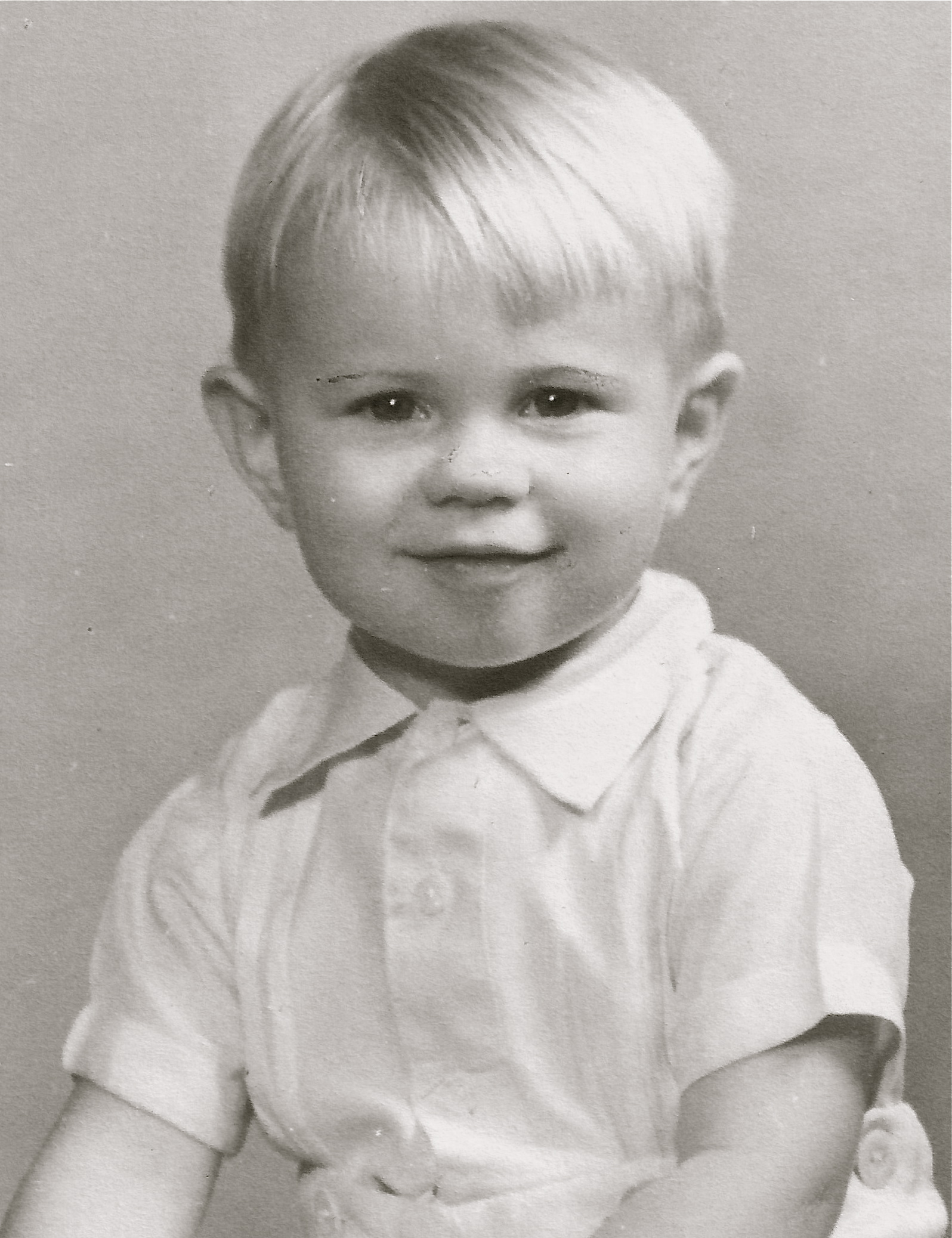
Boon Pong – and other forgotten heroes

Tucked into one of the books on Barry’s shelves about Far East POWs was a little photocopied leaflet of 1998, being re-issued for ‘X’mas 2000’. It starts:

I am one of the persons who had seen the event about the railway construction from Kanchanaburi to Myanmar during World War II when I was 19 years old, 1941. As a saleswoman at Khao Chon Kai (Chungkai) War-prisoner Camp.

page 1 of Lulu's story

page 1 of Lulu’s story

Her name was Lulu Na Wanglan and she tells her story, explaining that even after 50 years, ‘I dreamed of those war-prisoners before I started to wright.’. She supplied prisoners until she had ‘no more capital to trade or sale goods.’ At this point she was given some money, probably by the local underground, to continue supplying prisoners. She was suspected of spying by the Japanese and warned by Mr Bunpong (Boon Pong) in time to escape. The prisoners thought she had been shot (confusing her with a brave French spy, ‘Lulu’ who had been killed by the Japanese) and they missed her. After the war UNO staff painted Lulu on their vehicles. Prisoners remember her in their memoirs.

Boon Pong (Boonpong Sirivejjabhandu) was a Thai trader whose sympathies were aroused by the state of the prisoners. In early 1943 he became the interface between the V organisation and the prisoners. The ‘V’ organisation was run by an interned British man, Gairdner, with a free Thai wife, Millie, and many free business connections. Many others were involved and as the prisoners’ conditions worsened they raised large sums of money on loan. Millie was among the those who dared to risk passing money and drugs directly to prisoners via the many POW lorry drivers.

Boon Pong Sirivejjabhandu

Boon Pong Sirivejjabhandu

The upriver camps had almost no supplies of medicine and very little food, especially higher up-river where barges could not go. Conditions became dire beyond imagining and their only source of relief was the money and drugs that Boon Pong managed to get to them, acting always as a legitimate trader. He also obtained and supplied ‘Canary Seed’ (radio batteries), if the Japanese had discovered this he would have been tortured and killed. There were other traders, but his prices were lowest. He worked the length of the river, but after the railway was complete and the men poured down-stream in vast numbers to the big base ‘hospital’ camps, his role became even more crucial in saving lives with supplies of food and medicines and even violin strings.

In a story by Brian Brown of the Royal Signals in Beyond the Bamboo Screen (ed. Tom McGowran) he quotes another POW saying the Boon Pong’s wife swam their camp moat at night with medical aid round her neck. The effect on morale of the efforts by this family were incalculable.

Australian Surgeon and POW, Colonel Weary Dunlop, kept a diary. 25 October 1943 reads: The hospital today obtained some most useful drugs and money *. The footnote reads: By grace of that magnificent man, Boon Pong. His entry 30 December 1943, A Valuable supply of drugs and 3,000 ticals [this was due to the wonderful services of Boon Pong, the river trader]. And so on.

In the aftermath of the war in September 1945, Boon Pong was shot outside his shop in Kanchanaburi in front of his wife and father. Julie Summers in her book about Colonel Toosey, The Colonel of Tamarkan writes:

A British officer, …Captain Newall heard the shots and rushed to the scene. ‘He had been shot through his neck and left arm and he had also been shot clean through the back. There was a large hole in his chest where the bullet emerged and spent itself. He looked up at me. “Thai police kill me.” That was all he said.’

A British medical team gave him blood transfusions and operated on his wounds and, amazingly, he eventually recovered. In 1947, Colonel Toosey heard that Boon Pong, now running a bus company, had got into financial difficulties.

Bangkok

Bangkok

Toosey asked fellow prisoners to contribute and they raised £38,000. Boon Pong’s company became successful and his sons now run it. He received the MBE in 1948. He is popularly supposed to have been awarded the George medal*, but Clifford Kinvig in The River Kwai Railway, says there is no official record of this.
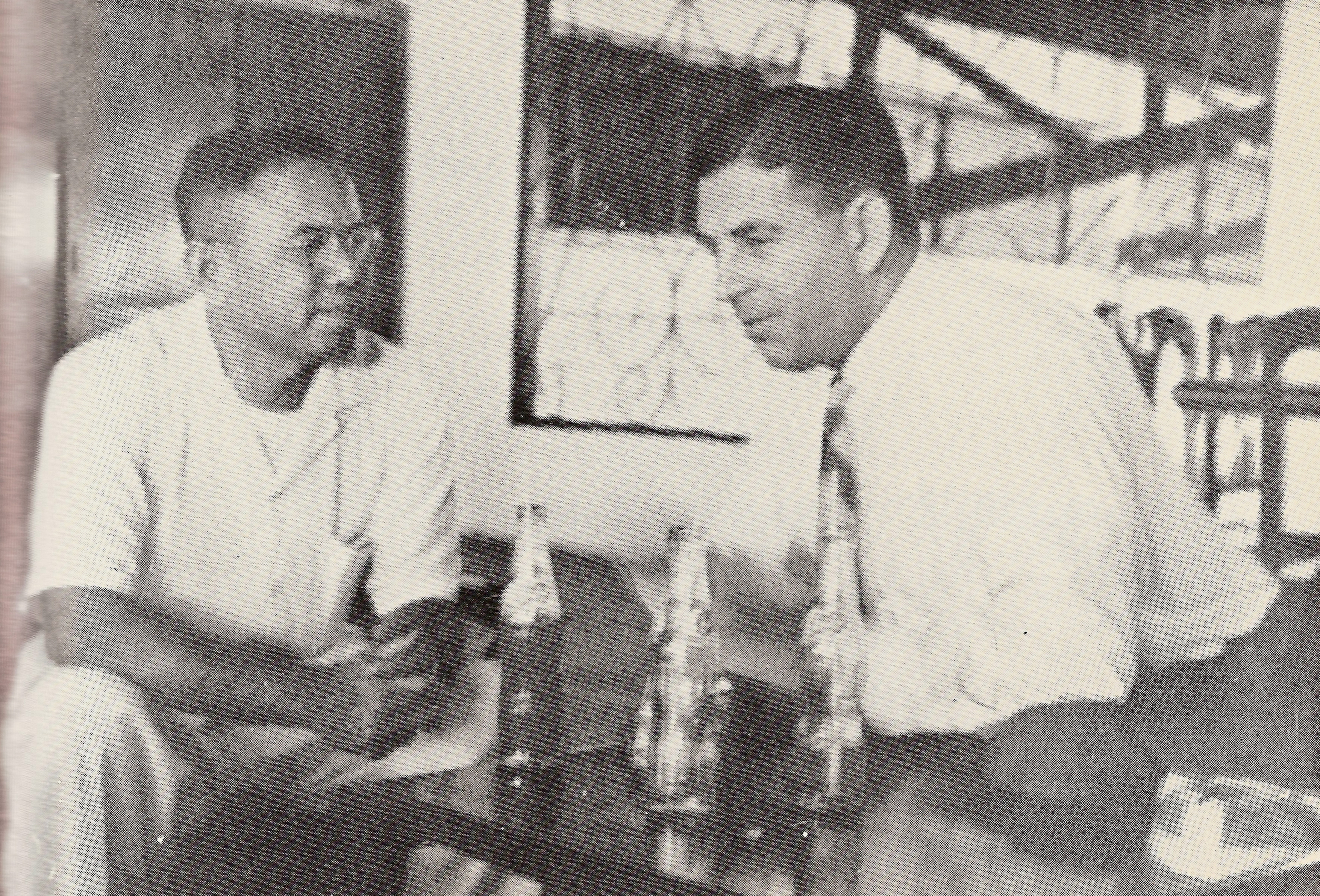
Boon Pong and ex POW in his shop after the war

Boon Pong and ex POW in his shop after the war

He died in January 1982 and in 1988 The Weary Dunlop Boon Pong Fellowship (http://www.surgeons.org/member-services/scholarships-awards-lectures-prizes/international-scholarships/weary-dunlop-boon-pong-exchange-fellowship/) – an Australian exchange fellowship for Thai surgeons, was set up.

Boon Pong is remembered in many memoirs and I have only given a rather scrambled outline here of his contribution to humanity. I apologise for any errors.

*Edit 21/7/20 The only award Boon Pong actually received was ‘the King’s Medal for Courage in the Cause of Freedom, a rare and most prestigious decoration. He was also made an Officer of the Order of Orange-Nassau by the Dutch’. Thank you Nick Metcalfe http://www.nickmetcalfe.co.uk for this information.
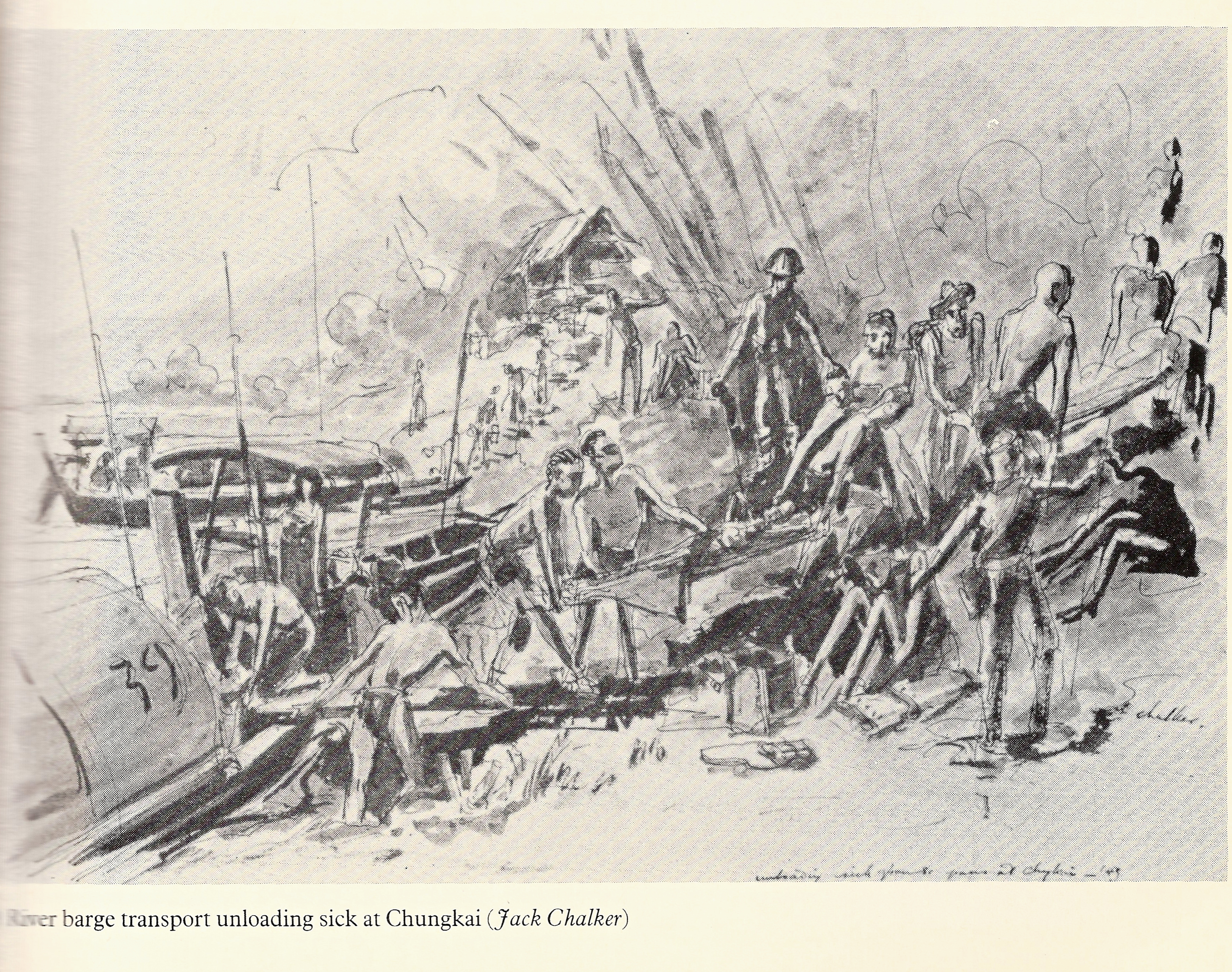
Hospital Orderly, Chungkai – POWs 22

As often happened in the course of 1943 and 1944, the theatre in Chungkai Camp was shut down for a period, because a production had offended the prison guards. During one of these periods Barry remembers:

With the closure of the theatre, I rejoined the group of volunteer orderlies in the ulcer ward and here met Dr Jacob Markowitz for the first time. For some months more and more men with large infected ulcers had been arriving at Chungkai from up-river camps.

Chungkai unloading the sick2

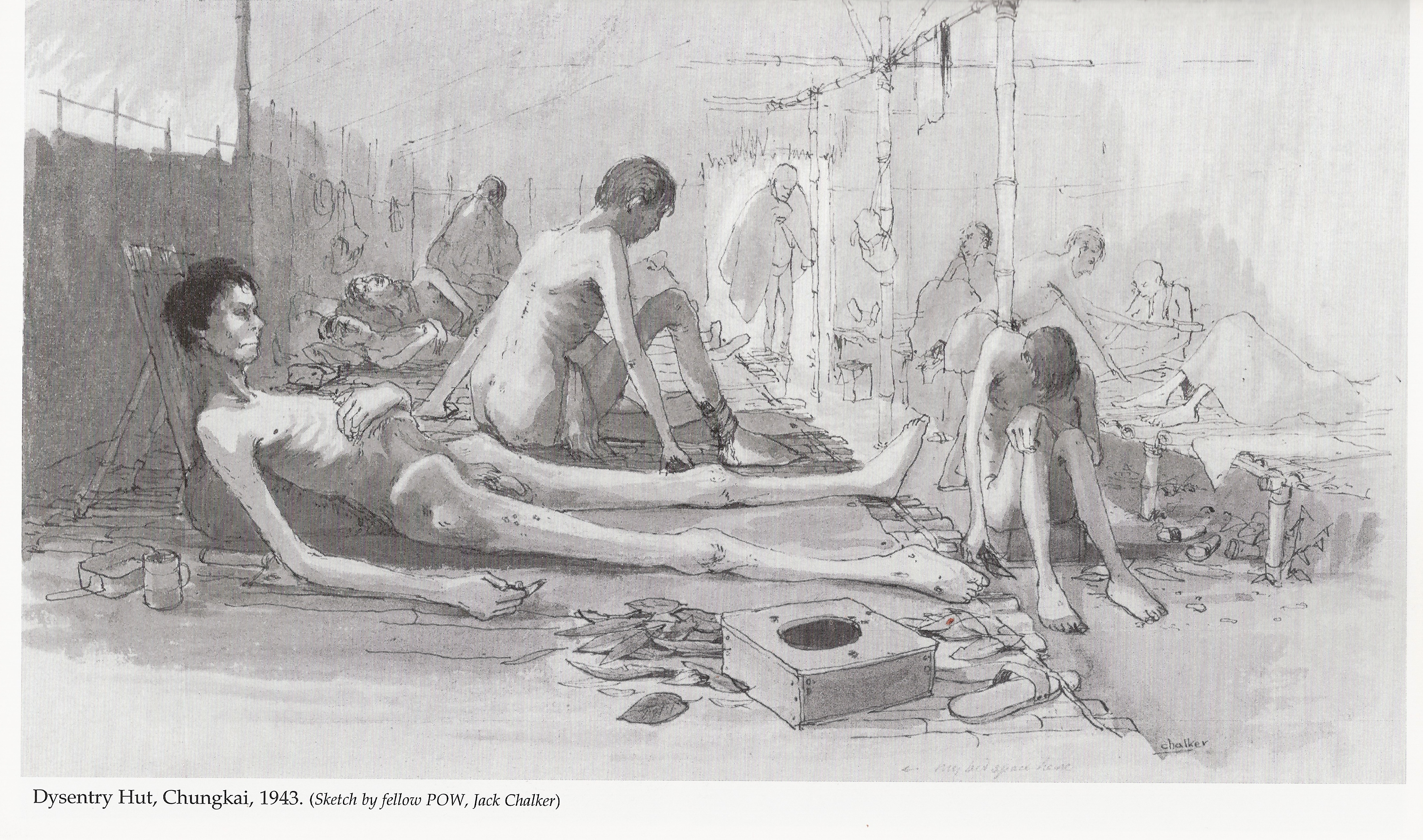
These ulcers were nearly all in the legs and were caused by scratches from the thorny bamboo, which like most wounds in the jungle soon became infected and ulcerated. The doctors decided that when an ulcer patient had a life expectation of not more than a fortnight then the limb would be amputated.

The doctors had a supply of Dental Cocaine and this was used as a spinal anaesthetic, very suitable for leg amputations. As I worked up and down the ward with the other volunteers, cleaning and dressing the ulcers we would regularly be asked “Will it be my turn soon?” Most of the men were anxious to be freed from the misery and pain of an ever-growing ulcer, and were prepared, even anxious, to undergo the risk and pain of an operation.

Chungkai ulcer ward

I worked for a short time as a member of Dr Markowitz’s team. My job was to tend a small fire under a cut-down paraffin can in which the instruments were boiled. We had, as I recall, two scalpels, a bone saw, and several retractors made from table forks. The operating theatre was in the open, without a roof as it was the dry season.

The area was surrounded by screens of rice sacks on bamboo frames. My job was to keep the fire going and to fish out the instruments with homemade bamboo tongs and to lay them on a piece of sterile cloth on a small bamboo side table.

There were no comforting pre-med drugs, so the patient was immediately rolled onto one side and one of Markowitz’s assistants inserted the needle into his spine and injected a suitable dose of cocaine. Marco usually had one or two doctors assisting him. When tests showed that the anaesthesia was satisfactory a very tight tourniquet was placed around the patients upper thigh or groin and the operation proceeded.

I believe about 80% of patients survived these operations, a great advance on certain death in a fortnight. Many of the ulcer patients would have preferred death to a continued endurance of their miserable condition.

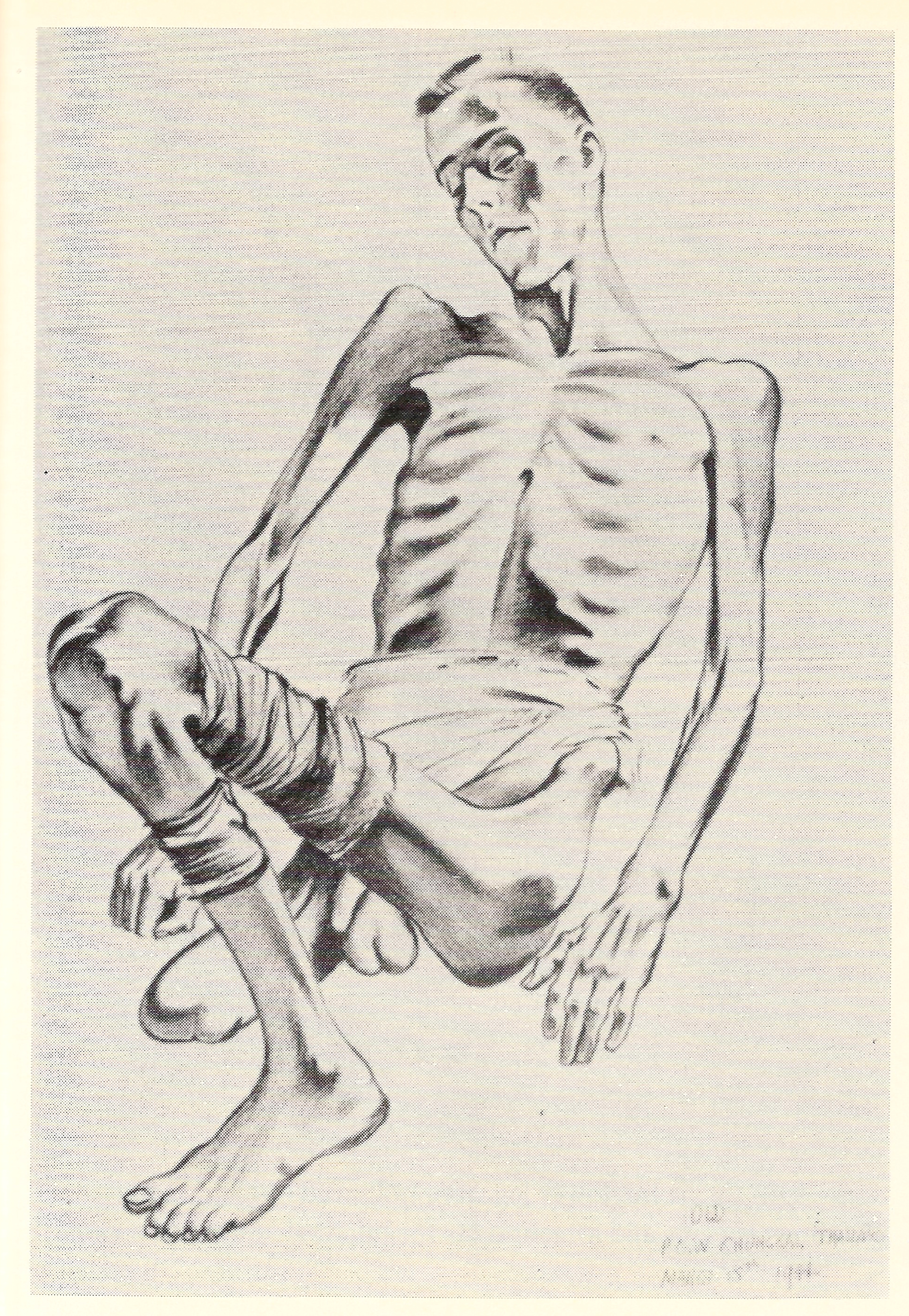
Ulcer patient, Chungkai

Extremely debilitated British soldier – amputation and multiple diseases, Chungkai. Recovered (Old)

There were no painkillers and the next few days must have been agonising after the anaesthetic had worn off. These patients, referred to as the “Amputs”, lived all together in a separate hut and no doubt comforted one another. By the end of the War most of the survivors were getting about on some sort of bamboo prosthesis.

Goods for these and other operations were supplied very secretly by Mr. Phi Boon Pong, a Siamese merchant and barge trader.

Boon Pong and other members of his family were crucial in the delivery of life-saving supplies through the underground to some of the camps. Many, many prisoners owe their lives to him.

Boon Pong Sirivejjaphand

Boon Pong Sirivejjaphand

Christmas 1944, Chungkai camp – POWs 21

Barry and several of the remaining men of 27 Line Section were still In Chungkai Camp at the end of 1944. Barry was still involved with the theatre at this time. He recalls:

Towards Christmas 1944 I was back in the theatre with Leo Britt’s company… At Christmas itself with the help of Gibby Inglefield, who had been a choral scholar at St. John’s Cambridge, the stage carpenters built a set of choir stalls, which were set diagonally on the stage and lit from the front so that they seemed to disappear into the darkness of a chapel. On the night, one night only, the choir was placed in these stalls hidden behind a mosquito netting gauze curtain. A radio announcer with a microphone in his hand stood alone in front of the curtain and told the audience that a radio broadcast of carols from King’s College [Barry’s old college] would now be presented. The gauze curtain was raised just like a pantomime transformation scene and disclosed a group of choristers in white surplices lit up by our two Tilly lamps and little oil lamps disguised as candles, in a row of stalls which really did appear to stretch away into a dark interior. Members of the audience told me that the illusion of the interior of a College chapel had been very convincing and nostalgic.

All the men, captives and captors, never mind their religion or lack of it, were profoundly moved by this.

Two tricky reads

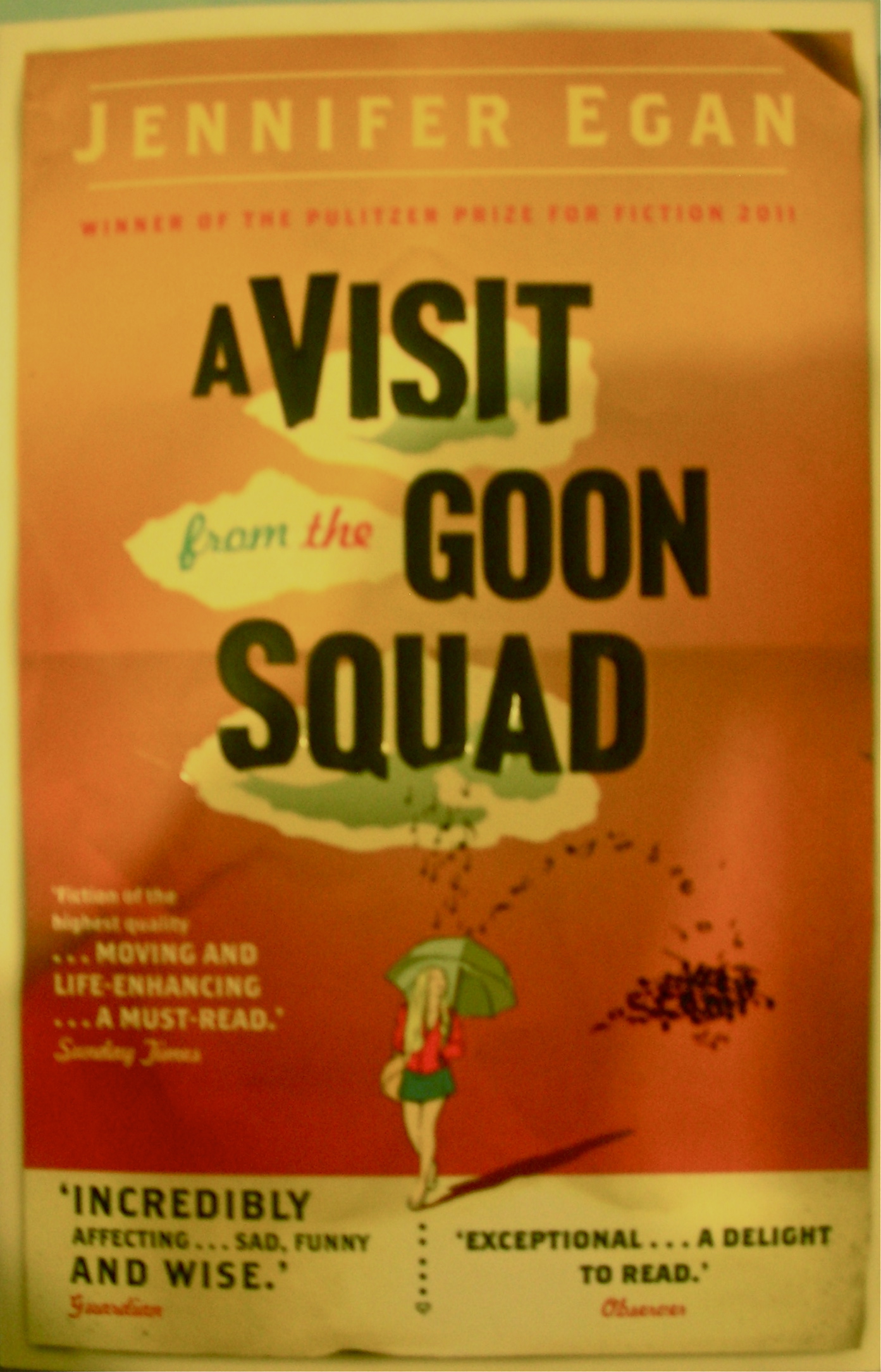
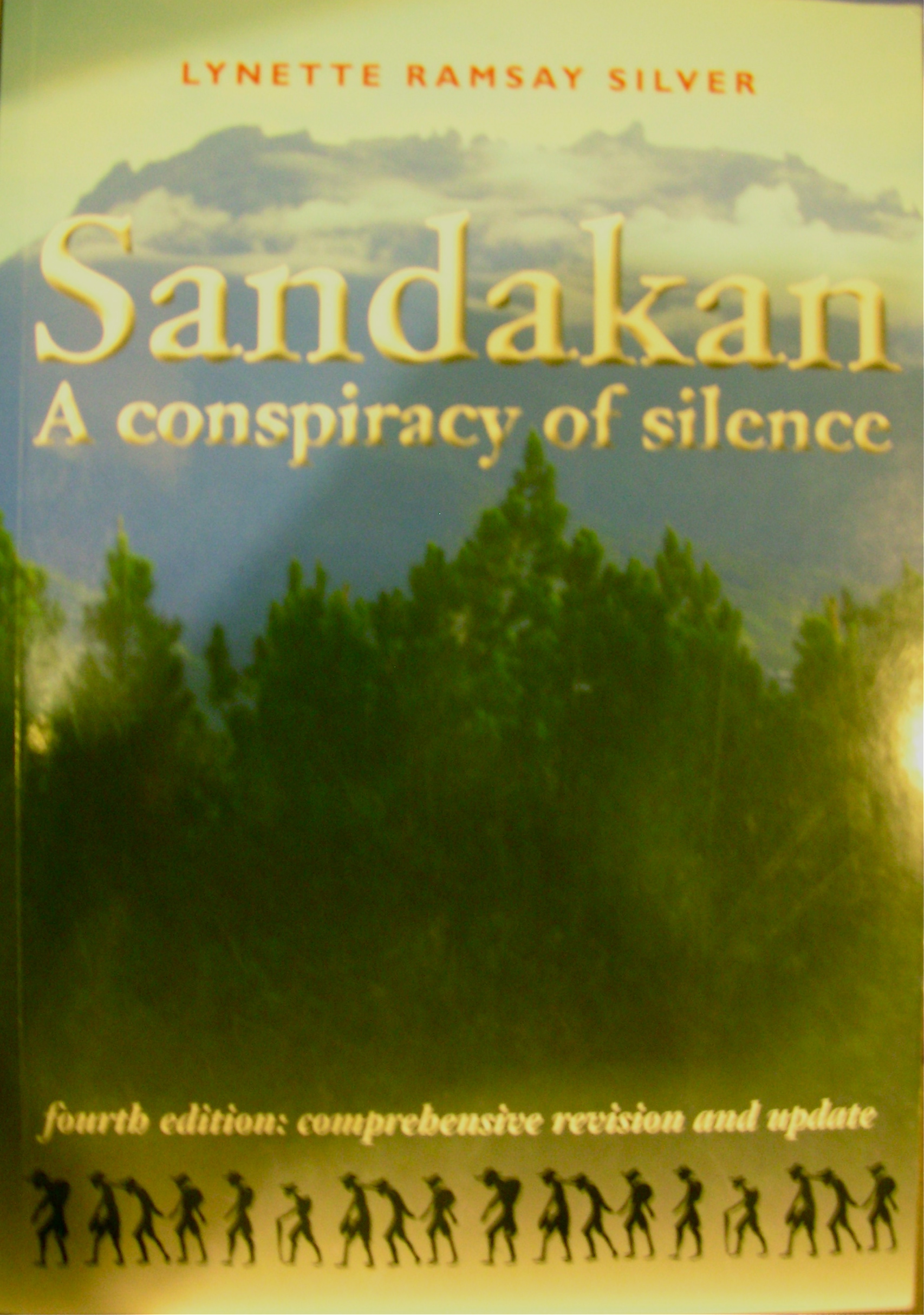
These two books, A Visit from the Goon Squad by Jennifer Egan and Sandakan A Conspiracy of Silence by Lynette Ramsay Silver, are both important, admirable, interesting to read and yet painful in different ways.

Jennifer Egan’s A Visit to the Goon Squad came with starry recommendations from many sources. The writing is sharp, uncomfortably realistic and funny. It tracks forwards and backwards through the individual lives of a group of people who all have connections with each other. For me, the milieu – the American music and celebrity scene from the 1960s to some terrifying future – is strange and alien.DSCN4543 - Version 2 So, as a reader I felt a bit of an outsider peering through the bars in a zoo. Only occasionally could I empathise with the characters.

This distance vanishes with the graphic section (flow charts, not comic strips) of the book (set in the year 202-). This is a child’s diary and also a brilliant description of day-to-day family life with an autistic sibling. I loved this, it is 3D writing at its best, it has the concentration of poetry, but an almost sculptural structure.

Did I enjoy this book? Not really, but I am immensely glad I read it.

Lynette Ramsay Silver’s Sandarkan, A Conspiracy of Silence (4th Edition), I bought for research purposes. It is the story of the death by disease, malnutrition, brutality and outright murder of 2428 POWs in Borneo during WWII and the failure of Allied plans to effect any rescue. The majority of the men, 1787, were Australian, but the among the 641 British were four young men from Barry’s 27 Line Section. DSCN4542 - Version 2There was a total of six survivors, all Australian. This book is a monument to the memory of these men and to painstaking research. Every name, every known detail of the men, their lives, their deaths, the recovery of bodies and possessions littering inaccessible jungle areas and their burial, has been uncovered and recorded.

My research has made me familiar with the worst deprivations, diseases, brutalities and appalling working conditions of Far East POWs in WWII. So as I started reading about the Sandakan POWs, the early years of their incarceration, though grim, seemed better than for POWs on the Thailand-Burma Railroad. From late 1944 onwards, however, their lives grew unspeakably awful and death inevitable. Large numbers of the men were marched in groups across impossible territory until they fell out and either died or were despatched by their guards. Others were starved to death, massacred in Sandakan or even killed by allied bombing.

The book is even more painful to read because, with hindsight, we know that all their attempts to survive were futile. The ones who died early on were the lucky ones. Even worse is the knowledge that rescue attempts, planned but cancelled, could have been successful.

I am in awe of the monumental task undertaken by Lynette Ramsay Silver and very grateful to her for the scope of her grim, but I hope rewarding, research. For me it has been necessary, but anguished, reading.

Phyllis and the War Office – POWs 20

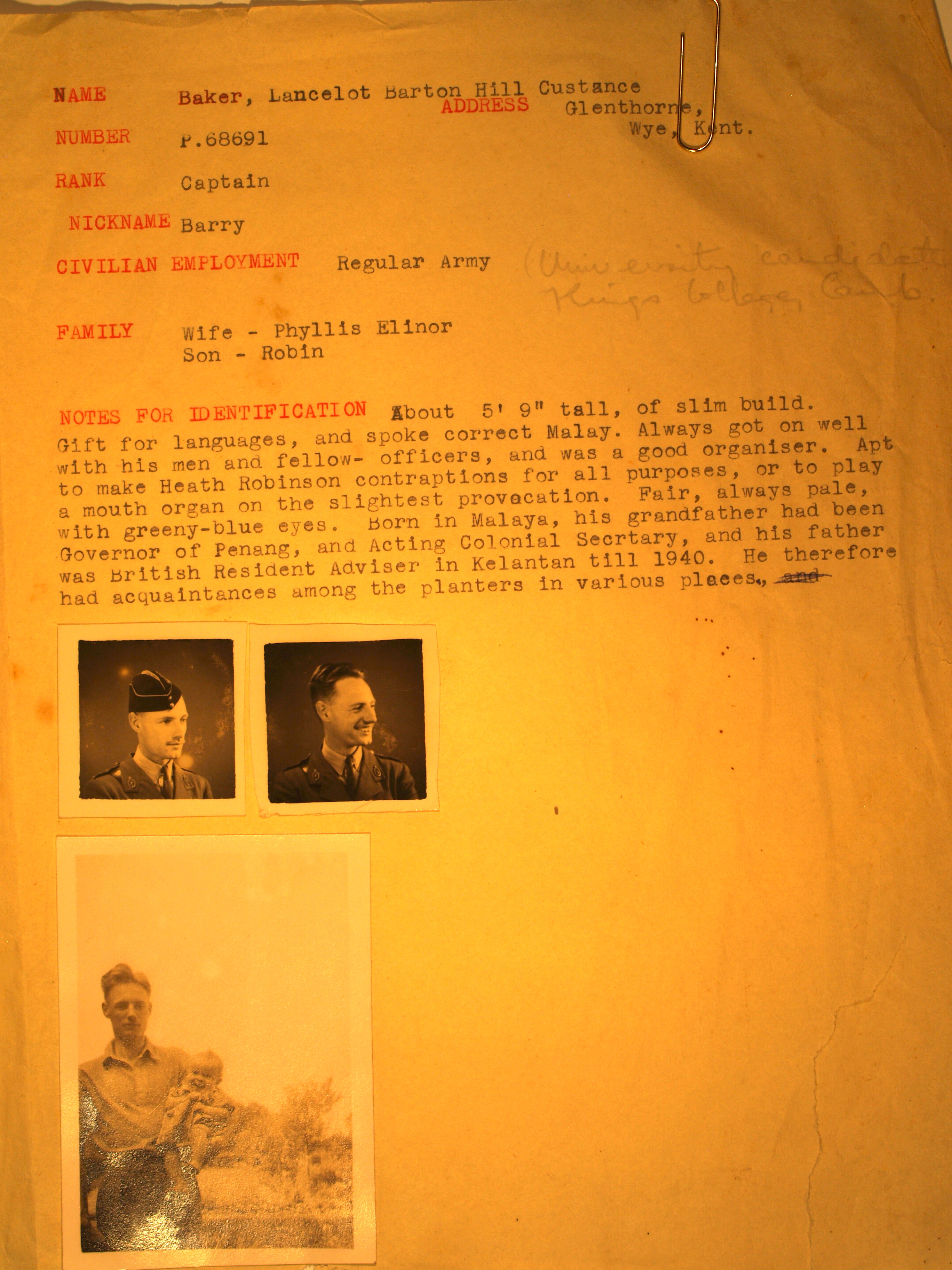
Page of Dossier for War Office

Page of Dossier for War Office

In September 1944 the Hofoku Maru (http://www.wrecksite.eu/wreck.aspx?59634), one of infamous Japanese transport ships (hellships), suffered aerial bombardment from the Allies. Among some 150 prisoners rescued, about 60 were British POWs from Thailand, including men from the Royal Corps of Signals. Interest in their accounts was intense. The War Office planned to debrief each survivor to try to ascertain the fates of the 40,000 British troops missing in the Far East.

Phyllis, thinking about Barry’s men, contacted the War Office. She realised the immensity of their task in finding out about the thousands of missing men from the few rescued individuals. With the help of Queenie, the wife of Lieutenant Robert Garrod, she decided to compile a dossier with personal details and if possible photographs of the men in 27 Line Section for use in the debriefing sessions. She wrote to relatives the replies flooded in.

Dear Mrs Baker,… it does certainly help to know that someone is personally doing their best for us. … Your heart must ache many a time like mine and we can only pray for strength to bear it. I am enclosing a snap of my husband [George] taken in Malaya soon after they arrived there, I have marked my man with a cross. He is of average height about 5’5” and of a slim build. His hair is medium brown and blue eyes. The only prominent feature is his nose, which is rather big.

In civilian life my husband was employed at John Walton’s Bleach-works, a firm which belongs to Tootal, Broadhurst, Lee, Co. Ltd., but which always goes under that name. His dept at that time was Anti-Crease, you will remember Tootals Products are famed for their crease resisting properties, that was a part of his job, treating the material to be crease resisting.

(George had already died on the Railway, probably of dysentery, on 8 August 1943)

Dear Madam I am writing on behalf of my sister Mrs Bamford as her and her husband is no scolar and I have to do all the writing for them, now in regards to her son William Bamford which is a prisoner his Mother had a card from him last July 1944 to say he was alright working with pay … as far as we know he had no nick name just Willie he did not speak very clear the last time we seen him but he had false teeth before he went oversea but we did not have the pleasure of seeing him with them in before he went away, … now I do hope and trust you may be able to send his mother some good news concerning her son as he is their only child and they are just living for their boy.

(Willie had already died of septicaemia from a tropical ulcer in Tha Khanun on 30 September 1943. Willie was, according to another POW, a: ‘Good kid, 100% well liked by everybody. Died quickly’.)

Sometimes the information was lost in an outpouring from desperate relatives.

Dear Madam,    In the first place I am not very good at letter writing, so I must ask you to excuse me if this is badly written…

He is my Grandson and I brought him up from a Baby having lost his mother and father. and unfortunately I lost my Husband so I was forced to put him and his brother into the National Childrens Home and he had just finished serving his time at the printing Trade, when he was called up. so I don’t think I have seen him for about 3 1/2 years. in the first place he was sent to Malaya, and no doubt you know what happened their, when the Japanese got their. So having received that card at Exmas it is a little bit assuring don’t you think so, although they are such a long time before they reach you, one never knows as they are not dated, as their is a person who lives close by me, and I believe her Husband is in Siam well he wrote her a card in May and she has only just received it. But I must tell you that I send him a Japanese P.C. one a fortnight and I address it as this. A.H. Newton 2361041. Signalman, British. P.OW. Sandaka. Borneo, and I also have to put my address, but of course whether he receives them or not that is another matter, but it is not for want of trying for I do my best. and occasionally I write to the Red Cross in fact I sent to them at Christmas asking them to put a message of 10 words through for me so you see I am not backward in doing all I possibly can to try and let him hear from me.

I am every so sorry for the Relatives and friends of all those poor fellows that were on that Ship In fact for all those who are going through such a terrible time in this bitter cold weather, it is Heartacheing when you think of it all. not only our poor fellows but all of them, that has been done to Death, I sometimes wonder why God lets such things happen, although we have been bombed out of our home, that is nothing compared to what they are going through. I am sorry to say that I only have one Photo of my Grandson and that I cannot spare, but I have one that was taken at the Home if you would care to see that. Well I think I have told you all I know, and I wish I knew more, but I do hope what I have said is correct so I will just go on living in hopes and trust in God and pray that we may come together in not so long a time so wishing you all success in your most trying work…

Phyllis extracted all the information from the letters and made a page for each man (including many not on 27 Line Section). Finally, on 12 January 1945, Phyllis went to the War Office and handed in her dossier to a Mr Rogers. He did not know this at the time, but he was going to hear a lot more of Phyllis between now and late 1945.

More pages from the dossier.

OLYMPUS DIGITAL CAMERA

OLYMPUS DIGITAL CAMERA

OLYMPUS DIGITAL CAMERA


OLYMPUS DIGITAL CAMERA

Chorus Girl – POWs 19

In Chungkai camp over the period late 1944 to early 1945 there were some highlights in the POWs lives, in particular the theatre provided not only distraction but some lifelong happy memories. Barry remembers:

In the summer of 1944, one of the Dutch POWs started a concert party and built a small stage. I was co-opted into the early productions as a stage carpenter and odd job man. Later on a fine new theatre for plays was built and used by several different groups of producers. As a small slim, handsome young man and a good dancer, my true potential as a chorus girl and romantic actress were eventually recognised. Most of the shows were mixed variety concerts with a line of chorus girls.

Cast includes Bob Garrod & Barry (Custance Baker)

Cast includes Bob Garrod & Barry (Custance Baker)

Leo Britt, a Corporal in the RASC, put on a number of straight plays in which I had minor parts. Leo was very strict with us ‘girls’. Report to the theatre after first rice and from then on wear skirts and high heels to become used to moving like a woman. Some of us became anxious that we might possibly be becoming ‘too too’ girlish, and to prevent this we kept a stock of barbells and weight bars (bamboo and logs) behind the stage, which we could lift from time to time as an assurance that our manly muscles were still there.

The parts for the plays were either copied out from books, which we happened to have in the camp, or more often written down by someone who knew the play well from having acted in it or produced it before the war. In my best scene (in Hay Fever), twisting around on a very hard bamboo sofa with the host, I was often worried that our kisses might cause giggles or rude comment, but we got away with it and the host, Leo himself, once whispered to me, “They’re taking it OK, do it just once more”. So we did, and the Japs who came every night and sat in the front row just loved it.

A small part with Dickie Lucas, the main leading lady at the time in a Café Colette show has given me my best-loved anecdote. We did a dance routine to the tune of “Yam” a popular song of the thirties. We danced separately and then as a pair, finally in the chorus line. When walking back to my hut after the show I overheard two soldiers, one of whom I knew, discussing the show. “Those two fucking tarts, they were more like real fucking tarts than any fucking tarts I’ve ever met”. My best theatre crit.

Other members of Barry’s original unit, 27 Line Section, who fetched up in Chungkai, were also stars of the stage. His lieutenant Bob Garrod acted in a very successful production of “Night Must Fall” in June 1944.

Night Must Fall  Chungkai Theatre

Night Must Fall Chungkai Theatre

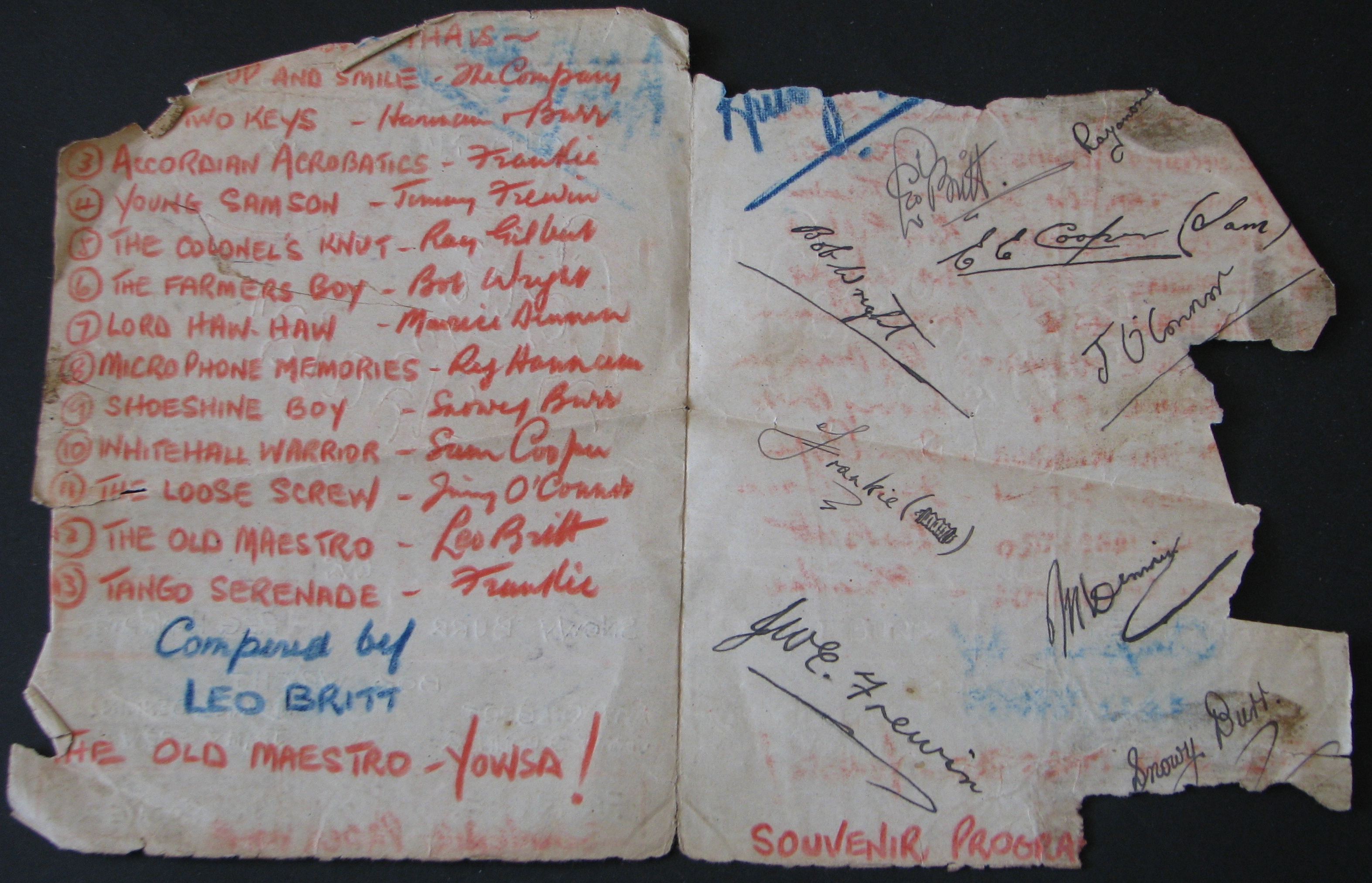
Meanwhile another member of the unit, Reg Hannam, was still on the railway driving lorries on maintenance work and in spite of this also performing regularly. His son (also Reg Hannam) found concert programmes for shows in Brankassi Camp at 208 km up the line. There was clearly a flourishing cabaret act in which Hannam and his friends performed to entertain their mates.

Reg Hannam in Love Thais

Reg Hannam in Love Thais

It is difficult to overestimate the morale-boosting effects of theatrical performances. The enthusiasm and dedication of those who performed were crucial to the survival of many of their fellow POWs. How much these events mattered can be seen by the fact that such fragile mementoes were preserved.

The cast of Love Thais

The cast of Love Thais

WWII letters across the world – POWs 18

In January 1944 , in response to a circular letter from Phyllis to the relatives of Barry’s men in 27 Line Section, several of them wrote back to say that they have had cards from their men. Although one wife writes:

…You see, Mrs Baker, I received a postcard from my husband in August but it had taken a year to come from the time of writing and he was fit and well then, next came the War Office communication confirming that he was a P.O.W. [more than a year after he went missing].

Just a few weeks later the War Office notified me that my husband had died from malaria in Thai Camp and that the date of his death was unknown…

While devastating for this family, this information may have given false hope to others, thinking that if they had heard nothing their men were still alive and well. Phyllis, still without any direct communication from Barry since early 1942, keeps sending the brief permitted typed slips.

Phyllis notes1

This one, sent in January 1944, miraculously reached Barry 9 months later.

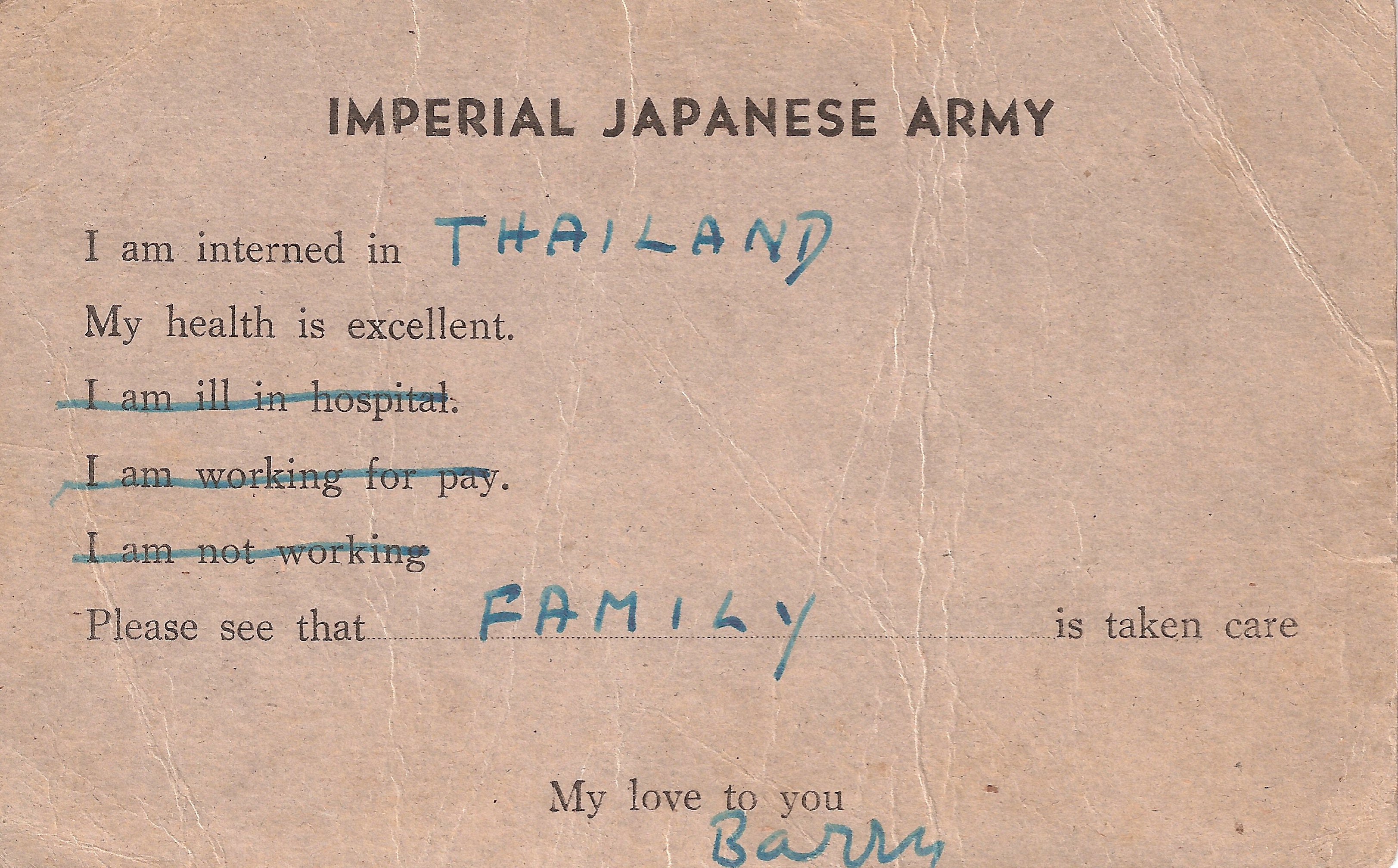
Sometime later in January 1944 Phyllis had her moment of hope, a POW card from Barry reached England. This was addressed to his parents house and the Post Office readdressed it across the Atlantic to Barry’s parents in San Francisco, where they were broadcasting to the Far East in Malay. This small card, having traversed the globe, reached Barry’s parents who then cabled Phyllis with the good news.

BCB POW card1

BCB POW card1R

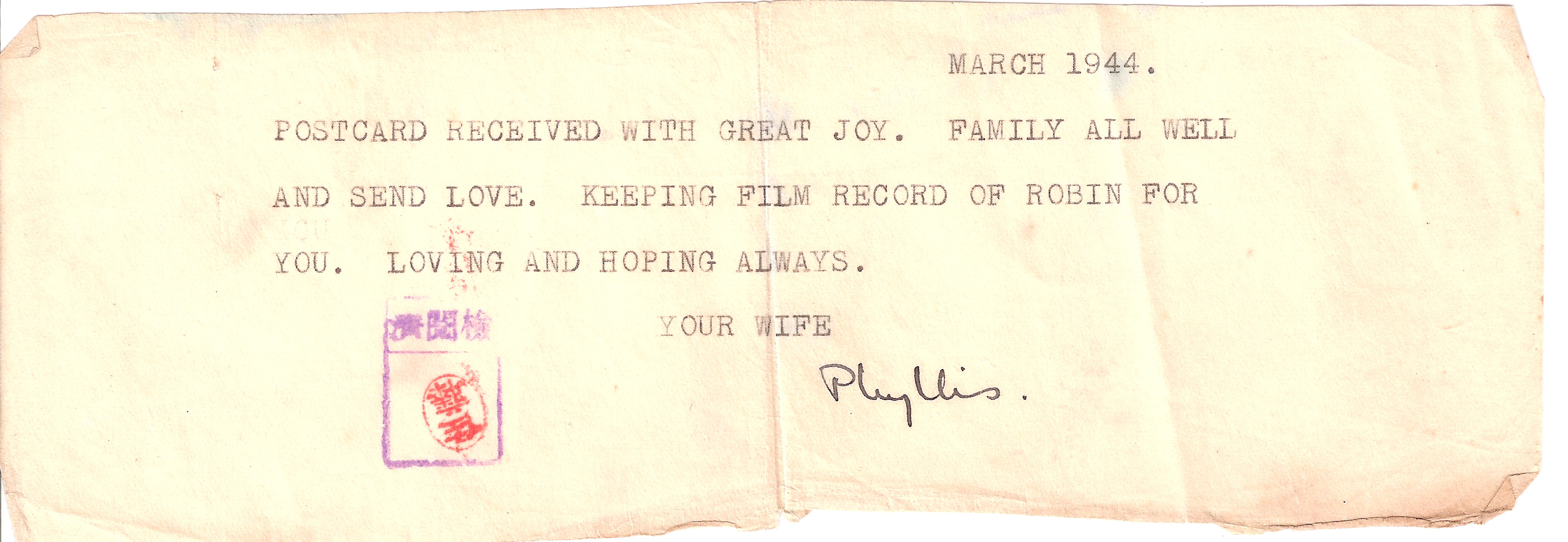
Phyllis was now among the lucky ones, she sent another slip to Barry.

Phyllis notes2

And she shared her joy with the other relatives of 27 line section. This reply, from the wife of one of the men who saved Barry’s life nine months earlier, shows that by now relatives are at least partially aware of the bad treatment of Far East POWs.

Dear Mrs Baker, Many thanks for your nice letter, and let me say how glad I am to know that your husband is safe and in the same camp as my own husband. [Relatives naturally assumed that “Camp or Group 2” referred to a fixed Prison camp.]

Things seem to be moving a bit now, with the Japs getting a foretaste of what’s to come, so maybe a few more blows will make them decide that better treatment of their prisoners would be beneficial.

Also that twenty-five words included the date, which I had not known, so I’m hoping, that my previous notes, have got through.

I was most interested to hear that you have a small son Mrs Baker, as I am very fond of children, and having one of my own, I know what a comfort he must be to you. My little boy is nearly seven, and it’s due to him that I kept going during the long period which his daddy was posted as missing.

It will be a wrench parting from him to take a job, but in the circumstances I think it would be best for you and will help to keep you from worrying. Often I have wished I could take a job myself, but having my father and sister to look after, (they are doing important work) along with my son, I seem always to have plenty to do.

I don’t think any more mail has arrived from the Far East since December, and although it’s unlikely that another postcard will arrive for a time, I’m just longing to hear that the men have received some mail from home.

Badly off as we think we are, it’s so much worse for them, not knowing how things are at home or how their dear ones are faring. Your father-in-law’s remark that the government hasn’t just let things slide, is very heartening, since he is in a position to know, so it’s up to us to be as brave and patient as our men, and who knows, it might not be too long before they return, when we will be able to make up to them a little for what they have gone through.

Hoping this finds you and your little son well and happy.

In late 1944 this correspondence that Phyllis kept up with the relatives became crucial when some Far East prisoners were rescued after the sinking of a transport ship.

From Palembang to Chichester – Singing to Survive

Last night we sat in the beautiful open nave of St Paul’s Chichester as thirty barefoot women filed past and took their places at the altar end. These were the singers of the Chichester Women’s Vocal Orchestra, conducted by Chris Larley about to re-create an extraordinary enterprise of WWII.

In early 1942, civilians caught up in the Japanese invasion sweeping across South East Asia, were rounded up and imprisoned. One group of about 600 women and children, from more than 20 nationalities, existed for the next three years in a series of camps on the island of Sumatra. They suffered starvation, lethal diseases and forced labour. For the full story see:

See http://www.singingtosurvive.com

By late 1943 morale had sunk disastrously and cultural misunderstandings between nationalities flourished. Then two women, Margaret Dryburgh and Norah Chambers, were inspired to create a language-free form of music. They created an ‘orchestra’ by dividing thirty women into four groups by voice (First and second sopranos, first and second altos). They then set well known quartet or even orchestral passages for these voices, using vowel and consonant sounds, but not words. The effect of this ‘orchestra’ on morale, cultural relationships was instantaneous – even their Japanese guards responded to the beauty of it.

Last night the Chichester Women’s Vocal Orchestra, with three members of the cast of Tenko, Stephanie Cole and Louise Jameson speaking and Veronica Roberts directing, performed the story. They used letters, poems and interviews with survivors for the narrative. For the musical passages, the choir used the original settings to recreate the  sounds that the women in this amazing jungle ‘orchestra’ made. They sang pieces such as the Largo from Dvorák’s New World Symphony, Beethoven’s Minuet on G, Bach’s Jesu Joy and many others.

The sound was unique and difficult to describe. It had a silky, liquid quality, softer and warmer in tone than orchestral or even string sounds. In a well-judged direction, we were asked not to applaud until the concert ended. This made the interleaving of story music even more spell-binding and fluent and there was a fully deserved standing ovation at the end.

Hospital reader and Lady Almoner – POWs 17

All through spring and summer of 1943 starving and diseased POWs from the up-country railway work camps (in Thailand) trickled south to the bigger camps such as Chungkai. Barry reached this camp in July 1943 and was soon fit enough to do some work.

My first and simplest job was basically as a storyteller or rather reader. I would take a likely book from the camp library and sit down on the end of a bed space in one of the sick huts, and read a chapter or two. Then I would move down the hut, twenty or thirty yards, and read the same piece to another lot of sick men. This was judged to be a useful employment, so I was never called on to join a maintenance party.

In October the two parts of the railway, Thailand and Burma, joined up at Konkuita and from then on sick and dying men poured into Chungkai transported by barges or on the railway itself. Meanwhile Barry began to enjoy the theatre and concerts got up by enterprising prisoners, but found that:

These jolly functions contrasted harshly with our work in the sick huts, which got steadily worse as more parties of sick and dying arrived from up river. We were burying ten, fifteen, or even twenty every day, and it was disconcerting during my readings to become aware that one or two of my audience were never going to hear the next chapter.

From Peter Fyans biography of Fergus Anckorn: Captivity, Slavery and Survival as a Far East POW, the Conjuror on the Kwai

From Peter Fyans biography of Fergus Anckorn: Captivity, Slavery and Survival as a Far East POW, the Conjuror on the Kwai

He progressed from reader to Lady Almoner

The job of Almoner, or “Lady Almoner” as it was called, involved the actual distribution of goodies bought from the welfare fund, to the sick men in the huts. The most useful purchases were eggs, honey, palm syrup, and occasional pots of vegemite, the Australian marmite. There was, of course, not nearly enough for everyone, the M.O. in charge of a particular hut would give me a list of the men due to receive these extras and the quantities for each one.

I did not at first realise the difficulty of the job but it became clear soon enough. Most of the very sick men got nothing at all because, as the M.O. told me, they would die anyway. The extras, very carefully husbanded, would go to those men who were able to profit from them and might just recover with their help but who would die without. At least I was spared the agony of deciding who got what, but every day I was faced with the need to find answers. “I am much sicker than Joe, Sir, why does he get two eggs this week and I get none?” An unanswerable question to which I had to find some reasonable answer day after day. I talked to the other Almoners and had no comfort from them, all in the same position as I was. “Tell them Orders is Orders, and you are just doing what you are told to do.”

Writing to a Ghost – POWs 16

While Barry is slowly recovering his strength in the big base camp at Chungkai, Phyllis has managed to move out of her parents house. Like so many other relatives, she struggled to write again and again with absolutely nothing coming back. It was, as someone said, like writing to a ghost – which sadly many of them were.

In November 1943 Phyllis wrote:

DEAR DARLING I HAVE NOT WRITTEN FOR SOME TIME, BECAUSE THERE SEEMS TO HAVE BEEN SO MUCH DOUBT ABOUT WHETHER YOU WILL EVER RECEIVE THE LETTERS AND THE MUST BE TYPED [IN CAPITALS] NOW. I HAVE BEEN ABLE TO BORROW THIS TYPEWRITER FOR A SHORT WHILE THIS MORNING. ROBIN AND I MOVED UP HERE AT THE END OF SEPTEMBER AND ARE NOW REALLY GETTING SETTLED IN. I HAVE A VERY NICE SITTING ROOM OF MY OWN. … ROBIN HAS BEEN RATHER SEEDY SINCE WE CAME HERE … BUT IS NOW PICKING UP AGAIN.

Robin

Robin

HE IS, NEEDLESS TO SAY, A CONTINUAL SOURCE OF DELIGHT TO ME. HE IS DEVELOPING IN SOME WAYS VERY LIKE YOU, AND IS REALLY AN INTELLIGENT COMPANION TO GO ROUND WITH NOW, THOUGH THE CLARITY OF HIS VOICE IS MATCHED BY THE DIRECTNESS OF HIS QUESTIONS AND OFTEN EXERCISES ALL MY TACT AND PATIENCE WHEN IN COMPANY, BECAUSE HE NEVER MISSES A POINT OR ALLOWS ME TO EVADE A DIRECT ANSWER. … HE IS ALWAYS TALKING ABOUT WHEN DADDY COMES HOME. … AND WHEN HE COMES HOME AND WE ALL HAVE A …HOME, AND A LITTLE BABY SISTER (PLEASE I WOULD LIKE A LITTLE BABY SISTER) LIFE WILL BE PERFECT.

HOW AM I? QUITE WELL, VERY BUSY, AND GLAD TO BE SO. TRYING TO POSSESS MY SOUL IN PATIENCE, NOT TO THINK WHAT LIFE MAY BE LIKE FOR YOU NOW, AND TO CONCENTRATE ON DOING ALL I CAN FOR YOU NOW BY WHAT I CAN DO FOR YOUR SON. ALSO TO SAVE AS MUCH AS POSSIBLE TOWARDS OUR FUTURE, … TO ONE IDEA I HANG ON FIRMLY, NAMELY THAT YOU WILL NOT BE WASTING YOUR TIME MORE THAN CAN BE HELPED, AND WILL BE LEARNING ALL THAT YOU CAN FIND ANYBODY TO TEACH YOU. ALSO, IF I KNOW ANYTHING OF YOU, YOU WILL BE DOING A LOT OF HELPING OTHER PEOPLE, TOO. SO MANY PEOPLE HAVE SAID TO ME THAT IF ANYBODY COULD ‘TAKE IT’ YOU CERTAINLY COULD. AND THANK GOD I KNOW THEY ARE RIGHT, MY DARLING. NEVER FORGET THAT I LOVE YOU, WILL YOU? EVER YOUR OWN, Phyllis

Sadly, Phyllis has missed notices in the post office saying that correspondence to Far East POWs has been limited by the Japanese to 25 words. Her letter is returned by the  censor.

Her next communications look like this.

permitted Far East POW letters

permitted Far East POW letters