The creative process?

I’m having a strange experience. Yesterday I finally gave myself permission to play with the novel I started writing in March – and haven’t touched since April. I love this phase, when ideas are in free play with no worries about the end product.

I have two scenes in Paris in 1947 and 1958 and I can hear Edith Piaf’s Milord playing in the background. There is an office in modern London and a house in Highbury, some digs in wartime (WWII) Oxford, a scene somewhere in America (seriously vague that), a musical mishap in Moscow with comic overtones. Some drafts are in the first person, some third, some in the present tense some in the past.

In the past I have started with a structure, like the armature of a sculpture, and let the story grow up and around this frame. This new story has a single central figure with plotlines radiating outwards, particularly into the past. I don’t at present see how it will ever shape into a continuous narrative.

Ideas for this book go back several years, and I have been disconcerted to find at least five different opening pages, several vague and/or contradictory plot outlines, some pages of character studies and dozens of unlikely names. There are four people alive and active in one or more of these scenes, but how the two from the earlier period interact with the more recent ones is still mostly opaque to me.

This is an octopus and I really don’t know which arm to investigate first. Actually, it’s more like a piece of knitting, with sections of sleeve or cuff half knitted on different size needles in different colours with different weights of wool.

Since I have created this chaos I should be able to sort out the strands and turn them into a serviceable rope. Hmm. In the meantime, I shall keep on playing Milord.

From Palembang to Chichester – Singing to Survive

Last night we sat in the beautiful open nave of St Paul’s Chichester as thirty barefoot women filed past and took their places at the altar end. These were the singers of the Chichester Women’s Vocal Orchestra, conducted by Chris Larley about to re-create an extraordinary enterprise of WWII.

In early 1942, civilians caught up in the Japanese invasion sweeping across South East Asia, were rounded up and imprisoned. One group of about 600 women and children, from more than 20 nationalities, existed for the next three years in a series of camps on the island of Sumatra. They suffered starvation, lethal diseases and forced labour. For the full story see:

See http://www.singingtosurvive.com

By late 1943 morale had sunk disastrously and cultural misunderstandings between nationalities flourished. Then two women, Margaret Dryburgh and Norah Chambers, were inspired to create a language-free form of music. They created an ‘orchestra’ by dividing thirty women into four groups by voice (First and second sopranos, first and second altos). They then set well known quartet or even orchestral passages for these voices, using vowel and consonant sounds, but not words. The effect of this ‘orchestra’ on morale, cultural relationships was instantaneous – even their Japanese guards responded to the beauty of it.

Last night the Chichester Women’s Vocal Orchestra, with three members of the cast of Tenko, Stephanie Cole and Louise Jameson speaking and Veronica Roberts directing, performed the story. They used letters, poems and interviews with survivors for the narrative. For the musical passages, the choir used the original settings to recreate the  sounds that the women in this amazing jungle ‘orchestra’ made. They sang pieces such as the Largo from Dvorák’s New World Symphony, Beethoven’s Minuet on G, Bach’s Jesu Joy and many others.

The sound was unique and difficult to describe. It had a silky, liquid quality, softer and warmer in tone than orchestral or even string sounds. In a well-judged direction, we were asked not to applaud until the concert ended. This made the interleaving of story music even more spell-binding and fluent and there was a fully deserved standing ovation at the end.

Hospital reader and Lady Almoner – POWs 17

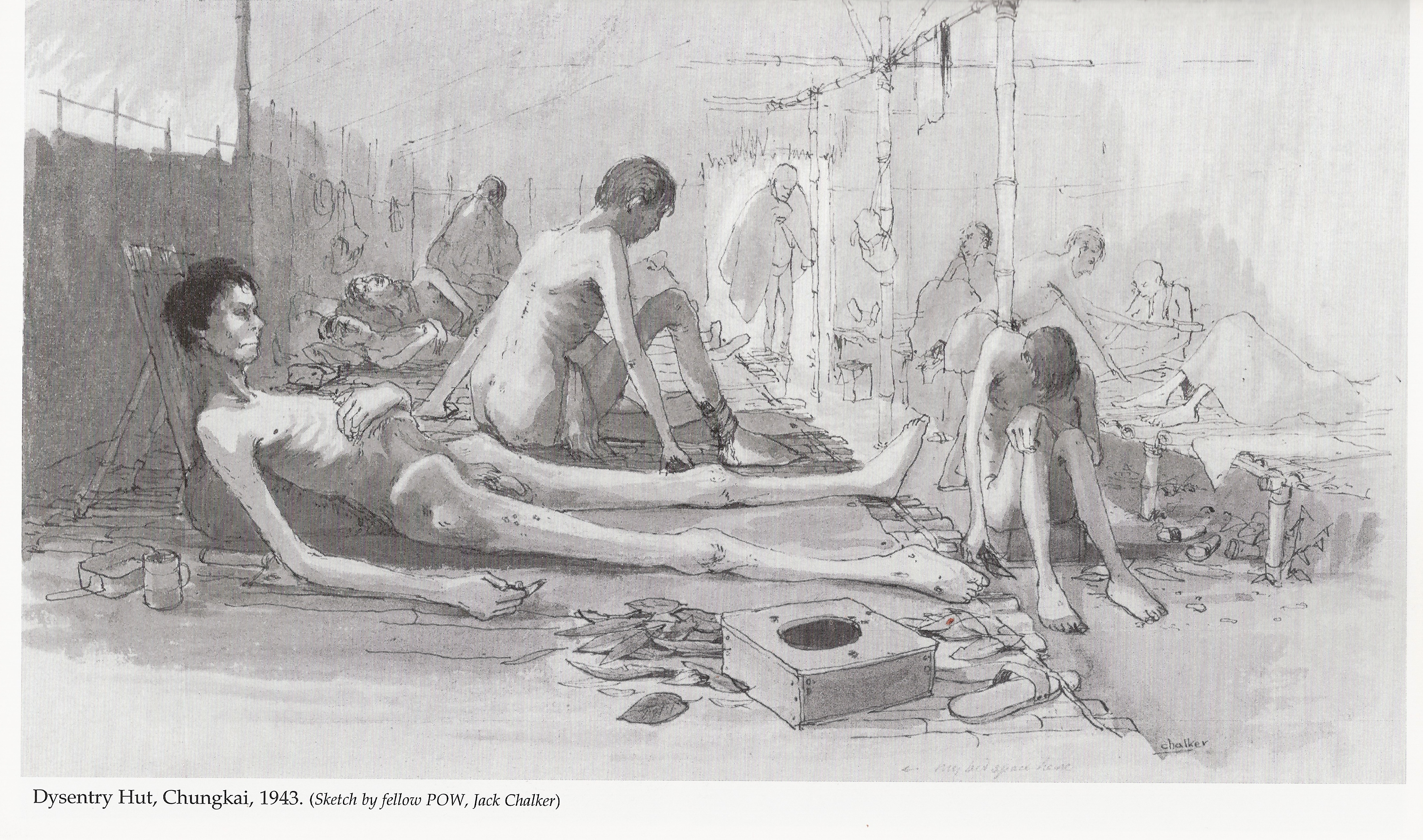
All through spring and summer of 1943 starving and diseased POWs from the up-country railway work camps (in Thailand) trickled south to the bigger camps such as Chungkai. Barry reached this camp in July 1943 and was soon fit enough to do some work.

My first and simplest job was basically as a storyteller or rather reader. I would take a likely book from the camp library and sit down on the end of a bed space in one of the sick huts, and read a chapter or two. Then I would move down the hut, twenty or thirty yards, and read the same piece to another lot of sick men. This was judged to be a useful employment, so I was never called on to join a maintenance party.

In October the two parts of the railway, Thailand and Burma, joined up at Konkuita and from then on sick and dying men poured into Chungkai transported by barges or on the railway itself. Meanwhile Barry began to enjoy the theatre and concerts got up by enterprising prisoners, but found that:

These jolly functions contrasted harshly with our work in the sick huts, which got steadily worse as more parties of sick and dying arrived from up river. We were burying ten, fifteen, or even twenty every day, and it was disconcerting during my readings to become aware that one or two of my audience were never going to hear the next chapter.

From Peter Fyans biography of Fergus Anckorn: Captivity, Slavery and Survival as a Far East POW, the Conjuror on the Kwai

From Peter Fyans biography of Fergus Anckorn: Captivity, Slavery and Survival as a Far East POW, the Conjuror on the Kwai

He progressed from reader to Lady Almoner

The job of Almoner, or “Lady Almoner” as it was called, involved the actual distribution of goodies bought from the welfare fund, to the sick men in the huts. The most useful purchases were eggs, honey, palm syrup, and occasional pots of vegemite, the Australian marmite. There was, of course, not nearly enough for everyone, the M.O. in charge of a particular hut would give me a list of the men due to receive these extras and the quantities for each one.

I did not at first realise the difficulty of the job but it became clear soon enough. Most of the very sick men got nothing at all because, as the M.O. told me, they would die anyway. The extras, very carefully husbanded, would go to those men who were able to profit from them and might just recover with their help but who would die without. At least I was spared the agony of deciding who got what, but every day I was faced with the need to find answers. “I am much sicker than Joe, Sir, why does he get two eggs this week and I get none?” An unanswerable question to which I had to find some reasonable answer day after day. I talked to the other Almoners and had no comfort from them, all in the same position as I was. “Tell them Orders is Orders, and you are just doing what you are told to do.”

Readers react in Great Malvern

The pendulum has taken another couple of swings over the weekend. I arrived in Great Malvern (UK) on Saturday and discovered that the book group there were expecting to discuss with me my first book (A Small Rain, 2002, out of print) and not the 2008 Unseen Unsung, which I had prepared. I borrowed my hosts’ tattered copy of A Small Rain for a frantic revision before setting off for the meeting.

We were made very welcome in a member’s home, fortified with a drink and the fourteen of us spread out in her lovely sitting room. Under admirable chairmanship, each member talked about their reactions to A Small Rain and Unseen Unsung, which many had also read. I was able to give explanations and answer individual questions as we went along. After a break for sustaining and delicious nibbles, there was a more open-ended question and answer session about writing and publishing.

For me, to sit among a group of perceptive, enquiring people who have read my two published books and to talk about what works (and what doesn’t) was both a luxury and an immensely helpful experience. I was encouraged to find that they positively relished the complexity of the plots and the variety of subject matter and wanted more stories like this. Several also made a plea (as most book groups do) for a character list because, like many people, they read before sleeping and want to pick up again quickly.

The male protagonist of my first novel came in for some justified criticism for his saintly demeanour and his grating use of endearments. Lesson learnt! On the other hand the child coping with upheavals in his life met universal approval. It gave me great lift that a reader who had never taken to poetry found the selections I used wholly accessible. The writing in my second novel was seen as better paced – a page-turner. They warmed to the main character, a rather spoilt young man, as he lived through the events in the story. Even my dark portrayal of a mother had come off.

I realised with gratitude as I listened and talked, that these intelligent, curious, caring men and women are my readers. This has left me with a glow that will carry my writing forward, and with encouragement such as this, I will get Border Line published knowing that I will have (at least) fourteen readers.

Writing – the swinging pendulum

I have been feeling flattered that a friend across the country asked me to come and be quizzed by her reading group about my book, Unseen Unsung. This was published in 2008, so last week I started re-reading it. I was quite shaken by some aspects of the prose; too dense in parts, too many scene changes. I think if I hadn’t written it myself, I might have had trouble following the plot. I became puzzled, people I don’t know (as well as family and friends) have told me how much they enjoyed this story. Apart from one moment, when I forgot I had written it and the story brought me close to tears, I felt that this was not a book I would recommend to friends.

One outcome of this re-reading was an increased confidence in my new book, Border Line, endlessly revised and now going out to agents. Then, last night, I received an email from another writer – an old and trusted friend. She had been reading my most recent draft and she felt that the majority of my revisions were a disappointment and that I had thrown out what was best and unique about my writing.

Tomorrow night I will travel across the country to find out what a group of strangers made of Unseen Unsung. On Monday I will look at Border Line again and see if I can distil and replace the missing spirit.

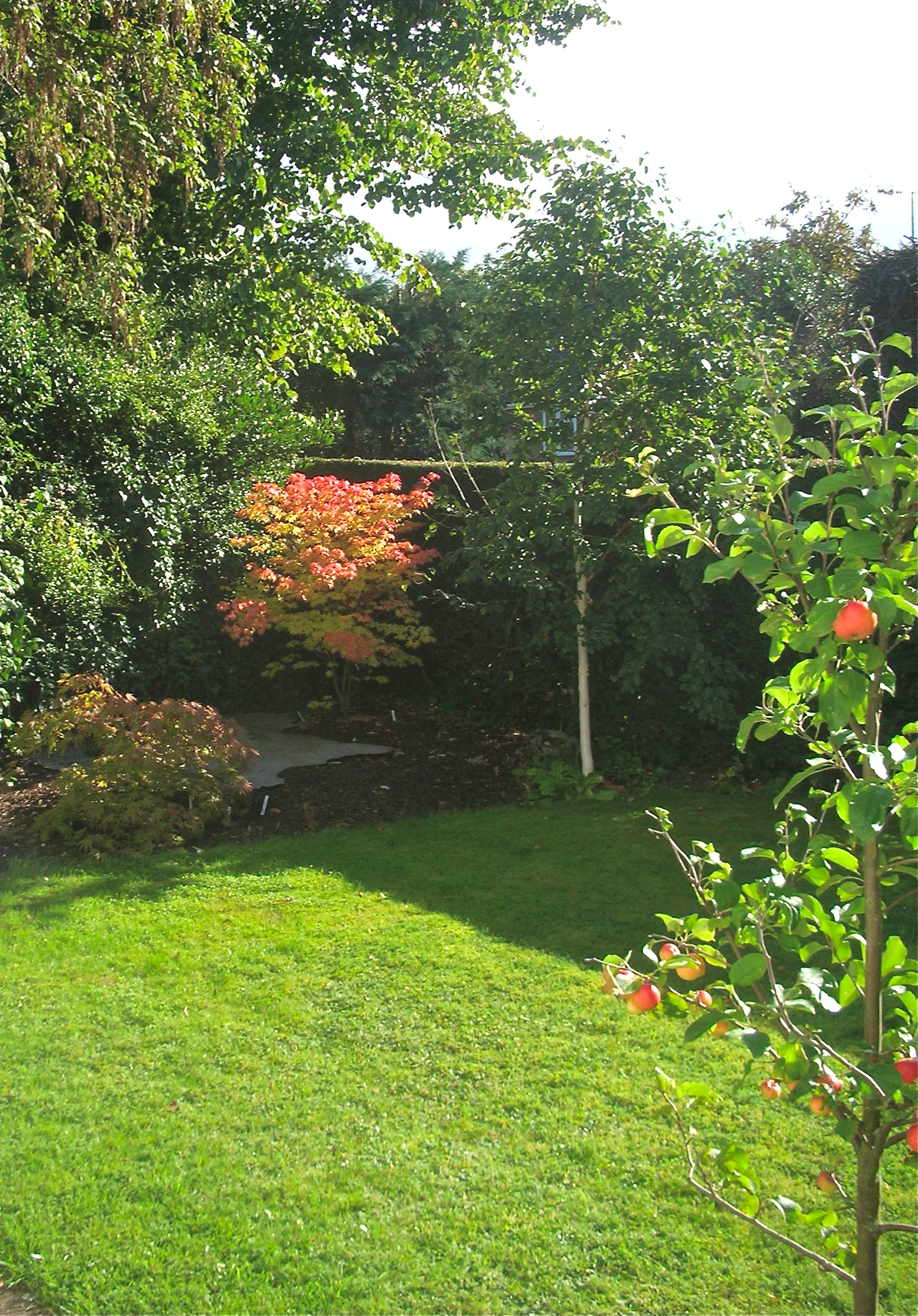
Meanwhile Autumn is quietly going about its inevitable and beautiful business.

Acer palmatum Sengukako

Acer palmatum Sango-kaku

The Dark Lady of DNA

I have just finished reading Brenda Maddox’s autobiography of Rosalind Franklin. I have read it very slowly over several weeks, as it was my entertainment while I stood on a tilted platform for the supposed good of my Achilles tendons. Perhaps it was appropriate to read about her life while standing up. This story of a natural, dedicated, curious, passionate scientist working in a period and against a backdrop in which her sex, her religion, her family, her nationality all contributed to either hold her back, belittle or occasionally encourage her, is a story to stiffen the morale of any woman (and, I would hope, man).

This is not a hagiography; Rosalind could be abrupt, exacting and almost anti-social in some atmospheres, but when among people she respected and, more tellingly, who respected her, she was full of life and fun, much-loved and her company sought after. She was a passionate walker and climber, happily travelling in France (where she worked for several years after the war), Italy and America (where she attended conferences and toured the university labs).

She ended her life in charge of a devoted research team at Birkbeck. Dying of ovarian cancer at the age of 37 in 1958, she worked almost to the last moments, when most of us would have been curled up and nursing our pain. Although known now for her role in the discovery of DNA (not acknowledged in her lifetime), she published innumerable scientific papers, many on coal and graphite and on the tobacco mosaic virus. Obscure subjects but ones of great significance for all of us down the line.

The book is detailed, illustrated and brings this very complex and admirable woman vividly to life.

Writing to a Ghost – POWs 16

While Barry is slowly recovering his strength in the big base camp at Chungkai, Phyllis has managed to move out of her parents house. Like so many other relatives, she struggled to write again and again with absolutely nothing coming back. It was, as someone said, like writing to a ghost – which sadly many of them were.

In November 1943 Phyllis wrote:

DEAR DARLING I HAVE NOT WRITTEN FOR SOME TIME, BECAUSE THERE SEEMS TO HAVE BEEN SO MUCH DOUBT ABOUT WHETHER YOU WILL EVER RECEIVE THE LETTERS AND THE MUST BE TYPED [IN CAPITALS] NOW. I HAVE BEEN ABLE TO BORROW THIS TYPEWRITER FOR A SHORT WHILE THIS MORNING. ROBIN AND I MOVED UP HERE AT THE END OF SEPTEMBER AND ARE NOW REALLY GETTING SETTLED IN. I HAVE A VERY NICE SITTING ROOM OF MY OWN. … ROBIN HAS BEEN RATHER SEEDY SINCE WE CAME HERE … BUT IS NOW PICKING UP AGAIN.

Robin

Robin

HE IS, NEEDLESS TO SAY, A CONTINUAL SOURCE OF DELIGHT TO ME. HE IS DEVELOPING IN SOME WAYS VERY LIKE YOU, AND IS REALLY AN INTELLIGENT COMPANION TO GO ROUND WITH NOW, THOUGH THE CLARITY OF HIS VOICE IS MATCHED BY THE DIRECTNESS OF HIS QUESTIONS AND OFTEN EXERCISES ALL MY TACT AND PATIENCE WHEN IN COMPANY, BECAUSE HE NEVER MISSES A POINT OR ALLOWS ME TO EVADE A DIRECT ANSWER. … HE IS ALWAYS TALKING ABOUT WHEN DADDY COMES HOME. … AND WHEN HE COMES HOME AND WE ALL HAVE A …HOME, AND A LITTLE BABY SISTER (PLEASE I WOULD LIKE A LITTLE BABY SISTER) LIFE WILL BE PERFECT.

HOW AM I? QUITE WELL, VERY BUSY, AND GLAD TO BE SO. TRYING TO POSSESS MY SOUL IN PATIENCE, NOT TO THINK WHAT LIFE MAY BE LIKE FOR YOU NOW, AND TO CONCENTRATE ON DOING ALL I CAN FOR YOU NOW BY WHAT I CAN DO FOR YOUR SON. ALSO TO SAVE AS MUCH AS POSSIBLE TOWARDS OUR FUTURE, … TO ONE IDEA I HANG ON FIRMLY, NAMELY THAT YOU WILL NOT BE WASTING YOUR TIME MORE THAN CAN BE HELPED, AND WILL BE LEARNING ALL THAT YOU CAN FIND ANYBODY TO TEACH YOU. ALSO, IF I KNOW ANYTHING OF YOU, YOU WILL BE DOING A LOT OF HELPING OTHER PEOPLE, TOO. SO MANY PEOPLE HAVE SAID TO ME THAT IF ANYBODY COULD ‘TAKE IT’ YOU CERTAINLY COULD. AND THANK GOD I KNOW THEY ARE RIGHT, MY DARLING. NEVER FORGET THAT I LOVE YOU, WILL YOU? EVER YOUR OWN, Phyllis

Sadly, Phyllis has missed notices in the post office saying that correspondence to Far East POWs has been limited by the Japanese to 25 words. Her letter is returned by the  censor.

Her next communications look like this.

permitted Far East POW letters

permitted Far East POW letters

Mantel’s ghost – my fury

Hilary Mantel – Giving up the ghost, a memoir

This book has roused profound emotions in me. I should wait until we discuss it next week, but by then the iron will no longer be so hot.  Reading it has cured me – possibly only temporarily – of envy and prejudice; it has also aroused in me a retrospective anger on a vast scale for the treatment of women in the past as well as firing me to write better.

This memoir is very short. As I read, I ached with envy over Mantel’s delicious touch with words and her self-deprecating humour. After admitting that she hardly knows how to write about herself, and listing her usual recommendations to writers, she continues:

“Rise in the quiet hours of the night and prick your fingertips, and use the blood for ink; that will cure you of persiflage!

But do I take my own advice? Not a bit. Persiflage is my nom de guerre. (Don’t use foreign expressions; it’s élitist.)”

She takes us back with her to the smells, sensations, fears, confusions and delights of very early childhood. She captures that total sense of being the centre of the world, that we all once had. She hammers on about the family Catholicism that is an unavoidable, and mostly pernicious, influence in her upbringing. She enables us to follow, step by step, as her body is consumed by an ill-defined disease. Her ‘unwellness’ is alternately treated or dismissed by her relatives and doctors.

As a young married woman, taking her body and its persistent pains to doctors, she meets  breathtakingly patronising assumptions: that she will be fine once she starts breeding, that she is perhaps overestimating her intellectual capabilities (as a law student), that she really needs mental treatment – in that period that would be tranquilizers and antidepressants. When these fail to cure her pain, she is hospitalised on antipsychotics and then given the whole pharmacopeia. No one actually listens to her.

In her mid twenties she finally researches and correctly diagnoses her acute form of endometriosis. By the age of 27 she has had a total hysterectomy and a medically induced menopause. In the succeeding years the problem returns crippling her already stick-like body.

Treatment, including steroids, then turns her from a wraith into the substantial woman with which we are familiar. And yes, I tend to make assumptions about substantial people. I try not to, and reading this memoir will help me to greater compassion.

I still envy Mantel her writing skills, but I no longer wish to swap places with her. I think she would have developed her astonishing skills with or without the extreme trials in her life and the sadness induced by her loss of fertility. But I remain furious with the ignorant, presumptuous people who prolonged her pain and made her achievements such hard work.

I think this book should be compulsory reading for all doctors – not to teach them to diagnose better, but to LISTEN.

Sorry, far too long a post, but her courage in writing this tricky memoir should be celebrated.

Invisible DIY, finding heroes, writing and autumn outside

It been a busy week!

Today I relaxed by covering another two wall areas with thin woollen jackets. Our house has a mere nine solid inches of brick between us and the winter storms, so each year we add another layer here or there or another piece of secondary glazing. Some panes arrived with the new magnetic attachment system which works brilliantly (though to my embarrassment I had the dimensions of one of them wrong).

I needed to relax from the excitement of two days of Internet connections. Pierre Lagacé, of Lest We Forget, found a website for me with the story of my airman uncle’s Commanding Officer (http://www.marcusbicknell.co.uk/nigel/). I have been in touch with his son, Marcus, and had a a wonderful and productive email exchange and the blog (http://johncustancebaker.wordpress.com) has now become a rich repository of Mosquito and meteorological lore of WWII.

Signalman William Dawson

Signalman William Dawson

Both these activities have been punctuations in my all out blitz on the manuscript of Writing to a Ghost: Letters to the River Kwai 1941-45. A few weeks ago we visited the museum where some of the materials – letters to my mother from the wives and mothers of my father’s Unit, all Far East POWs – are housed. This time we photographed all the photos my mother had collected. I have been able to put faces to nearly half the men in the story. They are brilliant, but some of them make me weep.  I have also been following a friend’s advice as I worked over the manuscript.

Meanwhile, the sun has come out again and the air is warm, and autumn is raging outside. I want to be in the garden. (We did have lunch in the garden.)

Rosa Mary Rose

Rosa Mary Rose

DSCN4320

Acer palmatum Sengokaku

Acer palmatum Sengokaku

DSCN4321

Beyond the call of duty – POWs 15

As the cholera epidemic raged, the POWs including Barry and the remnants of 27 Line Section were still working long hours on the railway. He remembers:

Towards the end of June 1943 several of us found it increasingly difficult to swallow and digest even the small ration of watery rice porridge that was our daily portion. We rapidly became so thin and weak that we were no longer able to get out to the working site. I carried on for a few days trying to do something useful in the camp or cookhouse, but eventually gave up.

The Japanese commander decided to make up a party of thin useless men and send them south in barges. We were a group of about twenty, I believe, unable to walk and barely able to stand, it was assumed that we would soon die, which most of us eventually did.

The day chosen for the evacuation was a Sunday, one of our rare ‘yasme’ (rest) days. We had about 7km to walk to reach the barges. Two of my men helped me, one carried my pack and I was supported between the two of them. After a short distance we found that we were making poor progress and one of them took me on his back and carried me the rest of the way. The two names of Gibby Douglas and Corporal McWhirter are in my mind but I cannot be at all sure that this is a true recollection.

The first proper camp the sick men reached was Tha Khanun (Tarkanoon). One of the POWs there was Dr Robert Hardie. His diary describes: “a lot of very sick men are coming down from 211 camp in a shocking condition – gaunt spectres of men, riddled with malaria and food deficiencies. One can do very little for these people. They can’t assimilate the sort of food we have except eggs, of which we have very few”.

Barry, and the men who reached this camp alive, were welcomed by:

 a proper reception committee of doctors and orderlies who first examined us very thoroughly to make sure that none of us was carrying a cholera infection and then did whatever they could to restore our strength. After we had been thoroughly tested we were all weighed on a beam balance, built in the camp and calibrated against a 50kg rice sack. My weight, about average for the group, was noted as 5 stone 12lbs, or 37kg.