writer’s balancing act

A rejection yesterday; today a request to discuss my first novel, A Small Rain (out of print), with a book group. In yesterday’s paper a brief article by a literary agent complaining about capricious, deadline missing, needy, rude authors. I want to put my hand in the air and shout, “Please Miss, please Miss, take me instead. I work happily to deadline’s, I don’t do rude, or writer’s block and…” but she’s not listening.

However many books I finish, I always seem to be reading three more. Current trio are Kate Atkinson’s One Good Turn, James Shapiro’s Contested Will (good scholarly look at the history of Shakespeare doubters) and Sue Monk Kidd’s The Secret Life of Bees.

Warm, sunny, windy spring day. Gardened to exhaustion.

Musician’s Lives

This morning I finished 1853 A Year in Music by High MacDonald. It sorted out a whole lot of misconceptions about composers’ and performers’ lives. Liszt, Berlioz, Schumann – Robert and Clara, Brahms, to name only the most famous, were zig-zagging about Germany performing, meeting, talking and planning non-stop. Every now and again they managed some composing. Wagner was exiled from Germany, but they all went to Switzerland or Austria to meet him, or they all spent time in Paris where technically Berlioz lived and worked, he also visited and performed in London. Verdi dropped by, but didn’t meet up with them. It was the amount of travelling they did, both the famous and many others less well-known today, that astonished me.

I had always thought of Brahms as a big solid man with enormous hands. Pianist friends had told me that you needed a giant span to reach his chords. He turns out to be (in 1853) a slight, shy, beautiful young man, with a high voice and modest bearing. Nearly silent in company, but an acknowledged genius both as a pianist and a composer almost from his first appearance. He was also a perfectionist. Many of the compositions played in 1853 were never published as he felt they were not good enough.

Clara Schumann comes to life as both a hardworking pianist/composer and an astonishingly devoted wife and mother. Liszt is a dynamo, moving, stirring, managing, travelling non-stop, composing, playing. Robert Schumann, firing on half his cylinders, a somewhat lost soul, in the last year before his confinement in a mental home. Wagner a frustrated exile, a troubled hypochondriac, full of gigantic plans and dependent on friends, both for society and money.

I just don’t know how they coped with all the travel. It was dizzying even to read about it.

Mad blackbird

This morning we saw a blackbird with a leaf as large as itself (ivy?) disappear into the holly tree outside our front door. This tree is only about twelve-foot high and brutally pruned each year to a ball shape to stop it taking the light out of the front windows. It’s pretty dense, but I have just looked and there is a nest there on eye level for the post man, or anyone else approaching the front door. This is no doubt the same blackbird (female) that does not bother to move if I cross her path while gardening.

DSCN3552

The heap of earth and turfs growing on the front lawn (ready to fill in the new bank after the drive is remade next week) is probably regarded by the blackbird as a permanent meal table. The state of my back may mean she is right as it will be a while before I can move, shovel and barrow it all into place.

I should be writing while the back recovers. I am – sort of, but without any sense of making progress. With two books in full draft all I can do is tinker, make submissions and try to decide when to make the break and self-publish – and check the clock to see if it is time to put on the kettle.

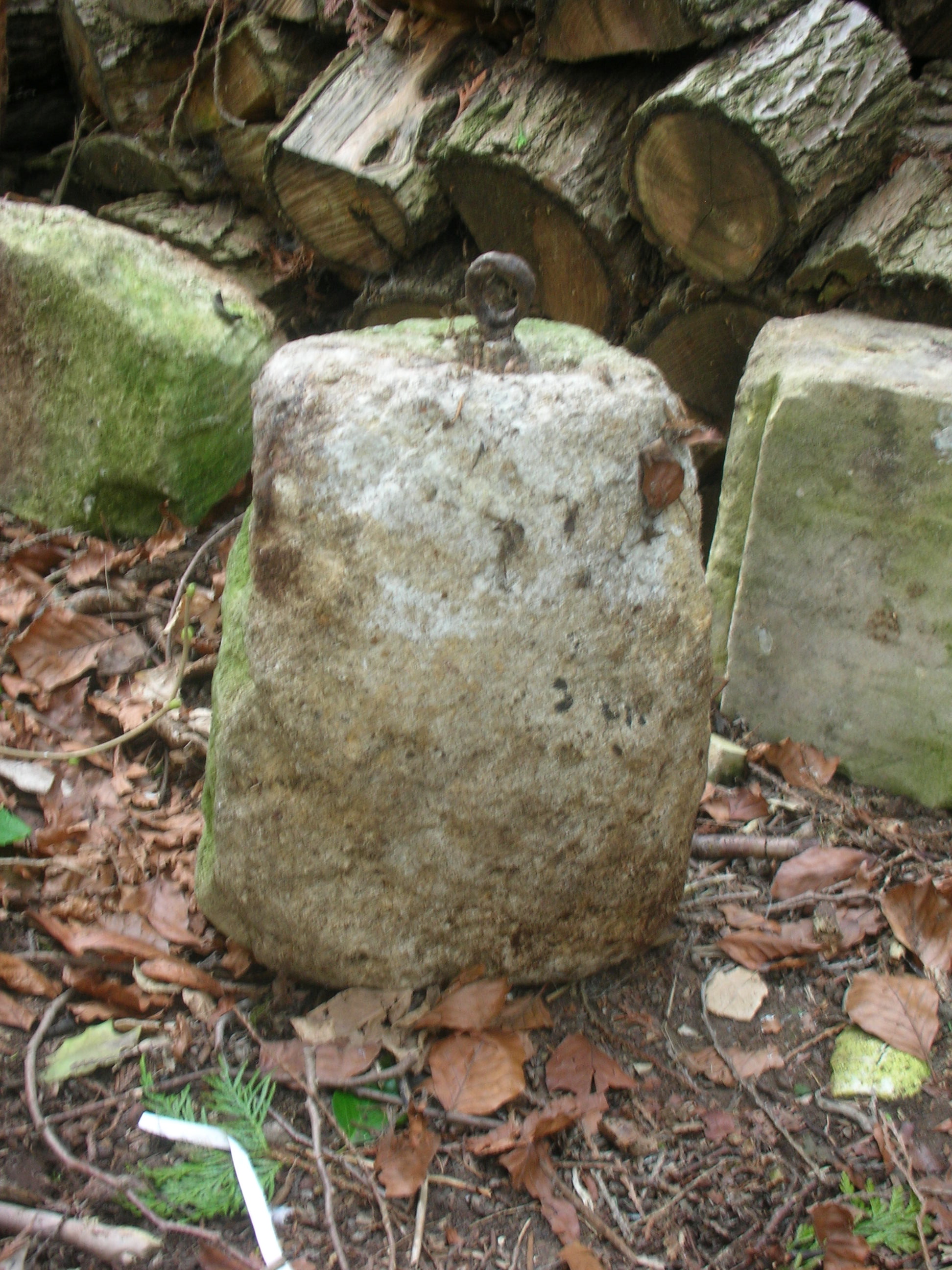
Boulder with iron loop?

The other day EG unearthed many building stones from among the roots of a giant conifer in our garden. We have been here more than 30 years, but still find caches of great rocks and stones and strangely shaped bricks. The orange-coloured one on the right has a cylindrical shape on one corner.

DSCN3538

We are rather curious about this boulder with the iron loop in the top. Any ideas?

DSCN3541

age and procrastination

I have noticed an interesting effect of age. I no longer put off doing a major job properly. So in the garden, finding the protective mortar flaking off the lowest level of bricks in one area – which was in the same state four years ago when I was laying paving slabs there – I know that I must deal with it. I have this feeling with all heavy work in the garden; best to do it now, I may not feel like it in a year or so’s time, and best make a good lasting job of it.

This feeling spreads to other areas not necessarily involving physical strength. There is no longer anything to be gained by waiting for a better/quieter/more mature period in my life. While the tendency to cook up long term schemes and projects has not left me, perhaps I am finally learning to live in the moment.

I read that you should only touch a piece of paper once – meaning that when you open a letter you should answer and file it in one go. Looking at the pile of paper in the box that masquerades as my in-tray, I still have a way to go on that front.

Of course it may not be age at all. I have just finished reading an unpublished memoir of a WWII Far Eastern Prisoner of War (Dishonourable Guest, by W G Riley). Riley is a young Signalman who starts POW life in Changi, works on the Thailand-Burma Railroad, gets transported on the doomed Hokofu Maru troopship, and is one of the 23 Britons rescued in the dramatic Cabanatuan Raid at Luzon. I have read many POW memoirs in the course of the last three year’s research. Elements are the same, but each man’s story is unique. You would have to be very obtuse to reach the end of even one of these memoirs and not learn to appreciate the moment.

Riley made, in his son’s words, ‘anguished attempts to get the work published’. His whole life was affected, not only by his experience as a prisoner, but also by his need to get his  story written and known. It was never published as a book, but his son, Steve, had the second version of the text (the first was lost) typeset and printed 1988. This certainly puts the odd rejection by agents or publishers into perspective.

not all downhill from now on

I can now definitely touch my fingertips behind my back, i.e. one hand over the shoulder the other reaching up – with either hand over the shoulder. A couple of months ago I could only do it one way. This feat can be accomplished in the shower – not sure about elsewhere.

displacement activities and rejection

Over Easter I decided to rearrange my writing room. I have that dream – a room of my own in which to write. It is almost perfect, but, as always, there are compromises. I need to fit into it my desk, which is a large old Victorian pine table, with flaps and a pitted, stained surface, and my mother’s piano – a hundred year old upright, on which I dream of achieving something better than my current Grade II skills – and the double piano stool my father made. There is also a large modern filing cabinet that I share with my husband, a wide bookcase full of poetry, a floor-to-almost-ceiling set of deep shelves (Sally Army) full of files, dictionaries etc. a cabinet, a working chair, a reading chair and an assortment of box files, document wallets etc without a home and a large wastepaper basket. Plus the photos and paintings (all by, or of, friends and family) on the walls.

There is no way all this will fit elegantly into a room 13 x 10 foot square. I don’t attempt elegance, but I am fanatic about practicality. I need to reach or see everything important. I am also keen on a sense of space. I might not have done anything about the urge to move the furniture, if I had not had another rejection for Border Line from an agent. It was very warm and friendly – though clearly a standard email – and they no longer surprise of hurt, but a little displacement activity often ensues.

So now I am sitting sideways on to the wide, low window, looking out onto the new paths and bed I have been working on and yesterday I cleared my desk and continued working on one of Border Line’s less satisfactory characters.

Since drafting this I have moved the piano. This required a certain amount of weightlifting attack, guile and a lot of leverage with undignified positions sitting with my back to most solid object, the filing cabinet. It was only when the piano was finally in position that I realised that I had switched off the socket (now behind the piano) for the much needed lamp. After some pointless fishing with torch and bamboo, waited for EG to come home and help.

All working now and miraculously my back is still OK. Not much work on Border Line, but an important correction in Writing to a Ghost achieved. Unless the weather makes path work possible tomorrow, I will surely WRITE.

Luzon Raid – correction

In the COFEPOW quarterly newsletter, there is a short piece about the memoirs of Signalman W G Riley, Dishonourable Guest. He was rescued on 30 January 1945 by Americans in the Cabanatuan, Luzon Raid. Checking in my newspaper cuttings from the period, I realise that it is this raid in which Thomas Potter was rescued not the later February one. The memoirs are available at the Imperial War Museum or, for a very small fee to COFEPOW, as a PDF via the author’s son. (If anyone wants these try the COFEPOW website http://www.cofepow.org.uk or get in touch with me).

The Reluctant Fundamentalist – part 2

We had a group discussion of Hamid’s The Reluctant Fundamentalist last night and I left feeling faintly troubled. Most people wanted to talk about the subject matter – leading off into all sorts of world views and favourite gripes. I had been knocked out by the use of language and the writer’s skills. One of the consequences of writing, which has both an upside and a downside, is that your perspective changes. You can’t help, even in the most absorbing of stories, becoming aware of the writer’s craft skills. I used to regret that total loss of self as I read, now I relish it.

That wasn’t the only disquiet I felt. I thought Hamid had taken us, very skilfully, by the hand and led us from a world perspective we shared into one that we mostly fail to understand and yet are worried by/curious about. The curiosity and worry were certainly shared by my fellow readers, but I am not sure they had all come on the same journey. Part of this is the assumption that the writer is the protagonist – an almost unshakeable belief held by so many readers – and this led them to mull over who Hamid is, and where his allegiances lie.

Having said that, the story is so concentrated – while appearing to be deceptively straightforward – that each person had noticed (or read about) aspects of the story that the rest of us had missed. I will certainly need to read it again. Perhaps I should lay aside my concern as there was a general vote to read another book by him.

The Reluctant Fundamentalist

Just finished Mohsin Hamid’s The Reluctant Fundamentalist. I am knocked out by both the writing and the story. I don’t know how he does that – keep the prose so spare and yet so vivid and rich. It is as if there is not a single misplaced word in the whole text. I love the way this astonishing monologue sways on an invisible fulcrum between the story and the immediate surroundings. It never jars. There is both dialogue and description and yet only one voice. There are new truths and perspectives. I don’t think you could ask more from a novel.

As you can see it is wipeout for this writer, as I try to look at the quiet engineering behind the prose and attempt to learn something – anything – from this example.