
Wang Po (Wampo), a handmade viaduct – POWs 11

Barry and the men of 27 Line Section, much reduced in numbers but still a coherent body, continued to work their way up the Kwai Noi building the Thailand-Burma Railway. In April 1943 they reached Wang Po (Wampo) Camp.  Barry remembers:

This was to be quite a different “one off” job, unlike the usual jungle clearance and embankment. Wang Po is at the 113 km mark, and when we reached it in early 1943, was quite a new camp, the rains had not started and the camp was quite dry and fairly clean. We were by now dying off quite frequently but not more than one or two each day and we were still on two bowls of rice per day, not one.

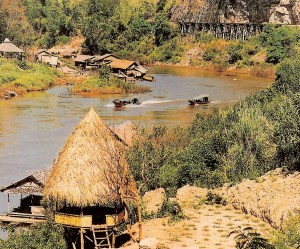
Wang Po area 1980s

Wang Po area 1980s

… near the village of Wang Po the river makes a sudden eastward loop into a rocky gorge that cuts into the line of the railway and here it was necessary to build a viaduct about half a mile long to carry the rails over the gorge beside the river.

Wampo Davies book

Our camp was set up on the west bank, opposite the working site as the gorge made it impossible to build a camp on the east bank. The camp was located on the edge of a forest of teak trees, which were to be the source of timber for the construction. We were a big group, a thousand or more I think… . One half of the group worked on the trees preparing the beams, the rest, of which I was one, worked in the gorge.
Wampo pc3

Our first job was to clear rocks and boulders from the planned route of the viaduct, which we did by drilling and blasting. The holes were made with a rock drill. One brave man holds the drill while two others smite the head of it with sledgehammers. We Linemen were used to sledgehammer work and did not often damage the hands of the drill holder but some of the other parties suffered several damaged or broken wrists. There was no power machinery of any sort in the whole construction, just hand tools.

By the time of the midday tea break our holes had generally gone in deep enough, and while we rested and drank our tea (no midday rice now), the Japanese engineers packed the holes with plastic gelignite and set detonators and lengths of safety fuse in them. There might have been as many as fifty blasts set off at once and it was important, both for us and for the Japs, to make sure they all went off. In the afternoon we shifted all the broken rocks and carried them down towards the riverbank.

When all the boulders had been cleared we set about making the concrete foundation piers, all built by hand with hand mixed concrete. …  which had to be carried to the site on the usual rice sack stretchers. Wet concrete makes a very heavy load. The Japanese engineers had already set up wooden shuttering for the piers… .

I should have mentioned that we had to cross the river from the camp to the site, morning and evening, but as it was in the dry season the water was quite shallow and you could walk on the bottom most of the way and only had to swim in the middle.

While we were clearing the rocks and building the piers, the other half of the group were felling teak trees. Very tiring work, as fresh teak is extremely hard. The trunks when felled were cut to length and then squared up by Japanese engineers using an adze. I have seen one of their engineers square up a log fifteen foot long and around two foot thick in one morning’s work.

When the concrete piers were nearly finished, 27 Line Section and others rejoined the timber party and started the very heavy task of carrying the squared timbers down to the riverbank. The intention had been to float them across the river but some of the POWs who had worked in the Burma teak forests insisted that green teak is so dense it will not float. The Japanese were unconvinced but the first trial proved the point. From then on we swam the beams across the river fastened to bundles of bamboo to keep them afloat.
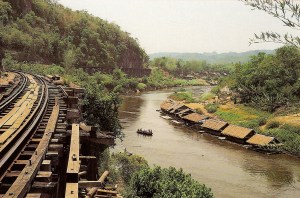
Wampo pc1

A few elephants with their Burmese mahouts helped in this work of shifting the beams down to the river but they were the only powered machinery on the job. They seemed extraordinarily precise, even fussy, in their handling of these heavy loads seemingly without any orders from the mahouts. There were not enough of them, of course, and we had to do much of the carrying ourselves. I reckon these beams must have weighed around 3/4 of a ton (or tonne) each, more or less, depending on their length. At first we tried to get them up on to our shoulders like undertaker’s men with a coffin. But the edges were too rough and sharp, so instead we used the ever-present bamboo poles. Eight or ten stout poles pushed under the beam and then lifted with one or two men at each end and the beam could then be carried down to the river looking like a giant caterpillar.

There were no cranes, simply intricate bamboo scaffolding fastened onto the rocky cliffs above the site and multi sheave pulley blocks fastened to it. A long rope over the pulleys with 50 POWs tailing on to it served to raise each of these beams into its proper position, where they were then all fastened together with dog spikes.

When the trestles were in place, held up by more bamboo props, then the even heavier horizontal beams which connected them together had to be heaved up into place by the same method and then spiked together. With the crudest estimate there must be between 500 and 1000 beams in the viaduct. While we were doing this other groups of POWs had laid sleepers and rails on the prepared embankment and were ready to go on over our viaduct as soon as each section was completed.

[The next section of the Railway had already been completed, so] we POWs who had built it were actually carried forward for a short section of our next march in railway trucks over the viaduct. I remember it as a very scary proceeding. The train went at a walking pace and at each rail joint, with its sudden change of direction, we felt that the wheels might easily jump the track and tumble us all down into the River. We got over without incident but I heard that the engineers kept a working party permanently on the viaduct with crowbars to lever bogey wheels back on to the rails if they came off.
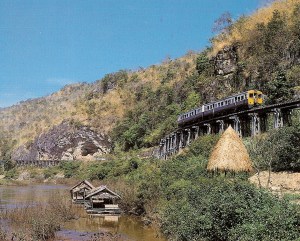
Wampo pc4

I have to admit that when this job at Wang Po was finished we POWs felt a certain mixed up pride in the work. We could see the completed viaduct and it worked and we had built it ourselves without mechanical aids of any sort beyond hand tools and a few elephants. I was left with a great admiration for the skill and planning ability of the Japanese engineers and an ever-growing bitter hatred for our guards.

[The b/w photo is from Peter Davies, The Man Behind the Bridge. The others are postcards from the 1980s/90s]

They are prisoners; they are safe – POWs 10

For Phyllis, and the other relatives in England of the men who vanished in Singapore on 15 February 1942, their greatest fear was that their men had died or been wounded in the fighting. The best news they could hope to hear was that they were prisoners. They might be bored or hungry, but they would be safe from death until the end of the war. In addition they could be sent comforts, they would be able to communicate (when the authorities had sorted a route out) and all would eventually be well. So Barry’s father wrote to him:

“I know that you will understand how important it is in spite of the many difficulties of being a prisoner to try and keep fit in mind and body. I hope you will try and find some special interest. You have a real gift for languages try if possible to keep up your French and Malay to learn to write in Arabic characters, and if possible also to learn to speak Japanese. Also learning good verse will be a help and writing and composing yourself. Also if possible work with your hands. I’m afraid that as yet we cannot send you any parcels but perhaps you can get some books in Singapore.”

Relatives have no information about those who have already died. Relatives of these men would go on writing into the blue, waiting and hoping, sometimes as long as three years. The War Office struggled to get reliable data, from any source. Sometimes relatives heard before they did. One wife wrote to Phyllis on 5 January 1943:

“I have had no official news of my husband, but a friend of his, serving in the Middle East, sent me an airgraph, telling me my husband was a prisoner, he wrote as though I had already heard the news, so each day I hope the good news will arrive, and as soon as it does I will let you know.”

The situation never improved. On the 5th of November 1945 nearly three months after the end of the war in the Far East, one of the mothers wrote to Phyllis:

“I am sorry to trouble you, but I wonder if you could try & find out any information about my son, we have not heard a word about him, & as they are nearly all home, makes us wonder if anything has happened to him.”

The pig-sty that was Ban Pong – POWs 9

In late autumn of 1942 we were told of a new delight to come. We were to be moved north into Siam [Thailand] where we would be engaged in light healthy labour with good food and pleasant sunny weather, housed in well-built camps in open country. We couldn’t wait for this promised treat.

We marched to the station carrying our backpacks and were there entrained in metal-sided cattle trucks, about 40 to each truck. […] We took it in turns to sit in the better places and arranged our packs in rows so that we could sit on them with our legs pointing towards the middle of the truck. […]

There were no latrine arrangements at all, not even a bucket. One could pee through the open sliding door and the train stopped twice a day at some point well away from a village so that we could get out and ease ourselves squatting over a ditch or under a hedge. As many of us were already suffering from dysentery, these two stops were not nearly enough and we got over the problem by rigging a rope across the doorway at a convenient height so that one could hang on with both hands, bottom outwards and shit on to the track.

We arrived at Ban Pong, all 800 of us soon after the start of the rainy season. Ban Pong was a substantial small town of about 5000 and the camp was a very disgusting place. As a transit camp there was no senior British officer in command who could see that the place was kept in order. […] After a few days we marched out of the pigsty of Ban Pong.

Ban Pong in Thailand was the starting point for the railway designed by the Japanese to link Bangkok with Moulmein in Burma. The planned stretch between Ban Pong and Thanbyusayet (roughly 400 km) ran through barely charted territory following the river Kwai Noi. Designing the railway posed an enormous engineering undertaking; building it, in wartime, with no mechanical aids, required enormous manpower and resulted in over 100,000 deaths, the majority of which were forced gangs of Chinese, Indians and Malays, but also included around 13,000 Allied POWs.

Forgotten African heroes

Last night Griff Rees-Jones had a programme about his father, an army doctor, posted during WWII to The Gold Coast (now Ghana) in West Africa. The African regiments who did much of the fighting to free Burma in WWII are largely forgotten in the films and popular history books. Apparently the British Establishment assumed that all Africans lived in the jungle and would therefore be used to the conditions in Burma. Most of those who enlisted were brought up in grassland areas.  Griff interviewed amazing 90-year-old veterans of the campaign. Very moving and a salutary reminder of the people to whom we owe our freedom.

The programme was called Burma, My Father and the Forgotten Army and was on BBC2 on Sunday 7 July

Roderick Suddaby – much sadness

The wonderful supporter of many researchers on Far East prisoners of war has died. He was, until 2010, Keeper of the Department of Documents at The Imperial War Museum. I got to know him after this when he had semi-retired. He was the most incredible source of information for those of us with relatives who had been POWs in the Far East. With great enthusiasm and patience, he listened to me as I talked of the documents and memoirs of my father. He used complicated sources to discover small hidden details about the 69 men who were in my father’s unit. He read and commented at length on my father’s memoirs and a draft of my book of WWII letters. I emailed him only two days ago, and I will never receive an answer, which I find devastating. He not only had an irreplaceable fund of knowledge and awareness of the materials in this area, but he shared them so generously, putting researchers in touch with one another. There is a short film of him on this link.

https://www.facebook.com/pages/Researching-FEPOW-History/279314032101180?hc_location=stream

‘Don’t stand still.’ Changi to Bukit Timah – POWs 8

In September 1942 Barry’s Line Section was sent by their captors, as a working party, from Changi to Bukit Timah near Singapore town. They were to build a memorial for soldiers of both sides killed during the invasion of Malaya. They marched the 16 miles to the new camp, carrying everything they owned. Barry remembers:

 As our party, No. 27 and the rest of No. 1 Company, arrived at the site one of the POWs already working there whispered to our Commanding Officer, “Just keep the tools moving. Make a noise. Don’t stand still.” We noted guards standing around the site all with fixed bayonets and each of them carrying a stout bamboo rod to encourage the laggards. We had not met this situation before as none of us had yet experienced the sensation of working directly under the eyes of a Jap guard.

Some of my Glasgow men had inevitably been in prison at some time in their careers and we had good advice from them. “Keep your head down, do not be noticed. Do what you are told to do and never give the slightest hint of reluctance. If you are hurt or very tired carry on with every appearance of bravery and co-operation and perhaps a guard will take pity and give you a rest.”

Some men seemed quite unable to grasp the fact that their very survival depended on their maintaining a very humble appearance, obeying orders, combined with eagerness to please our masters. A sour look, a shrug, a turned away shoulder or any such gesture earned an immediate swipe, accompanied by loud shouts.

Silence in England – POWs 7

After the Fall of Singapore in February 1942, Phyllis and the other wives and mothers of 27 Line Section wait anxiously to hear what has happened to their men. The silence is absolute. No one in authority can tell them anything, The men of 27 Line Section could be dead, evacuated or prisoners of war. Phyllis has addresses for many of the wives and mothers. She sends out a circular and several write to thank her for: “…your kind letter which has given me new heart at a time when I have nearly made myself ill with anxiety.”

Phyllis starts writing to Barry: “Dear Love, I haven’t written a letter for a fortnight hoping each day may bring me good news  from you…”

Nine months later she is still writing and waiting. So are almost all the other relatives, though there is now a presumption, unless they died in the battle for Singapore, they are now prisoners of the Japanese. The War Office finally thrash out an agreement with Japan to exchange information and send post using the Swiss Red Cross and a complex route across Russia. Relatives can now write – though it is into the blue and they still have no idea where the men are. For the Japanese, overwhelmed by the numbers of prisoners they have captured, the gathering and release of names is very low priority.

Finally, on the 12 December 1942, Phyllis hears that Barry is a prisoner. She writes :

My own dear husband, At last that blessed news has come to me – the assurance that you are a prisoner of war. I am awaiting the letter from the war office now with further details. The relief has left me a little lightheaded, I think. Dear darling, I fear my letters have been dreadful lately – but it was like holding a telephone conversation with a deaf & dumb person. Things have become real again now, & worth while.

Phyllis is lucky and she knows it, because she keeps in touch with the other wives and mothers. Some have to wait several more months for that news. Others hear nothing at all for another two and a half years.

Death and Churchill – POWs 6

In the Changi POW camps epidemic diseases took hold. In the space of eight days three men of 27 Line Section died, two of dysentery, one of Cerebral Malaria. They were three of Barry’s highly regarded Sergeants.

By summer all the senior officers had been sent away to Japan – supposedly to foil any attempts at an uprising – and the Kempi Tei (special police) cracked down on any whiff of escape plans. The little news the POWs received on secret radios was dire. As Barry remembers:

The general spirit of the POWs was in fact very sad and pessimistic with no serious thoughts of revolt or even of escaping. In a European War once out of the prison camp one may well pass for a native of the country, but in Asia any European is immediately recognisable.

[On the radio] We heard much of the false propaganda, which even then seemed untrue, but once quite unexpectedly, I heard the very recognisable voice of the Prime Minister, Winston Churchill. It made a lasting impression as he was quoting a poem by Arthur Hugh Clough. The war was going very badly for the Brits. We were out of Europe with not much prospect of getting back again. Rommel was winning all his battles in the desert against Wavell, the Russians were falling back on Moscow overpowered by the Nazi armour, our Fortress Singapore had fallen, our two biggest battleships had been sunk and the US Pacific Fleet almost destroyed at Pearl Harbor. Churchill quoted:

Say not the struggle naught availeth
The labour and the wounds are vain.
The enemy faints not nor faileth
And as the things have been they remain.

If hopes were dupes fears may be liars
It may be, in yon smoke concealed
Your comrades chase e’en now the flyers
And but for you possess the Field.

For while the tired waves vainly breaking
Seem here no painful inch to gain
Far back through creek and inlet making
Comes silent, flooding in, the Main.

And not by Eastern windows only
When daylight comes, comes in the light
In front the sun climbs slow, how slowly,
But westward look! The land is bright.

This was obvious reference to the fact that the USA was now at war and on our side.

Changi prisoners – making boreholes – POWs 5

After capture, British and Australian soldiers marched across the island of Singapore and joined many thousands of other prisoners in the complex of camps around Changi barracks. Over the next few months they learned to eat rice for breakfast and lunch and supper. Disease, particularly malaria and dysentery, became a serious problem. 27 Line Section turned their expertise in boring post holes to the more urgent need of making latrines. They found some large auger bits and constructed a tall set of sheer legs fitted with a block and tackle.

Barry remembers:

The first hole went well, about fifteen feet deep, say 4 metres. One of our carpenter-and-joiners built a seat with a cover, very civilized. Then we then collected the other big auger bit from the Post Office stores and set up a second team of bore hole makers. We made several holes within our Unit’s area and a few for other regiments, until one day when we were at work the sergeant in charge of the other party came to me to announce a disaster.

The drill head had fallen off and stuck in the shaft. The team had tried everything then decided someone would have to be lowered head first into the hole. Since I was the officer I would, according to the sergeant, naturally volunteer for the job, especially as I was probably the thinnest and lightest man in the section. So I volunteered.

My ankles were tied onto the rope and I was heaved up and then lowered into the hole with my arms stretched out like a diver. I just fitted, but only just. When I reached the bit I found that there was luckily only a little earth in it and I was able to loosen it and get a good grip on it. At my word the team pulled me gently up again and swung me aside onto the spoil heap, untied me and then untied the bit. We found that the fastening bolt was too thin and had sheered under the strain, so we fitted a stouter bolt and restarted the work. I warned them that if it happened again someone else would have to go down. It is not an adventure that I recall with any pleasure.

February 15 1942 – Singapore – POWs 4

On the 8th December 1941 [Pearl Harbour] Barry wrote to his wife Phyllis:

Darling Wife, very darling wife just now. War declared this am. You will have read all      about it in the papers. Bombs on S’pore, landing in Kelantan. All safe so far…

27 Line Section continued to put up communications lines in Malaya for anyone who asked, but found themselves slowly retreating down to the Island of Singapore and eventually, in February 1942, to the city itself. The bombing was continuous but, as signalmen, they worked on through it. While most of them received only minor injuries, one unlucky man, installing a field cable on an airfield, was wounded and died in Singapore. The oil stores and dumps of raw latex were on fire, the reservoir pipeline had been breached, and over a million unarmed civilians were being bombed daily. Singapore fell.

Barry remembers:

Fighting actually stopped on the 15th February 1942. I remember it very clearly as I was up the top of a telephone pole trying to regulate and terminate a new section of open wire, while meantime a brief air raid was going on at ground level. This consisted of the usual small high explosive fragmentation bombs, which killed people and broke shop windows but did little heavy damage except for holes in the road. The bombing and shelling suddenly stopped and one of my NCOs [Non-Comissioned Officers] on the ground shouted, “I think the war is over”. And so it was.