Small is exceedingly beautiful

Pencil drawing – Amy Green

Pencil drawing – Amy Green

Yesterday we went to a private house for a small exhibition of drawings by Amy Green. Amy’s work has moved over the years from large paintings to the small drawings that are now her exclusive output (but who is to say when or if that will change again). The pencil work is exquisite and repays nose-to-paper examination, or even a magnifying glass.

My photographic skills are not up to this task, but here is a flavour of the work.

DSCN4482

The way each drawing occupies a page with enough space and looseness, gives them a very calm quality.

DSCN4486 - Version 3

DSCN4486

Pencil drawings – Amy Green

Pencil drawings – Amy Green

Amy is my daughter, but I safely say that my appreciation of her work is shared by many others.

There are lots of Amy Greens on the net, her work is at http://amygreen.tumblr.com

The workshop in the dining room and a sunset

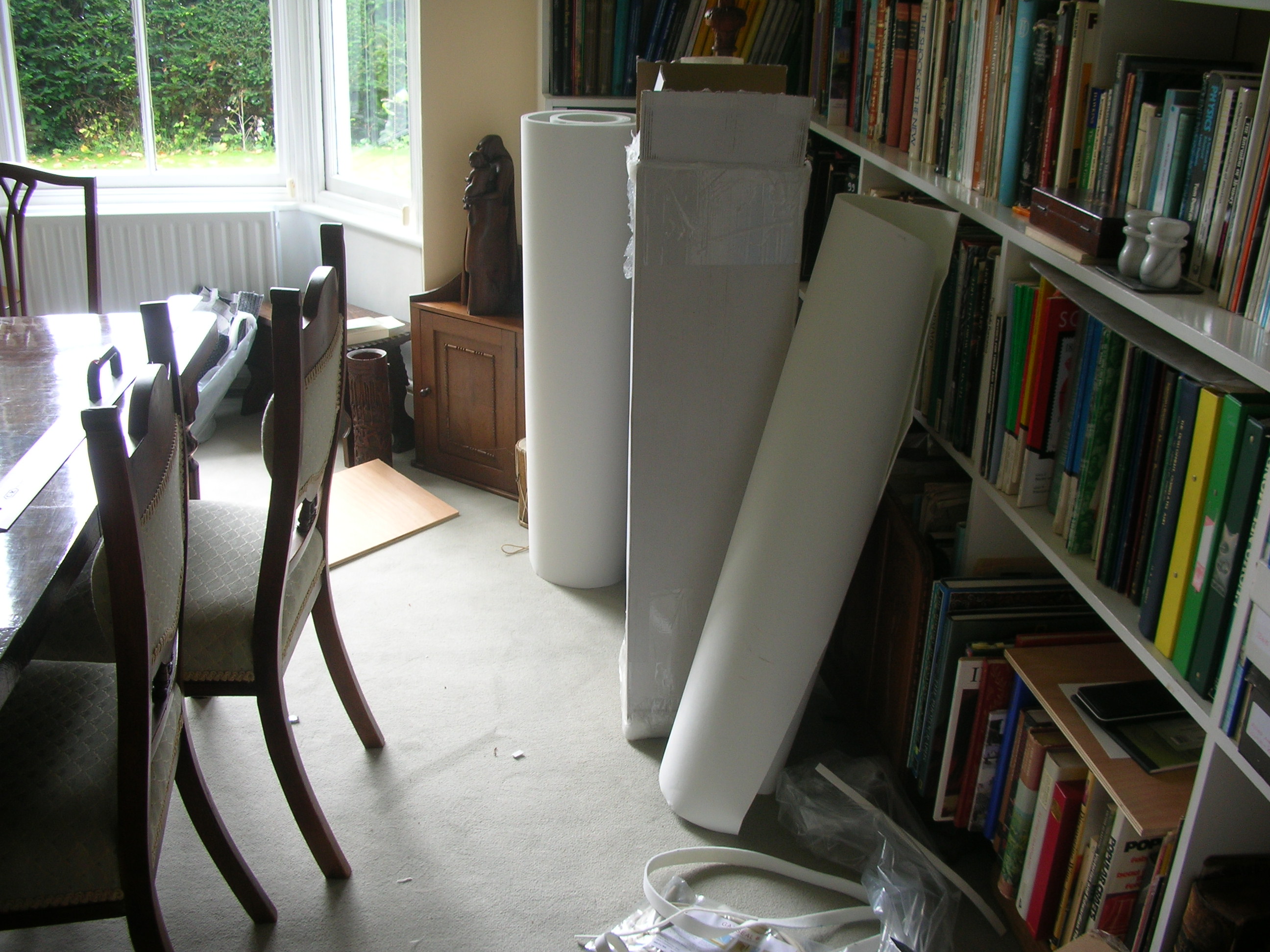
I’m not sure what law I’m invoking, but whatever DIY job I take on, tool by tool, the workshop slowly transfers itself to some unsuitable room in the house. This time it is the dining room.

DSCN4328I swear I only needed a ruler, a set square, some paste, a brush, a set of ladders and some cloths. Two weeks later the dining room has lost its identity under cardboard boxes full of the extra tools required.

DSCN4327

It will be worth all the effort when winter finally arrives. We have lined many of our thin outer walls with wool fibre thermal lining paper (you can just paint over the top).

DSCN4329 We have also added some incredibly simple magnetic secondary glazing, purchased online from the wonderful www.nigelsecostore.com There are real, helpful people who answer emails and the phone.

Yesterday after spending all day trying to finish off the walls, I went outside for a break and this is what I saw.

DSCN4342

DSCN4343

DSCN4346

DSCN4347

Mantel’s ghost – my fury

Hilary Mantel – Giving up the ghost, a memoir

This book has roused profound emotions in me. I should wait until we discuss it next week, but by then the iron will no longer be so hot.  Reading it has cured me – possibly only temporarily – of envy and prejudice; it has also aroused in me a retrospective anger on a vast scale for the treatment of women in the past as well as firing me to write better.

This memoir is very short. As I read, I ached with envy over Mantel’s delicious touch with words and her self-deprecating humour. After admitting that she hardly knows how to write about herself, and listing her usual recommendations to writers, she continues:

“Rise in the quiet hours of the night and prick your fingertips, and use the blood for ink; that will cure you of persiflage!

But do I take my own advice? Not a bit. Persiflage is my nom de guerre. (Don’t use foreign expressions; it’s élitist.)”

She takes us back with her to the smells, sensations, fears, confusions and delights of very early childhood. She captures that total sense of being the centre of the world, that we all once had. She hammers on about the family Catholicism that is an unavoidable, and mostly pernicious, influence in her upbringing. She enables us to follow, step by step, as her body is consumed by an ill-defined disease. Her ‘unwellness’ is alternately treated or dismissed by her relatives and doctors.

As a young married woman, taking her body and its persistent pains to doctors, she meets  breathtakingly patronising assumptions: that she will be fine once she starts breeding, that she is perhaps overestimating her intellectual capabilities (as a law student), that she really needs mental treatment – in that period that would be tranquilizers and antidepressants. When these fail to cure her pain, she is hospitalised on antipsychotics and then given the whole pharmacopeia. No one actually listens to her.

In her mid twenties she finally researches and correctly diagnoses her acute form of endometriosis. By the age of 27 she has had a total hysterectomy and a medically induced menopause. In the succeeding years the problem returns crippling her already stick-like body.

Treatment, including steroids, then turns her from a wraith into the substantial woman with which we are familiar. And yes, I tend to make assumptions about substantial people. I try not to, and reading this memoir will help me to greater compassion.

I still envy Mantel her writing skills, but I no longer wish to swap places with her. I think she would have developed her astonishing skills with or without the extreme trials in her life and the sadness induced by her loss of fertility. But I remain furious with the ignorant, presumptuous people who prolonged her pain and made her achievements such hard work.

I think this book should be compulsory reading for all doctors – not to teach them to diagnose better, but to LISTEN.

Sorry, far too long a post, but her courage in writing this tricky memoir should be celebrated.

Spoiled for choice – writer’s support network

My writing has been stalled because I had finished one project and was in desperate need of feedback on the other two.

The project, an article on my airman uncle (A Very Unlikely Hero) had been sent to a specialist blogger. My non-fiction (Writing to a Ghost: Letter to the River Kwai) was being read, as a favour, by a wonderfully meticulous friend and my re-re-re revised fiction book (Border Line) was in a queue to a busy writing friend.Two days ago my writing frustration peaked and I also felt a need of independent professional advice for some tricky chapters. So I sent them off to Sally Jenkins, who had done such a swift and helpful job on the synopsis, agent letter and first chapter of Border Line.

Later that same day the blogger, Pierre Lagacé, of Lest we Forget, http://athabaskang07.wordpress.com came up trumps and starting posting a new blog using parts of my article on my Mosquito Navigator uncle at http://johncustancebaker.wordpress.com/2013/09/10/and-if-by-chance/ I am thrilled with this.

Yesterday my friend, Lesley, came round with a wonderfully annotated manuscript of my non-fiction book and some very good advice.

Today, to my amazement, Sally Jenkins came through with the critique of my tricky chapters in Border Line. Her speed of turnaround only equalled by the seriously helpful advice on my chapters. http://www.sallyjenkins.wordpress.com/

Writing is something of a game of snakes and ladders. Today I am on a ladder. Back at my desk, I feel like a bee in clover – totally happy and busy though spoiled for choice about which manuscript to tackle first. It is this wonderful network of support from people we know and, in this new age, those we have never met that make writing possible.

This state of affairs has been very good for the house. DIY flourished, I have insulated a tricky section of bay wall with thermal lining, put up a pane of secondary glazing and ordered more lining, glazing panels etc.

(And my L reg. Nissan passed its MOT!)

“a small oak hutch”

I have been smiling all day. This morning I received a letter such as one can only dream of.

The letter notified me that my next door neighbour (for more than thirty years) had made me a specific legacy of “a small oak hutch”. I have no idea what this is exactly, but I am honoured that my neighbour should have thought of me in this context. She was an original, someone for whom both the words feisty and refined seem to be designed. She was never seen without brave lipstick. She was genuine, frank, demanding, warm and sometimes terrifying.

In WWII she worked for the ATS (Auxiliary Territorial Service), by the time we moved in next door she worked in local government. She lived from the age of two in the house her father built – and, with the help of devoted friends, she had her wish and died there at the age of ninety-two.

I shall cherish my hutch whatever it turns out to be.

Forgotten African heroes

Last night Griff Rees-Jones had a programme about his father, an army doctor, posted during WWII to The Gold Coast (now Ghana) in West Africa. The African regiments who did much of the fighting to free Burma in WWII are largely forgotten in the films and popular history books. Apparently the British Establishment assumed that all Africans lived in the jungle and would therefore be used to the conditions in Burma. Most of those who enlisted were brought up in grassland areas.  Griff interviewed amazing 90-year-old veterans of the campaign. Very moving and a salutary reminder of the people to whom we owe our freedom.

The programme was called Burma, My Father and the Forgotten Army and was on BBC2 on Sunday 7 July

Roderick Suddaby – much sadness

The wonderful supporter of many researchers on Far East prisoners of war has died. He was, until 2010, Keeper of the Department of Documents at The Imperial War Museum. I got to know him after this when he had semi-retired. He was the most incredible source of information for those of us with relatives who had been POWs in the Far East. With great enthusiasm and patience, he listened to me as I talked of the documents and memoirs of my father. He used complicated sources to discover small hidden details about the 69 men who were in my father’s unit. He read and commented at length on my father’s memoirs and a draft of my book of WWII letters. I emailed him only two days ago, and I will never receive an answer, which I find devastating. He not only had an irreplaceable fund of knowledge and awareness of the materials in this area, but he shared them so generously, putting researchers in touch with one another. There is a short film of him on this link.

https://www.facebook.com/pages/Researching-FEPOW-History/279314032101180?hc_location=stream

Vision in one eye?

Oliver Sacks did end up with vision in only one eye and in his book (http://www.oliversacks.com/books/the-minds-eye/) he describes this experience and its effect on him. How any one individual would experience vision with only one eye, would vary depending on the age at which that vision was lost, and how the brain adapted to monocular vision.

I mention this as there seems to be a question on my dashboard, though it has not appeared elsewhere in the blog. If you are interested, do visit Oliver Sack’s website and The Mind’s Eye is a great read.