Mixed fortunes

The week has been disconcerting.

I have, with relief, finished reading yet another book I did not enjoy very much (I swear the last time I will do this), though it did travel across countryside I am fond of. At least I am only reading three books now. 

Every attempt to settle to writing on my new novel has been thwarted, however my finished novel has had a bite from an agent… I am not holding my breath.

I have been working on the Far East POW book again (new post tomorrow night).

In the garden warm weather has led to some strange anomalies. A spring clematis, Wada’s Primrose is flowering.

DSCN4521

Another maple is only just now shedding its autumn colour.

DSCN4519

But sadly one of my favourite maples, Sengokaku, was showing canker and today I have had to cut a big stem out of it.

Tomorrow I shall be at a Lindy Hopping workshop all day – happiness!

Operatic tragedy Nutcracker style

I’ve just got to get a couple of things off my chest.

I had been looking forward to my first production of the early Verdi opera Sicilian Vespers for some months. I was a little concerned by reviews which talked of excessive violence. This opera is a political tragedy set in the 12th century and murder, rape and treason are very much at its heart. HOWEVER, the director had decided to set it in the 18th century (when it was first written and performed) in ballet mode. The cast of Swan Lake appeared to have strayed onto the stage (and were promptly ravaged en masse), they reappeared several times for more of the same treatment. The villain doubled as a distinctly camp dancing master. The Sicilian conspirators lined up at a bar to execute ballet steps and the executioner was a barely-clad child-as-cherub with an axe.

There were some very clever wheezes when the audience appeared to be watching themselves on stage, the singing was often beautiful and moving AND the saving grace was the sublime music and the conducting skills of Antonio Pappano. But… I like tragedy to be tragic, I want to be moved to tears not giggles.

Grouse two. I read one of a series of books by a popular historical fiction writer (for a book group). I was given some facts I never knew. Fine. I was also treated to a scummy, slanderous, prurient version of the mental state of several historical figures. I was left with a feeling of disgust – a real mental indigestion.

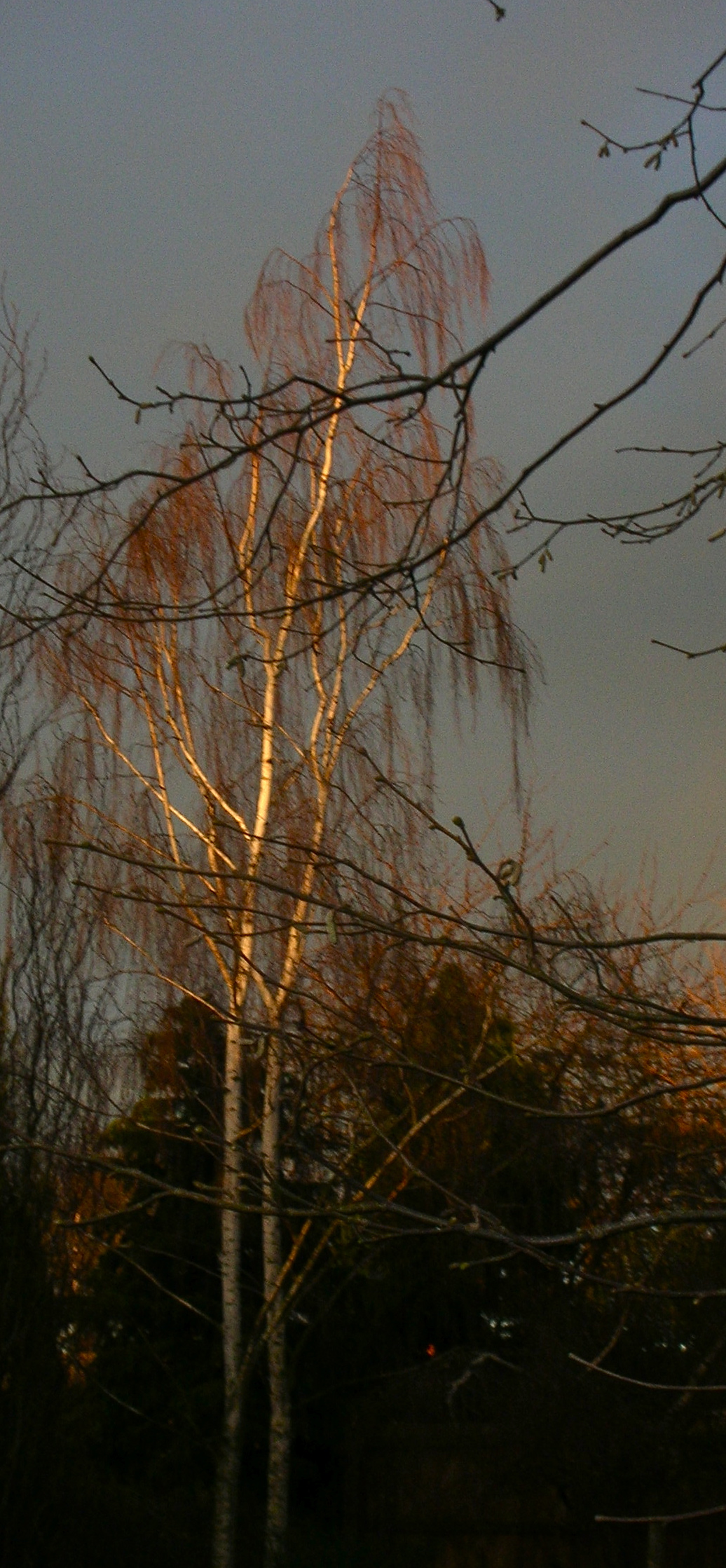
Here is a suitably sad silver birch in winter to express my feelings.

Betula Tristis

Betula Tristis

Disintegrating Earth – don’t panic!

I have just finished Jared Diamond’s book, Collapse: How Societies Choose to Fail or Survive. I found it riveting, though being so full of information it is a substantial read. He looks in detail at societies, ancient and modern, that have failed, imploded or are now struggling (e.g. Greenland Norse, Easter Island, Maya, Rwanda, Haiti etc). He analyses the  many factors from natural climate change (cold periods, drought), through human activity (deforestation, poisonous mining outfall) to political (every type). What emerges clearly is that there are nearly always multiple factors at play many of which we can, if we have the foresight, control (population, pollution etc). He also points out that some nations in the past have perceived their problems and acted in time (e.g. Japan two centuries ago and the Dominican Republic more recently to reverse serious deforestation). The chapters on China and Australia are packed with information that was much of it news to me. I should note that Collapse was published in 2005, but the data remains entirely relevant.

This book also showed how people have individually and collectively persuaded those wielding power in politics and business to change and sort out some major problems. The remaining problems are an immediate threat and will affect the next generation. But I have been left with a determination to make changes in my own small corner.

This positive feeling was enhanced by the delightful lecture broadcast on the BBC This World a couple of days ago titled: Don’t Panic – The Truth About Population, given by Professor Hans Rosling (statistician and physician) http://www.bbc.co.uk/programmes/b03h8r1j . With gentle humour he exposed the misapprehensions of the majority of first world people about the life and problems of the third world (we didn’t know that the birth rate in Bangladesh is now under 2.5% and world literacy is now at 80%). There are gigantic challenges, but we are, he claims, doing better than we think.

Those of us who have, must learn to have a little less, share scarce resources and manage those that are remaining a lot better than we have to date. I didn’t mean to sound quite so evangelical. Back to the DIY insulation and put on another jumper.

Meanwhile roses are still blooming.

Rosa Susan

Rosa Susan

From Palembang to Chichester – Singing to Survive

Last night we sat in the beautiful open nave of St Paul’s Chichester as thirty barefoot women filed past and took their places at the altar end. These were the singers of the Chichester Women’s Vocal Orchestra, conducted by Chris Larley about to re-create an extraordinary enterprise of WWII.

In early 1942, civilians caught up in the Japanese invasion sweeping across South East Asia, were rounded up and imprisoned. One group of about 600 women and children, from more than 20 nationalities, existed for the next three years in a series of camps on the island of Sumatra. They suffered starvation, lethal diseases and forced labour. For the full story see:

See http://www.singingtosurvive.com

By late 1943 morale had sunk disastrously and cultural misunderstandings between nationalities flourished. Then two women, Margaret Dryburgh and Norah Chambers, were inspired to create a language-free form of music. They created an ‘orchestra’ by dividing thirty women into four groups by voice (First and second sopranos, first and second altos). They then set well known quartet or even orchestral passages for these voices, using vowel and consonant sounds, but not words. The effect of this ‘orchestra’ on morale, cultural relationships was instantaneous – even their Japanese guards responded to the beauty of it.

Last night the Chichester Women’s Vocal Orchestra, with three members of the cast of Tenko, Stephanie Cole and Louise Jameson speaking and Veronica Roberts directing, performed the story. They used letters, poems and interviews with survivors for the narrative. For the musical passages, the choir used the original settings to recreate the  sounds that the women in this amazing jungle ‘orchestra’ made. They sang pieces such as the Largo from Dvorák’s New World Symphony, Beethoven’s Minuet on G, Bach’s Jesu Joy and many others.

The sound was unique and difficult to describe. It had a silky, liquid quality, softer and warmer in tone than orchestral or even string sounds. In a well-judged direction, we were asked not to applaud until the concert ended. This made the interleaving of story music even more spell-binding and fluent and there was a fully deserved standing ovation at the end.

Hospital reader and Lady Almoner – POWs 17

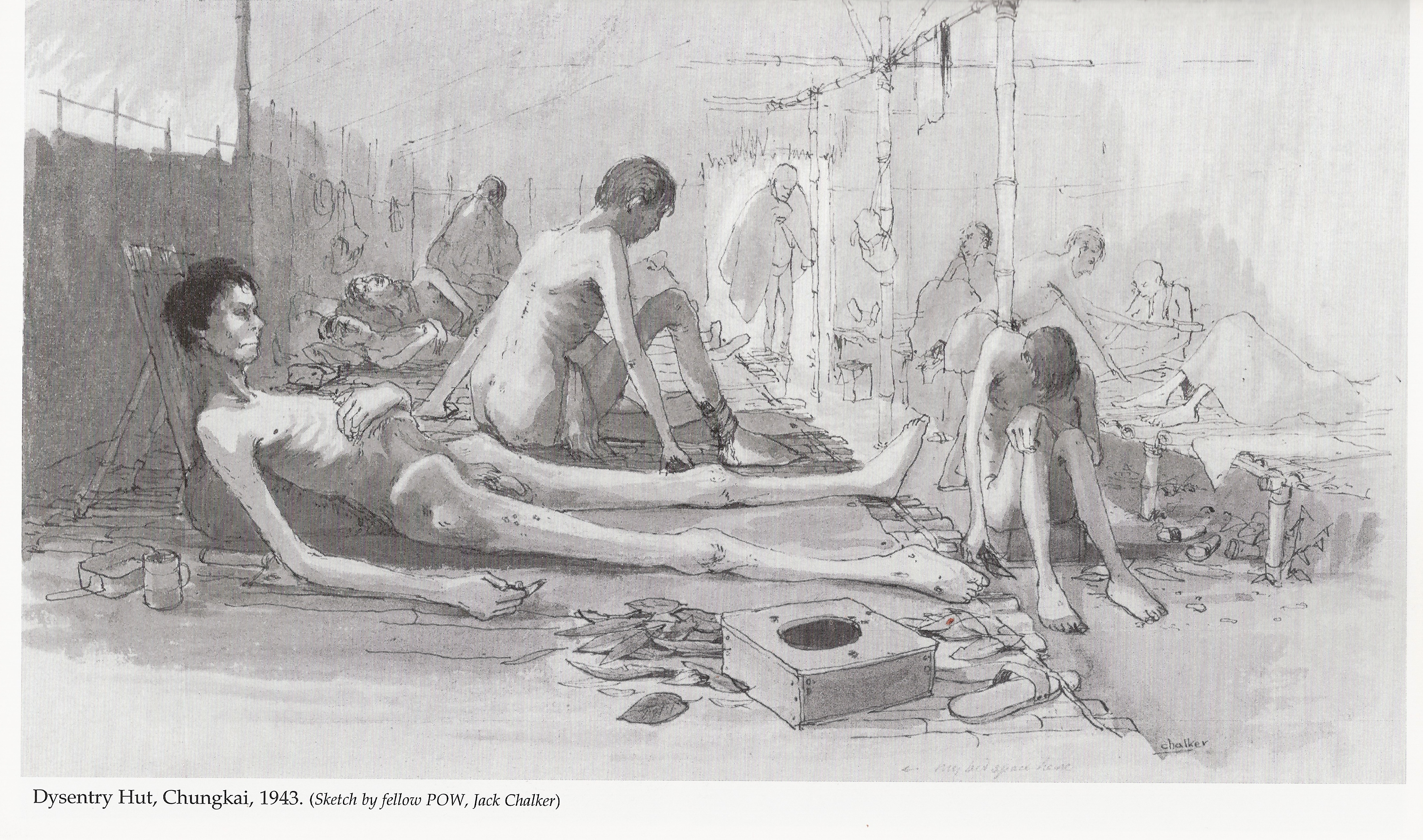
All through spring and summer of 1943 starving and diseased POWs from the up-country railway work camps (in Thailand) trickled south to the bigger camps such as Chungkai. Barry reached this camp in July 1943 and was soon fit enough to do some work.

My first and simplest job was basically as a storyteller or rather reader. I would take a likely book from the camp library and sit down on the end of a bed space in one of the sick huts, and read a chapter or two. Then I would move down the hut, twenty or thirty yards, and read the same piece to another lot of sick men. This was judged to be a useful employment, so I was never called on to join a maintenance party.

In October the two parts of the railway, Thailand and Burma, joined up at Konkuita and from then on sick and dying men poured into Chungkai transported by barges or on the railway itself. Meanwhile Barry began to enjoy the theatre and concerts got up by enterprising prisoners, but found that:

These jolly functions contrasted harshly with our work in the sick huts, which got steadily worse as more parties of sick and dying arrived from up river. We were burying ten, fifteen, or even twenty every day, and it was disconcerting during my readings to become aware that one or two of my audience were never going to hear the next chapter.

From Peter Fyans biography of Fergus Anckorn: Captivity, Slavery and Survival as a Far East POW, the Conjuror on the Kwai

From Peter Fyans biography of Fergus Anckorn: Captivity, Slavery and Survival as a Far East POW, the Conjuror on the Kwai

He progressed from reader to Lady Almoner

The job of Almoner, or “Lady Almoner” as it was called, involved the actual distribution of goodies bought from the welfare fund, to the sick men in the huts. The most useful purchases were eggs, honey, palm syrup, and occasional pots of vegemite, the Australian marmite. There was, of course, not nearly enough for everyone, the M.O. in charge of a particular hut would give me a list of the men due to receive these extras and the quantities for each one.

I did not at first realise the difficulty of the job but it became clear soon enough. Most of the very sick men got nothing at all because, as the M.O. told me, they would die anyway. The extras, very carefully husbanded, would go to those men who were able to profit from them and might just recover with their help but who would die without. At least I was spared the agony of deciding who got what, but every day I was faced with the need to find answers. “I am much sicker than Joe, Sir, why does he get two eggs this week and I get none?” An unanswerable question to which I had to find some reasonable answer day after day. I talked to the other Almoners and had no comfort from them, all in the same position as I was. “Tell them Orders is Orders, and you are just doing what you are told to do.”

Reading, reading, reading

I think this article on libraries and reading by Neil Gaiman is clear, persuasive and wonderfully straightforward. I missed it when it appeared and was alerted to it by a Facebook post from a Swedish relative – vive la Internet.

http://www.theguardian.com/books/2013/oct/15/neil-gaiman-future-libraries-reading-daydreaming

Readers react in Great Malvern

The pendulum has taken another couple of swings over the weekend. I arrived in Great Malvern (UK) on Saturday and discovered that the book group there were expecting to discuss with me my first book (A Small Rain, 2002, out of print) and not the 2008 Unseen Unsung, which I had prepared. I borrowed my hosts’ tattered copy of A Small Rain for a frantic revision before setting off for the meeting.

We were made very welcome in a member’s home, fortified with a drink and the fourteen of us spread out in her lovely sitting room. Under admirable chairmanship, each member talked about their reactions to A Small Rain and Unseen Unsung, which many had also read. I was able to give explanations and answer individual questions as we went along. After a break for sustaining and delicious nibbles, there was a more open-ended question and answer session about writing and publishing.

For me, to sit among a group of perceptive, enquiring people who have read my two published books and to talk about what works (and what doesn’t) was both a luxury and an immensely helpful experience. I was encouraged to find that they positively relished the complexity of the plots and the variety of subject matter and wanted more stories like this. Several also made a plea (as most book groups do) for a character list because, like many people, they read before sleeping and want to pick up again quickly.

The male protagonist of my first novel came in for some justified criticism for his saintly demeanour and his grating use of endearments. Lesson learnt! On the other hand the child coping with upheavals in his life met universal approval. It gave me great lift that a reader who had never taken to poetry found the selections I used wholly accessible. The writing in my second novel was seen as better paced – a page-turner. They warmed to the main character, a rather spoilt young man, as he lived through the events in the story. Even my dark portrayal of a mother had come off.

I realised with gratitude as I listened and talked, that these intelligent, curious, caring men and women are my readers. This has left me with a glow that will carry my writing forward, and with encouragement such as this, I will get Border Line published knowing that I will have (at least) fourteen readers.

The Dark Lady of DNA

I have just finished reading Brenda Maddox’s autobiography of Rosalind Franklin. I have read it very slowly over several weeks, as it was my entertainment while I stood on a tilted platform for the supposed good of my Achilles tendons. Perhaps it was appropriate to read about her life while standing up. This story of a natural, dedicated, curious, passionate scientist working in a period and against a backdrop in which her sex, her religion, her family, her nationality all contributed to either hold her back, belittle or occasionally encourage her, is a story to stiffen the morale of any woman (and, I would hope, man).

This is not a hagiography; Rosalind could be abrupt, exacting and almost anti-social in some atmospheres, but when among people she respected and, more tellingly, who respected her, she was full of life and fun, much-loved and her company sought after. She was a passionate walker and climber, happily travelling in France (where she worked for several years after the war), Italy and America (where she attended conferences and toured the university labs).

She ended her life in charge of a devoted research team at Birkbeck. Dying of ovarian cancer at the age of 37 in 1958, she worked almost to the last moments, when most of us would have been curled up and nursing our pain. Although known now for her role in the discovery of DNA (not acknowledged in her lifetime), she published innumerable scientific papers, many on coal and graphite and on the tobacco mosaic virus. Obscure subjects but ones of great significance for all of us down the line.

The book is detailed, illustrated and brings this very complex and admirable woman vividly to life.

Mantel’s ghost – my fury

Hilary Mantel – Giving up the ghost, a memoir

This book has roused profound emotions in me. I should wait until we discuss it next week, but by then the iron will no longer be so hot.  Reading it has cured me – possibly only temporarily – of envy and prejudice; it has also aroused in me a retrospective anger on a vast scale for the treatment of women in the past as well as firing me to write better.

This memoir is very short. As I read, I ached with envy over Mantel’s delicious touch with words and her self-deprecating humour. After admitting that she hardly knows how to write about herself, and listing her usual recommendations to writers, she continues:

“Rise in the quiet hours of the night and prick your fingertips, and use the blood for ink; that will cure you of persiflage!

But do I take my own advice? Not a bit. Persiflage is my nom de guerre. (Don’t use foreign expressions; it’s élitist.)”

She takes us back with her to the smells, sensations, fears, confusions and delights of very early childhood. She captures that total sense of being the centre of the world, that we all once had. She hammers on about the family Catholicism that is an unavoidable, and mostly pernicious, influence in her upbringing. She enables us to follow, step by step, as her body is consumed by an ill-defined disease. Her ‘unwellness’ is alternately treated or dismissed by her relatives and doctors.

As a young married woman, taking her body and its persistent pains to doctors, she meets  breathtakingly patronising assumptions: that she will be fine once she starts breeding, that she is perhaps overestimating her intellectual capabilities (as a law student), that she really needs mental treatment – in that period that would be tranquilizers and antidepressants. When these fail to cure her pain, she is hospitalised on antipsychotics and then given the whole pharmacopeia. No one actually listens to her.

In her mid twenties she finally researches and correctly diagnoses her acute form of endometriosis. By the age of 27 she has had a total hysterectomy and a medically induced menopause. In the succeeding years the problem returns crippling her already stick-like body.

Treatment, including steroids, then turns her from a wraith into the substantial woman with which we are familiar. And yes, I tend to make assumptions about substantial people. I try not to, and reading this memoir will help me to greater compassion.

I still envy Mantel her writing skills, but I no longer wish to swap places with her. I think she would have developed her astonishing skills with or without the extreme trials in her life and the sadness induced by her loss of fertility. But I remain furious with the ignorant, presumptuous people who prolonged her pain and made her achievements such hard work.

I think this book should be compulsory reading for all doctors – not to teach them to diagnose better, but to LISTEN.

Sorry, far too long a post, but her courage in writing this tricky memoir should be celebrated.

Spoiled for choice – writer’s support network

My writing has been stalled because I had finished one project and was in desperate need of feedback on the other two.

The project, an article on my airman uncle (A Very Unlikely Hero) had been sent to a specialist blogger. My non-fiction (Writing to a Ghost: Letter to the River Kwai) was being read, as a favour, by a wonderfully meticulous friend and my re-re-re revised fiction book (Border Line) was in a queue to a busy writing friend.Two days ago my writing frustration peaked and I also felt a need of independent professional advice for some tricky chapters. So I sent them off to Sally Jenkins, who had done such a swift and helpful job on the synopsis, agent letter and first chapter of Border Line.

Later that same day the blogger, Pierre Lagacé, of Lest we Forget, http://athabaskang07.wordpress.com came up trumps and starting posting a new blog using parts of my article on my Mosquito Navigator uncle at http://johncustancebaker.wordpress.com/2013/09/10/and-if-by-chance/ I am thrilled with this.

Yesterday my friend, Lesley, came round with a wonderfully annotated manuscript of my non-fiction book and some very good advice.

Today, to my amazement, Sally Jenkins came through with the critique of my tricky chapters in Border Line. Her speed of turnaround only equalled by the seriously helpful advice on my chapters. http://www.sallyjenkins.wordpress.com/

Writing is something of a game of snakes and ladders. Today I am on a ladder. Back at my desk, I feel like a bee in clover – totally happy and busy though spoiled for choice about which manuscript to tackle first. It is this wonderful network of support from people we know and, in this new age, those we have never met that make writing possible.

This state of affairs has been very good for the house. DIY flourished, I have insulated a tricky section of bay wall with thermal lining, put up a pane of secondary glazing and ordered more lining, glazing panels etc.

(And my L reg. Nissan passed its MOT!)